
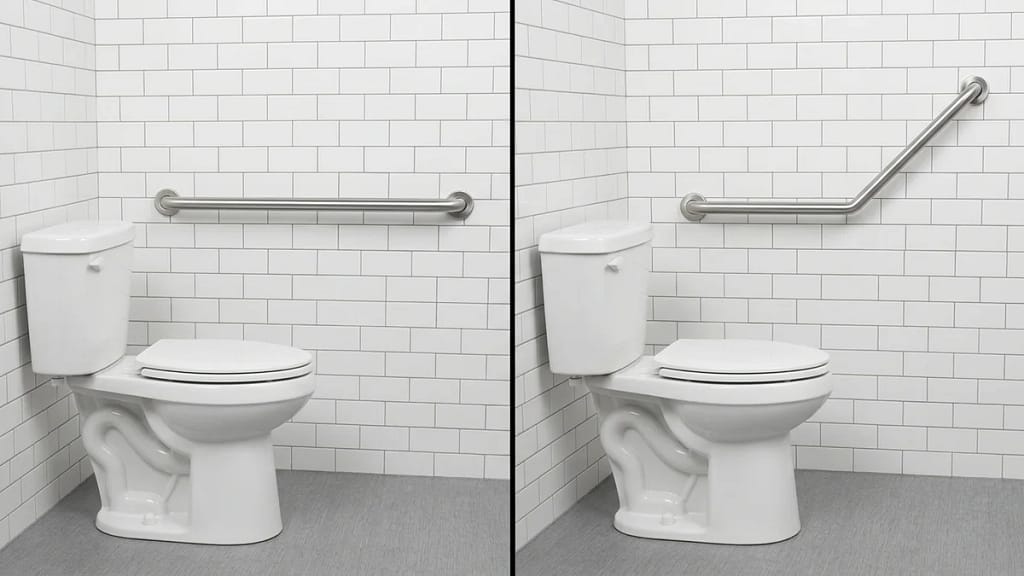
The choice between angled and straight grab bars depends mainly on the type of movement they are meant to support. Straight grab bars provide stable support along a wall, while angled grab bars can better follow the natural hand path during transitions such as sitting or standing.
When comparing angled grab bars vs straight grab bars, the safest option depends on the location, the person’s movement pattern, and whether the bar is mainly used for balance, standing, sitting, or transferring.
Disclosure: As an Amazon Associate, I earn from qualifying purchases. This post may contain affiliate links. If you purchase through these links, I may earn a small commission at no extra cost to you. I only recommend products I would feel comfortable using in my own home. Learn more.
On This Page
Quick Answer
Straight grab bars are usually the safer default, while angled grab bars can help when the user’s hand naturally moves diagonally during sitting, standing, or transferring.
For most bathrooms, a straight horizontal or vertical grab bar is easier to understand and more predictable. An angled grab bar can still be useful, but only when its position supports the way the person actually moves.
The safest choice depends on the location, the user’s reach, and the movement the bar needs to support.
Angled Grab Bars vs Straight Grab Bars: Key Differences
← Swipe to see more →
| Feature | Straight Grab Bars | Angled Grab Bars |
|---|---|---|
| Primary Purpose | Stable balance support along a wall | Support through a changing movement path |
| Best Default Choice | Usually the safer starting point for most bathrooms | Best when the movement clearly follows a diagonal path |
| Common Locations | Showers, beside toilets, bathtub walls, shower entries | Beside toilets, near shower seats, selected bathtub walls |
| Grip Movement | Consistent hand position | Hand may move upward or downward along the bar |
| Toilet Transfer Use | Good for steady side support | May help if the user pulls upward while standing |
| Shower Use | Usually more predictable for standing balance | Useful only when placed for a specific transfer or seated movement |
| Shared Bathroom Use | More universal and easier for different users to understand | Less ideal unless the angle fits the main user’s movement |
| Watch Out | Wrong height or placement can still make the bar hard to use | Wrong angle can feel awkward or less reliable |
| Best Use Case | Maintaining balance while standing or moving along a wall | Standing up, sitting down, or transferring through a diagonal motion |
Our Recommendations Based on Your Situation
Best for Stable Movement
Amazon Basics 24-Inch Grab Bar
Its 24-inch length provides a predictable, continuous handhold for areas where steady support is needed while standing, shifting position, or moving along a wall.
- 24-inch length provides a wider continuous handhold
- 1.25-inch diameter offers a substantial grip size
- Stainless steel construction suits bathroom environments
- Straight design can be installed in different orientations based on the support needed
Best for Diagonal Movement
Vive 16-Inch Angled Grab Bar
A strong angled grab bar designed to provide reliable support when the user’s hand naturally follows a diagonal path while entering or exiting a shower, bathtub, or toilet area.
- Supports up to 440 lb when properly installed
- 45-degree angled design can better match a diagonal hand path
- Ergonomic anti-slip grip helps provide a more secure hold
- Compact design works well in areas with limited wall space
Should Grab Bars Be Angled?
Grab bars should not be angled by default. An angled grab bar only makes sense when the diagonal position matches how the person naturally reaches, pulls, pushes, or rises during a bathroom movement.
Use the movement path test:
Start by asking how the hand needs to move during the actual task.
- If the hand stays at roughly the same height: a straight grab bar is usually the better starting point.
- If the hand naturally changes height: an angled grab bar may be worth considering if the angle follows that movement.
- If the movement involves more than one transition: focus on placement first and consider whether more than one grab bar would provide better support.
The key question is not whether angled bars are better overall. The better question is whether the angle matches the user’s actual movement path. If it does not, a straight grab bar is usually the more dependable choice.
If you are planning more than one bathroom support point, placement matters just as much as orientation. This guide on where to install grab bars in a bathroom can help connect each bar location to the movement it needs to support.
What Are Straight Grab Bars?
Straight grab bars are the most common type of grab bar used in bathrooms.
They are installed either horizontally or vertically and provide stable support along the wall.
Straight grab bars are a common choice because they are:
- simple to install
- easy to grip
- compatible with most bathroom layouts
Straight grab bars are also the conventional configuration used in established accessibility standards for many toilet and bathing locations. That doesn’t mean every home bathroom needs to follow the same layout, but it helps explain why straight bars are usually the starting point when planning reliable support.
They are typically installed in locations such as:
- shower side walls
- beside the toilet
- along bathtub walls
Straight bars are a common starting point when planning support for many bathroom locations.
Because straight grab bars can be installed horizontally or vertically, this guide on vertical vs horizontal grab bars can help explain how each straight orientation supports different bathroom movements.
What Are Angled Grab Bars?
Angled grab bars are installed diagonally rather than straight across the wall.
Instead of running parallel or perpendicular to the floor, they slope slightly upward or downward.
This design places different points of the gripping surface at different heights, which can better match movements where the hand position naturally changes.
In practice, this can make the bar a better fit for movements such as sitting down or pushing up to stand.
Research has also examined angled grab bar configurations alongside horizontal and vertical bars for movements such as sit-to-stand transfers. That doesn’t make an angled bar the better choice for everyone, but it does support the idea that grab bar orientation can affect how the bar is used during a specific movement.
Angled grab bars are sometimes installed in areas where people frequently move between sitting and standing.
Common locations include:
- beside the toilet
- near shower seating
- along bathtub walls
Because the grip angle changes along the bar, users can hold different points depending on their height and movement.
When Angled Grab Bars Work Best
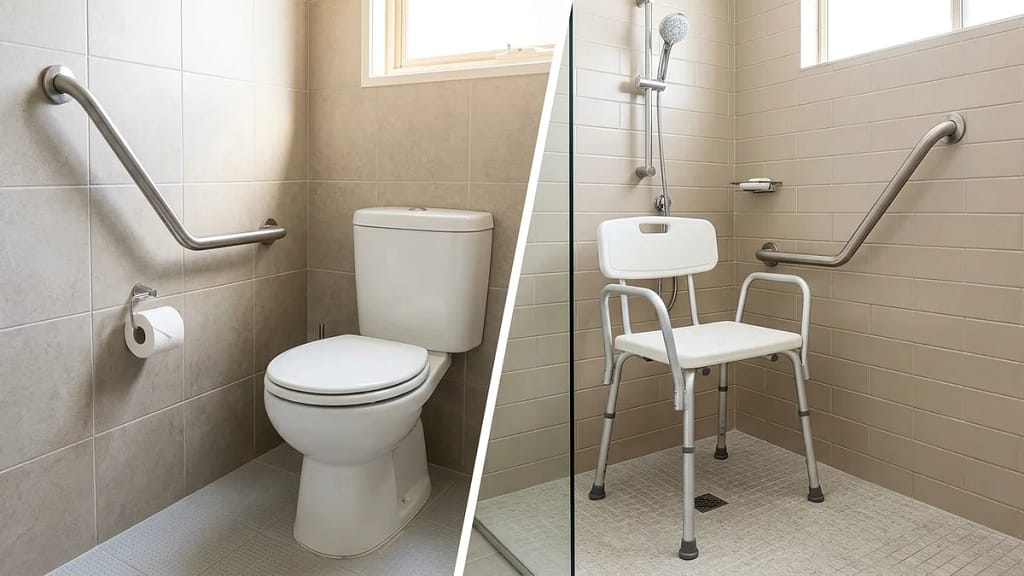
Angled grab bars can be helpful when the movement being supported involves both balance and lifting, but they should not be installed diagonally just because there is open wall space.
The best angled or diagonal grab bar placement is the one that follows the user’s real hand path. If the hand naturally moves upward, downward, or diagonally during the transfer, an angled bar may feel more intuitive than a straight bar.
Angled grab bars often work best in situations like these:
- Standing up from the toilet
An angled grab bar for toilet transfers may help when the user starts with the hand lower on the bar and naturally moves upward while rising from the seat. - Transitioning from a shower seat
Near shower seating, a diagonal grab bar may provide a smoother grip path if the user moves from sitting to standing and needs support through the full motion. - Supporting a specific movement pattern
Some users with limited mobility may find an angled bar easier to use when their hand position changes gradually as they move.
However, the angle must be chosen carefully. If the bar is too steep, too low, too high, or too far from the user’s natural reach, it can feel less reliable than a straight grab bar.
Example:
A person rising from a toilet may start with the hand lower on the bar, then naturally move upward as the body lifts. In that situation, an angled grab bar can feel smoother than a straight bar because the grip path changes with the movement instead of staying fixed at one level.
This is why angled grab bars are usually most useful when the movement involves both lifting and a changing hand position rather than simple wall-side balance.
When Straight Grab Bars Are Better
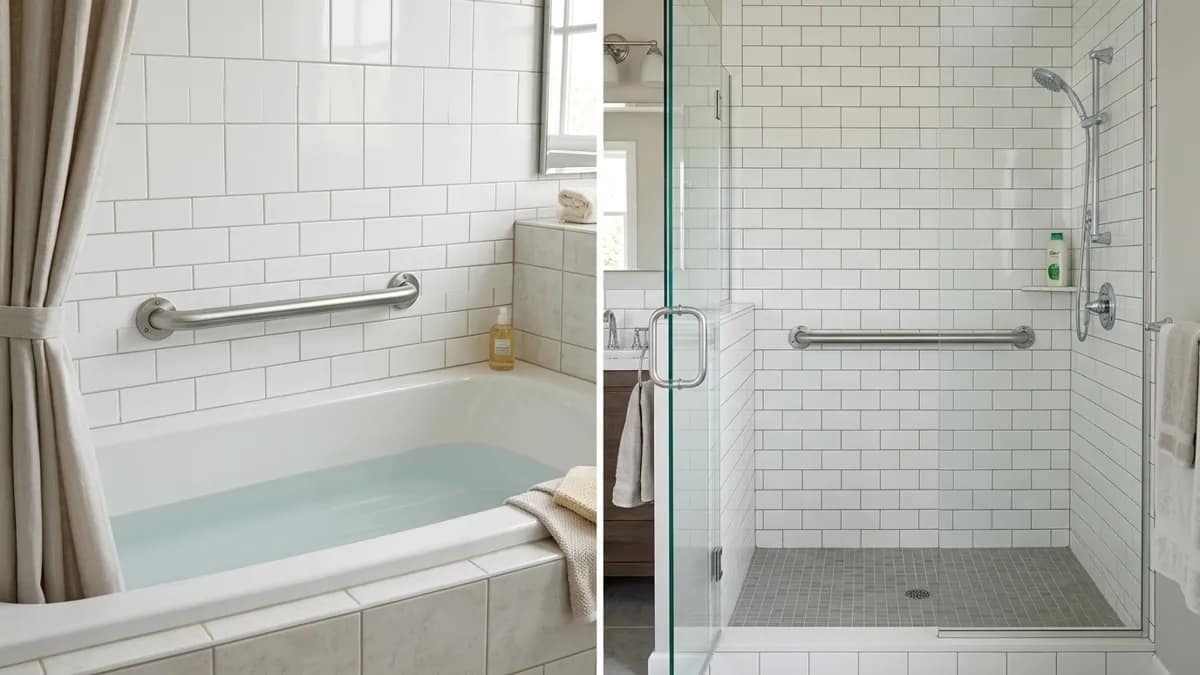
Straight grab bars remain the most widely recommended option for most bathrooms because they provide predictable support and allow users to maintain balance along a wall.
They provide stable support, and their straightforward orientation can make placement easier to plan.
In the comparison of angled grab bars vs straight grab bars, straight bars are generally preferred for steady balance and predictable support.
Straight grab bars work best when:
- Maintaining balance while standing
A horizontal bar along the shower wall helps users steady themselves. - Supporting movement along a wall
Users can slide their hand along the bar as they move. - Providing predictable support
Straight bars offer a consistent grip position, which many people find more reliable.
Because of their simplicity and stability, straight grab bars are the most common recommendation in residential bathrooms.
Example:
A person standing inside a shower may need to shift weight slowly while washing or turning. In that situation, a straight horizontal bar often feels more dependable because the hand can stay at a consistent height while moving along the wall.
That consistency is one of the main reasons straight grab bars remain the safer default in most bathroom layouts.
Safety Considerations
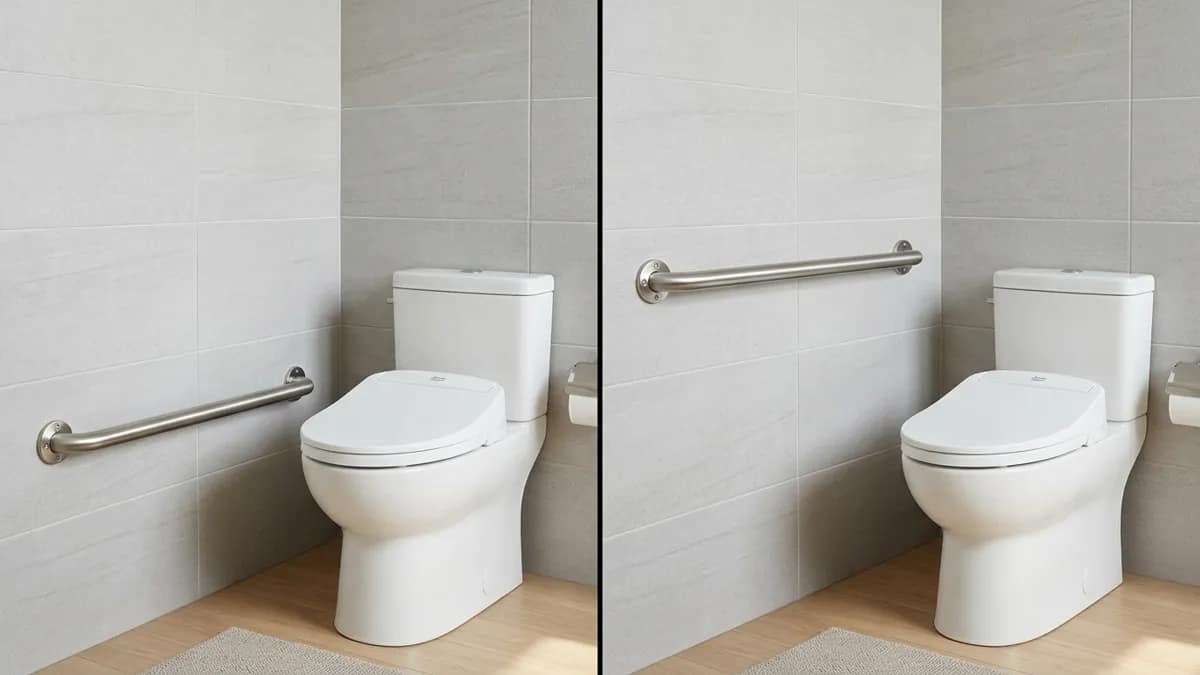
Regardless of orientation, the most important factor is proper installation.
Grab bars must be securely mounted so they can support real bathroom-use forces during sitting, standing, turning, or transferring.
The bar itself is only part of the safety equation. Its mounting and supporting structure matter just as much because the bar needs to remain secure when force is applied during everyday use.
Whenever possible, grab bars should be anchored into wall studs to ensure long-term stability.
If you are planning a DIY installation, this guide on how to install grab bars in studs explains why secure mounting matters more than the bar angle alone.
Height also plays an important role in usability because a grab bar that sits too high or too low can be uncomfortable or difficult to reach. Once the orientation is chosen, this guide on grab bar placement height guidelines explains how height affects comfort and daily use.
Quick placement check:
Before installing, think about where the hand will first reach during the actual movement. If the bar only becomes usable after stretching, twisting, or shifting balance first, the orientation or placement probably needs adjustment.
Even the right grab bar style will not feel safe if the orientation, height, or mounting position does not match the movement it is supposed to support.
What I Recommend
For most bathrooms, straight grab bars are the better starting point because they are versatile and easier to plan around common support needs.
A typical setup might include:
- a horizontal grab bar inside the shower
- a vertical or horizontal bar near the shower entrance
- a horizontal grab bar beside the toilet
In certain cases, angled grab bars can be useful near the toilet or shower seating where the user transitions between sitting and standing.
However, straight grab bars usually provide the most predictable support across different bathroom layouts.
After deciding whether a straight or angled bar fits the movement better, the next step is choosing a reliable product style. This guide to the best grab bars for seniors compares options for different bathroom support needs.
FAQ
Should grab bars be angled?
Not by default. Grab bars should be angled only when the diagonal position matches the user’s natural hand movement during sitting, standing, or transferring. For general balance support, straight grab bars are usually the safer default.
What angle should a grab bar be installed at?
There is no single angle that works for every bathroom. The angle should match the user’s reach, transfer direction, and hand path. If the angle does not match the movement, a straight grab bar is usually easier to use.
Is an angled grab bar good beside a toilet?
It can be helpful beside a toilet if the person naturally pulls upward while standing from the seat. If the user mainly needs steady side support, a straight horizontal grab bar may be easier to use.
Are straight grab bars better for showers?
In many cases, yes. Straight horizontal or vertical grab bars are usually more predictable for standing balance in a shower. Angled bars may be useful near shower seating if the placement matches a specific sit-to-stand movement.
Where should an angled grab bar be placed?
An angled grab bar should be placed where the user naturally reaches during a sit-to-stand or transfer movement, such as beside a toilet or near shower seating. It should not be angled only because the wall space looks convenient.
Should grab bars always be installed into studs?
Whenever possible, grab bars should be anchored into wall studs or proper structural backing so they can safely support bathroom movement. The safest orientation will not help much if the installation is weak.
Final Thoughts
When comparing angled grab bars vs straight grab bars, both types can improve bathroom safety when installed correctly.
Straight grab bars are the most common choice because they provide stable support and work well in many different locations.
Angled grab bars can offer a more natural grip path for certain movements, particularly when transitioning between sitting and standing.
Choosing the right orientation depends on the layout of the bathroom and the type of support needed during everyday movements.
