

Avoiding drilling is a common concern when installing grab bars. This is especially true for renters, tiled bathrooms, or situations where permanent modifications are not preferred.
This leads to a practical question: can grab bars be installed without drilling and still provide reliable support?
While non-drill options exist, they come with important limitations. Understanding can grab bars be installed without drilling requires balancing convenience with safety.
Disclosure: As an Amazon Associate, I earn from qualifying purchases. This post may contain affiliate links. If you purchase through these links, I may earn a small commission at no extra cost to you. I only recommend products I would feel comfortable using in my own home. Learn more.
On This Page
- Types of Grab Bars That Don’t Require Drilling
- How Safe Are Grab Bars Without Drilling?
- When Non-Drill Grab Bars Can Be Used Safely
- When You Should NOT Use Grab Bars Without Drilling
- When No-Drill Grab Bars Are Acceptable vs When to Avoid Them
- Pros and Cons of Installing Grab Bars Without Drilling
- Alternatives When You Want to Minimize Drilling (Safer Options)
- What I Recommend
- FAQ
- Final Thoughts
Quick Answer
Grab bars can be installed without drilling using options like suction, adhesive, or tension-mounted designs, but these solutions typically offer lower stability and should only be used for light support or temporary situations where full weight-bearing is not required.
- Yes, but only for limited support scenarios
- Suction, adhesive, and tension-mounted options are available
- Stability depends heavily on surface and installation quality
- Not designed for full body weight support
- Require regular checking and re-testing
These options can provide convenience, but their effectiveness depends on proper installation, surface conditions, and realistic expectations about how much support they can safely provide.
Types of Grab Bars That Don’t Require Drilling

Non-drill grab bar options use different attachment methods, each with specific limitations that affect how much support they can safely provide.
Understanding how each type works helps determine where it can be used safely and what limitations to expect.
This is especially useful when comparing temporary and fixed solutions, as outlined in suction vs permanent grab bars.
Suction Grab Bars
Suction grab bars attach to smooth surfaces using a vacuum seal. They are one of the most commonly used no-drill options.
- Easy to install and remove
- Do not damage walls
- Depend heavily on surface condition
Their performance can vary depending on how well the suction cups adhere. Even small imperfections or moisture can reduce effectiveness.
Because suction-based designs have specific limitations, it helps to understand whether suction grab bars are safe for seniors before relying on them for support.
Adhesive Grab Bars
Adhesive grab bars use strong bonding materials to attach to walls.
- Provide a semi-permanent solution
- Require careful surface preparation
- May leave residue or damage upon removal
They can offer more stability than suction options in some cases, but only if installed correctly on compatible surfaces.
Tension-Mounted Grab Bars
Tension-mounted grab bars rely on pressure between two opposing surfaces.
- Do not require drilling
- Can be installed quickly
- Limited to specific layouts
These are typically used in narrow spaces where pressure can be applied securely. Their effectiveness depends on proper alignment and surface stability.
How Safe Are Grab Bars Without Drilling?
Grab bars installed without drilling are significantly less stable than permanently mounted options, especially when used for weight-bearing support.
Their performance depends on surface quality, installation technique, and ongoing conditions such as moisture or temperature changes.
Example:
A suction grab bar may feel secure immediately after installation but lose adhesion over time, especially in a humid shower environment. This change may not be noticeable until the bar is used for support.
In situations where consistent support is required, non-drill options may not provide the same level of reliability.
If you’re unsure whether non-drill options are sufficient, it helps to understand whether grab bars need to be screwed in for proper support.
When Non-Drill Grab Bars Can Be Used Safely
Non-drill grab bars can be appropriate in certain situations.
- Temporary use, such as short-term recovery
- Light balance support rather than full weight support
- Low-risk environments with stable surfaces
These options work best when the level of support required is limited and the environment is controlled. They are not intended to replace permanent solutions in high-demand situations.
In scenarios where flexibility is necessary—such as rental spaces or temporary setups—selecting the right type of non-permanent solution becomes especially important.
In these cases, options like grab bars suited for renter-friendly use are designed to provide support without permanent installation. They can provide helpful assistance when used correctly and monitored regularly.
When You Should NOT Use Grab Bars Without Drilling
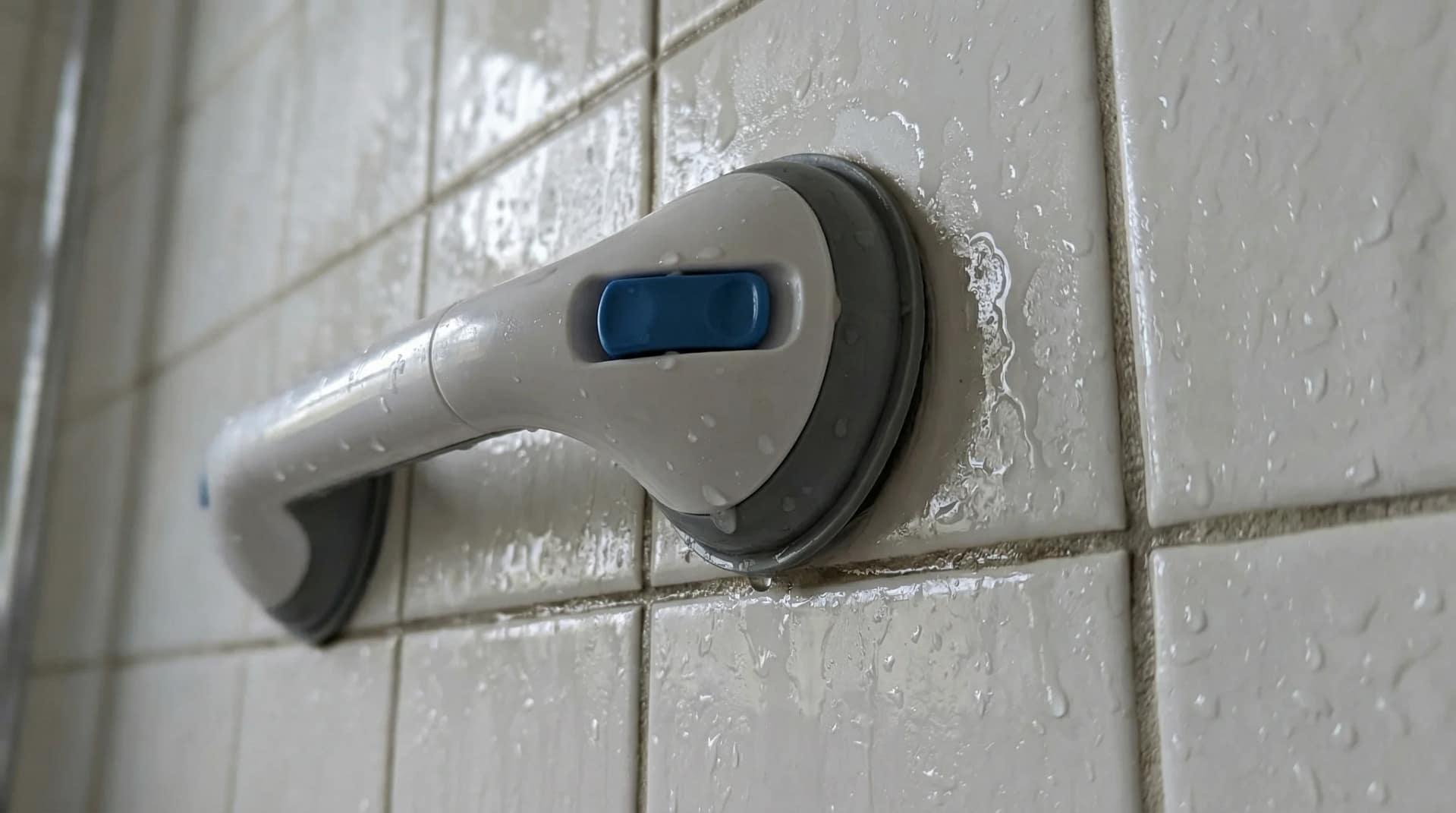
There are situations where non-drill grab bars are not suitable.
- When full body weight support is needed
- For users with significant mobility challenges
- In consistently wet or slippery environments
These situations require stable and predictable support. Non-drill options may not provide the level of reliability needed in these conditions.
Important note:
In a shower where surfaces are frequently wet, suction or adhesive grab bars may lose strength over time, increasing the risk of sudden detachment.
In these cases, permanent installation is the safer and more appropriate choice.
When No-Drill Grab Bars Are Acceptable vs When to Avoid Them
A simple decision threshold can help determine whether a no-drill grab bar is appropriate. These options may be acceptable only when the required support level is low and the installation conditions are stable and controlled.
- Acceptable if: support is light, the surface is smooth and stable, and the grab bar is used mainly for balance rather than weight-bearing
- Avoid if: full body weight support is needed, the environment is wet or high-use, or the user depends on consistent stability
- Choose permanent installation if: safety depends on reliable, daily support in areas like showers or near toilets
This distinction helps separate convenience from safety. If the grab bar must support significant force or frequent use, drilling and secure mounting are the safer options.
Pros and Cons of Installing Grab Bars Without Drilling
Non-drill grab bars offer convenience, but they also come with important trade-offs. Understanding both sides helps determine whether they are suitable for your situation.
Pros:
- No wall damage
- Easy and quick installation
- Removable and flexible
- Suitable for temporary setups
Cons:
- Lower reliability compared to permanent options
- Reduced weight capacity
- Performance depends on surface conditions
- Require regular testing and monitoring
While non-drill options can be useful in certain situations, they should be selected carefully based on how much support is needed and where they will be used.
Alternatives When You Want to Minimize Drilling (Safer Options)
If avoiding drilling completely is not possible, there are ways to minimize wall impact while still improving safety.
For example, installing grab bars into studs provides strong and reliable support while limiting damage to a small number of secure points.
For a more secure solution, installing into wall studs provides reliable support, as explained in how to install grab bars in studs.
Another approach is using proper anchors designed for specific wall types. While this still involves drilling, it allows for controlled and secure installation.
These options offer a balance between safety and minimal structural impact, especially compared to fully non-drill solutions.
What I Recommend
Non-drill grab bars should only be used in temporary or low-risk situations where strong, consistent support is not required.
First, assess how much support is actually needed. If full weight or strong stability is required, non-drill options are not the best choice.
Next, consider the environment. Wet or high-use areas increase the risk of failure and favor permanent installation.
If both risk and usage are low, non-drill options may be acceptable with regular monitoring.
In all cases, prioritize safety over convenience when making the final decision.
FAQ
Can grab bars be installed without drilling?
Yes, options such as suction, adhesive, and tension-mounted grab bars are available, but they are generally less reliable than permanently installed bars.
Are no-drill grab bars safe?
They can be safe for light use and temporary situations, but they are not recommended for full weight support.
What is the safest non-drill option?
Suction grab bars are commonly used, but their safety depends on proper installation and surface conditions.
When should drilling be used instead?
Drilling is recommended when strong, consistent support is required, especially in high-risk areas.
Final Thoughts
Grab bars can be installed without drilling, but these solutions come with important limitations.
While suction, adhesive, and tension-mounted options offer flexibility and convenience, their performance depends heavily on surface conditions, proper installation, and ongoing maintenance. This makes them less predictable than permanently installed grab bars.
Understanding when these options are appropriate—and when they are not—is essential for maintaining safety. In low-risk or temporary situations, non-drill grab bars can provide useful support when used correctly.
However, in high-risk areas such as showers or for users who rely on strong, consistent support, more secure installation methods should be prioritized.
Choosing the right solution is not just about avoiding drilling—it is about ensuring that support is reliable when it is needed most.
