
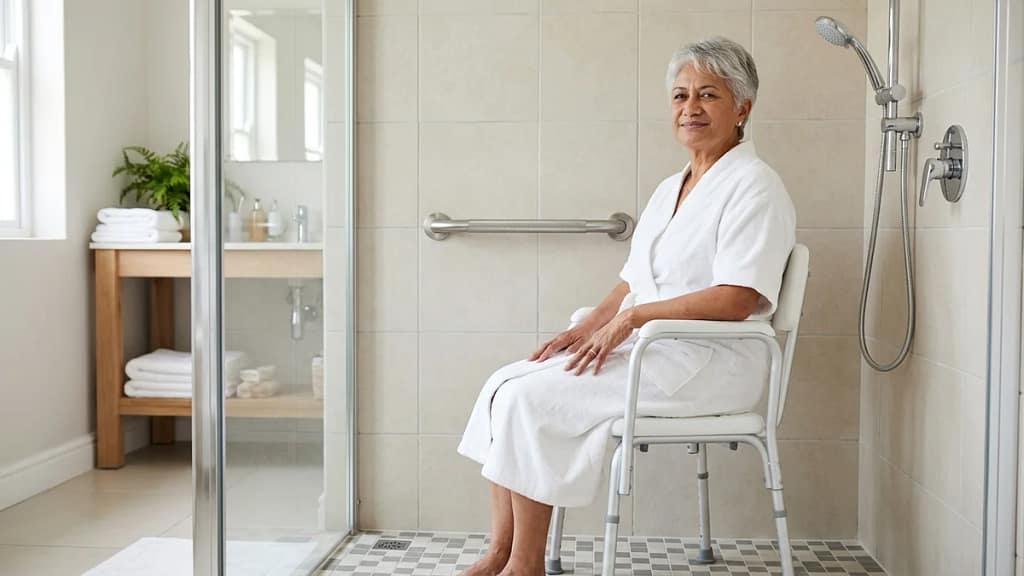
Bathrooms are one of the highest-risk areas in any home for seniors, and most of that risk is concentrated in the shower or tub. About 68% of bathroom injuries treated in U.S. emergency departments happen in or around the shower or bathtub, and the injury rate rises steeply with age, according to the CDC.
A shower chair lowers that risk by giving a steady place to sit during bathing. However, a shower chair is only as safe as the way it is used. Knowing how to use a shower chair safely comes down to a repeatable routine: prepare the chair and the space, control the water temperature, move carefully during each transfer, and step out onto a dry, stable surface.
Disclosure: As an Amazon Associate, I earn from qualifying purchases. This post may contain affiliate links. If you purchase through these links, I may earn a small commission at no extra cost to you. I only recommend products I would feel comfortable using in my own home. Learn more.
On This Page
- Get the Shower Chair Ready Before You Bathe
- Set and Test the Water Temperature
- How to Sit Down and Stand Up Safely
- Washing Safely While Seated
- Getting Out and Drying Off Safely
- Common Mistakes to Avoid
- Special Situations: Tubs, Walk-In Showers, and Recovery
- Keep the Shower Chair Safe Over Time
- What I Recommend
- FAQ
- Final Thoughts
Quick Answer
To use a shower chair safely, place it on a flat, non-slip surface, adjust it so both feet rest flat on the floor, and confirm it holds steady before leaning on it. Sit down and stand up slowly using the chair arms or a grab bar, keep soap and a handheld sprayer within easy reach, and step out onto a dry mat.
- Stability first: the chair should not rock, slide, or tip when weight shifts onto it.
- Correct height: feet flat and knees near hip level give the most control when standing.
- Non-slip contact: rubber tips on the legs and a textured floor reduce sliding on wet surfaces.
- Everything in reach: stretching for soap or the sprayer is a common way balance is lost.
- Careful transfers: sitting down and standing up are the riskiest moments, so they deserve the most attention.
Most problems with shower chairs come from setup and technique, not the chair itself. A chair that fits the space and the person, placed and tested before bathing, removes most of the everyday risk. For a closer look at when this equipment does and does not add safety, see are shower chairs safe for seniors.
Each of those principles depends on the setup, so that is where a safe routine begins.
Get the Shower Chair Ready Before You Bathe
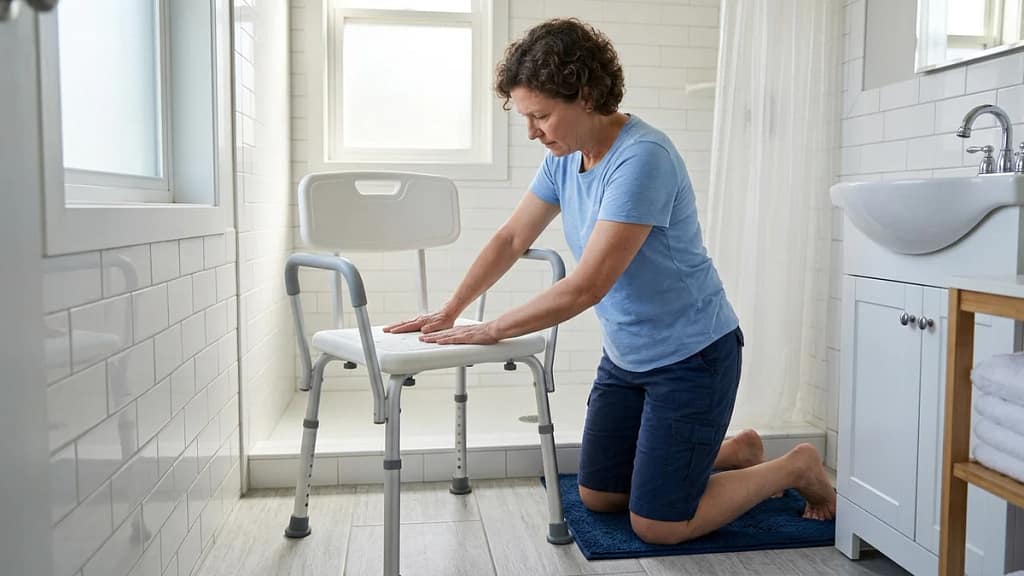
Before choosing where to sit, take a minute to set the chair up correctly. A short setup routine, done the same way each time, is what keeps the chair dependable.
- Pick the right chair for the space and the user. A chair with arms helps with standing, while a backless stool fits a smaller shower. If the chair has not been chosen yet, comparing options in best shower chairs for seniors can help match features to the person’s needs.
- Set the height correctly. Adjust the legs so the feet rest flat and the knees sit near hip level, which gives the most leverage when standing. Getting this right is covered in the shower chair height guide.
- Confirm the weight limit. Check the listed weight rating and treat it as one part of the decision, not a guarantee. A wider, sturdier frame is usually the safer choice for a heavier user or anyone who leans hard on the arms, as explained in the shower chair weight limit.
- Stop the chair from sliding. Fit rubber tips on all four legs, place the chair on a textured or matted surface, and press down on each corner to check it does not shift. Practical fixes are covered in keeping a shower chair from sliding.
- Test stability before every use. From a standing position, push gently on the seat and arms and watch for rocking or movement before any weight goes onto the chair.
- Set up a safe surround. Position the chair where a grab bar is within natural reach, since a bar gives a second point of support during transfers. Options are compared in best grab bars for shower safety.
- Clear the floor. Remove loose bath mats or rugs from the path in and out, and make sure the lighting is good.
Important note:
Test the chair’s stability before every use, not just the first time. Rubber feet wear down and legs can loosen over time. If sitting down or standing up still feels unsteady after setup, a physical or occupational therapist can check the fit and suggest whether added support, such as a transfer bench, would be a better match.
With the chair stable and the floor clear, the next thing to control is the water.
Set and Test the Water Temperature
Water that is too hot is easy to overlook, and it matters more for seniors because thinner skin and slower reactions raise the risk of a scald.
- Set the water heater to about 120°F. The U.S. Consumer Product Safety Commission recommends this level because higher settings burn much faster: at 140°F a serious burn can happen in about six seconds, while at 120°F it takes around five minutes (CPSC).
- Turn the water on and adjust it before sitting down, so there is no reaching or standing to fix the temperature mid-shower.
- Test the water by hand, or with a handheld sprayer aimed away from the body first, before it touches the skin.
Once the water is set, attention shifts to the movement that causes the most falls: getting on and off the chair.
How to Sit Down and Stand Up Safely
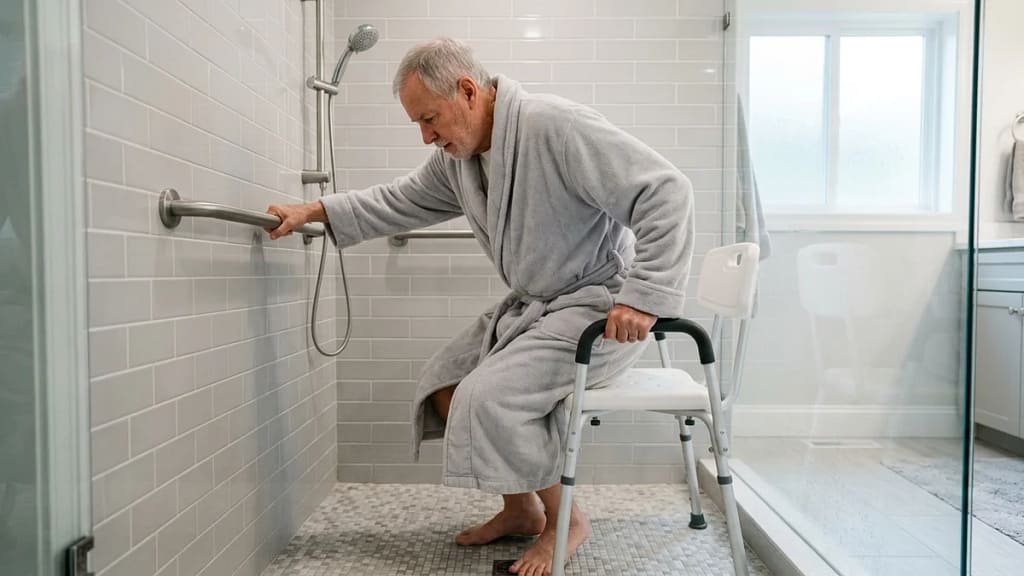
Transfers, moving from standing to sitting and back, are the moments when most balance is lost, so they are worth slowing down for.
- Approach the chair until the backs of the legs touch the seat, so its position is known without looking down.
- Reach for the chair arms or a grab bar, not the wall or a towel bar, which can give way. Occupational therapists consistently recommend reaching for a fixed, load-bearing support during transfers (Shirley Ryan AbilityLab).
- Lower slowly and under control, bending at the knees and hips rather than dropping onto the seat.
- Settle fully back on the seat before starting to wash, keeping weight centered.
- To stand, move to the front of the seat, place the feet flat and slightly back, and push up through the legs while holding the arms or bar.
When helping someone else, stand to the user’s weaker side, guide rather than lift, and let the chair and grab bar carry the weight. Lifting a person by hand raises the risk of a fall for both people.
That same care carries into the next stage: staying steady while actually washing.
Washing Safely While Seated
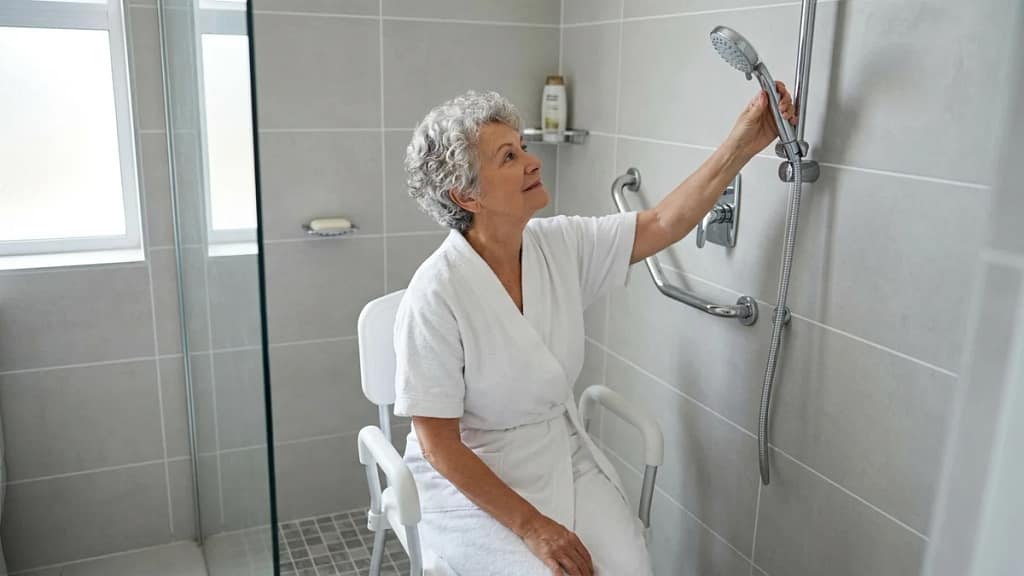
Once seated, the goal is to wash without leaning, twisting, or reaching past a stable position.
- Keep soap, shampoo, and a washcloth on a caddy or shelf within arm’s reach, set up before sitting.
- Use a handheld shower head so the water comes to the body instead of the body moving toward the water.
- If the shower has only a fixed head, an inexpensive handheld unit that attaches to the existing pipe makes staying seated much easier.
- Wash from the center outward, and bring each foot up rather than bending far forward to reach it.
- Pause the water while soaping, which keeps the floor and hands less slippery.
Real-life example:
A senior recovering from hip surgery may be told to avoid bending the hip past a certain angle. A shower chair paired with a handheld sprayer lets that person stay seated and upright, washing the lower legs with a long-handled sponge instead of leaning down and risking a fall.
Once washing is done, the last risky moment is leaving the chair.
Getting Out and Drying Off Safely
Stepping out is as risky as getting in, because the floor is now wet and movement resumes.
- Turn the water fully off and let excess water drip before moving.
- Dry the feet and lower legs while still seated, so they are less slippery on the floor.
- Place a non-slip bath mat where the feet will land outside the chair or tub.
- Stand using the chair arms or grab bar, then step onto the dry mat before turning.
- Keep a towel and robe within reach so there is no cold, hurried scramble after standing.
Even a careful routine can slip when a few common habits creep in, so they are worth naming directly.
Common Mistakes to Avoid
A few habits account for most avoidable shower chair falls.
- Reaching too far for a dropped item instead of leaving it until after the shower.
- Using a chair with worn or missing rubber tips on a slick floor.
- Rushing the stand-up before the feet are flat and the hands have a grip.
- Bathing with no phone or call button within reach in case of a slip.
- Relying on a towel bar, soap dish, or shower door for support, none of which are built to hold body weight.
Avoiding those mistakes matters more in some bathrooms than others, depending on the layout and the person’s needs.
Special Situations: Tubs, Walk-In Showers, and Recovery
The safest setup depends on the bathroom and the person, and a few situations call for extra thought.
- In a bathtub, a standard shower chair can work only if it sits flat and stable on the tub floor. Climbing over the tub wall is often the harder problem, and when that step is the risk, a transfer bench that bridges the tub wall is usually safer. Whether a chair fits a tub is covered in using a shower chair in a bathtub.
- In a walk-in or curbless shower, a lightweight chair or a wall-mounted fold-down seat keeps the floor clear for movement.
- After surgery or during recovery, follow the surgeon’s or therapist’s guidance on movement limits, and favor a chair with arms and adjustable height for more control.
- For arthritis or a weak grip, padded arms and a chair that is easy to hold reduce strain during transfers.
Whatever the situation, the chair only stays safe if it is kept in good condition.
Keep the Shower Chair Safe Over Time
A shower chair stays safe only if it is maintained, since daily use in a wet environment wears parts down.
- Rinse and dry the chair after use to limit soap scum and mildew, which can make surfaces slick.
- Check the rubber tips monthly and replace them once they are worn smooth.
- Tighten any adjustable legs or bolts that have loosened.
- Inspect the frame for cracks, rust, or flex, and replace the chair if it no longer feels solid.
Maintenance keeps the chair reliable over time, and the final step is putting the whole routine together.
What I Recommend
For most people, I recommend starting with the simplest stable setup that solves the actual problem: a well-fitted chair, placed and tested the same way each time, paired with a grab bar within reach. Added features matter less than a routine that is followed consistently.
A practical way to build a safe routine is:
- measure the shower or tub floor before choosing a chair
- match the chair type to the space and the person’s movement
- set the height so the feet stay flat and knees near hip level
- test stability before every single use
- keep soap, a handheld sprayer, and a phone within reach
- set the water to a safe temperature before sitting
- exit onto a dry, non-slip surface
The right setup is not the most expensive or feature-heavy one. It is the one that fits the bathroom and the person, and gets used the same safe way every time.
FAQ
Can a shower chair be used in a bathtub?
Yes, if it sits flat and stable on the tub floor and the person can step over the tub wall safely. When getting over the wall is the harder part, a transfer bench is usually the safer option.
What weight capacity should I look for in a shower chair?
Check the listed weight rating and choose a frame comfortably above the user’s weight, since a wider, sturdier build stays more stable when someone leans on the arms. Treat the number as one factor, not a guarantee.
Do you need grab bars with a shower chair?
Grab bars are not required, but they add a second point of support during transfers, which are the riskiest moments. A bar within natural reach of the chair is worth considering.
How does a senior get in and out of a shower chair safely?
Approach until the legs touch the seat, reach for the chair arms or a grab bar, and lower slowly by bending the knees and hips. To stand, move to the front of the seat, place the feet flat, and push up through the legs while holding a fixed support.
Can you use a shower chair every day?
Yes. A shower chair is designed for daily use. Rinse and dry it after each shower, and check the rubber tips and frame regularly so it stays stable over time.
Final Thoughts
A shower chair turns bathing from a series of risky standing movements into a mostly seated routine, and that shift is where its safety benefit comes from. The equipment does its part only when the setup and habits around it are dependable.
That said, needs change over time. A chair that fits well today may need a different height, added arms, or a move to a transfer bench as mobility changes, so it is worth reassessing the setup every few months rather than treating it as settled.
