
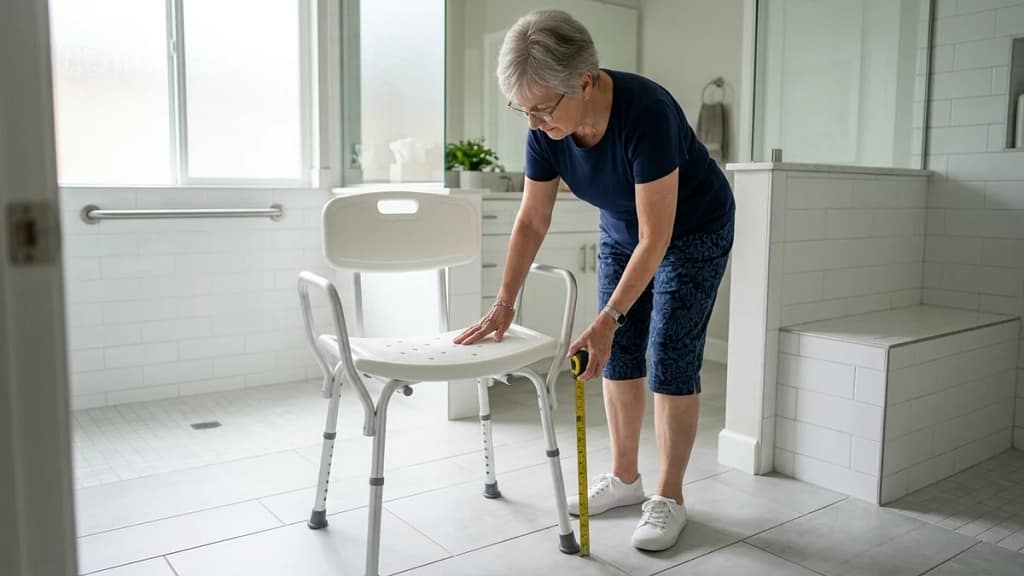
Falls in the bathroom are common among seniors, and a shower chair set to the wrong height is one overlooked reason why. According to the CDC, bathroom injuries send a large share of older adults to the emergency room each year, and unstable seating is a recurring factor.
A shower chair height guide usually starts with one number: 17 to 19 inches. That range is a real standard, but it was not written with every body, every bathroom, or every recovery timeline in mind.
The sections below cover where that number comes from, how to check it against your own measurements, and what to do if the chair you already own does not quite fit.
Disclosure: As an Amazon Associate, I earn from qualifying purchases. This post may contain affiliate links. If you purchase through these links, I may earn a small commission at no extra cost to you. I only recommend products I would feel comfortable using in my own home. Learn more.
On This Page
Quick Answer
Most shower chairs should sit between 17 and 19 inches from the floor to the top of the seat, matching the standard used for accessible fixtures. The right height for a specific person depends on their own leg length and how the chair is used, so this range is a starting point rather than a fixed rule.
- Standing height: the seat should let the knees stay roughly level with the hips when sitting, so standing up does not require extra effort.
- Chair type: fixed-height chairs use one preset number, while adjustable models can be raised or lowered in small increments if the standard range does not fit.
- Recovery needs: someone recovering from hip or knee surgery may need a different height than the general range, based on guidance from a doctor or physical therapist.
- Floor contact: feet should stay flat on the floor or shower base, not stretched down or lifted with the knees higher than the hips.
Important note:
Anyone recovering from hip, knee, or spine surgery should confirm any seat height change with a doctor or physical therapist first, since recovery-specific positioning can differ from the general guidance in this article.
Fixed-Height vs Adjustable Shower Chairs
Shower chairs come in two basic types, and the difference affects how much flexibility there is once a chair is already in the bathroom.
← Swipe to see more →
| Feature | Fixed-Height | Adjustable |
|---|---|---|
| Typical height | One set number, usually within the 17-19 inch range | Adjustable in small steps, often 15 to 22 inches |
| Cost | Usually lower | Usually higher |
| Best for | A single user whose measurements already match the standard range | Shared bathrooms, changing recovery needs, or a user outside the standard range |
| Stability | Fewer moving parts, generally simpler to keep stable | Requires checking that all legs lock at the same height |
Once the type is clear, the next question is whether the number itself fits the person using it. If it does not, adjusting the height is usually simpler than replacing the chair.
If replacing the chair is not practical
A fixed-height model can sometimes be corrected without buying a new one. A folded towel or a thin non-slip cushion can raise the seat by an inch or so, and some manufacturers sell replacement legs in a different length for the same model. Neither option works for a chair that is too tall, though, since there is no safe way to shorten fixed legs at home.
The ADA Standard, and Why It’s Only a Starting Point
The 17 to 19 inch range comes from the Americans with Disabilities Act’s guidelines for permanently mounted shower seats in accessible facilities. The standard also calls for a listed capacity of at least 250 pounds, which is a reasonable baseline to check even on a portable chair.
That said, the ADA range was written for fixed, code-compliant installations, not for every portable chair sold for home use. A chair within the standard range can still feel wrong for a taller or shorter user, which is why measuring your own fit matters more than matching a published number exactly.
How to Measure Your Own Correct Height
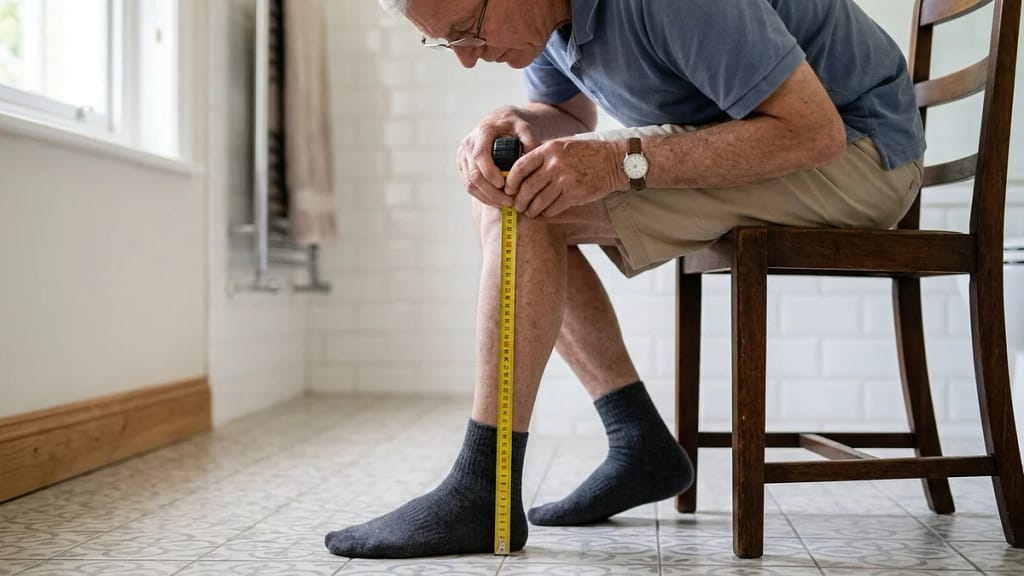
Getting the number right takes a tape measure and about two minutes.
- Sit on a firm chair with your feet flat on the floor and your knees bent at roughly a right angle.
- Measure from the floor to the crease behind your knee, a method used by occupational therapists checking seat height.
- Add about 2 inches to that number. This accounts for shoe or slipper thickness and gives a small margin for the shower floor’s slope.
- Compare the result to the shower chair’s seat height, checking the manufacturer’s listed range if the chair is adjustable. This matters most while you’re still choosing a shower chair, before a purchase is final.
- Sit on the chair once it is placed and confirm your feet stay flat with your knees level with or slightly below your hips.
Real-life example:
A caregiver measuring a shower chair for her father after his hip replacement found that his usual 18 inch chair now felt too low. His surgeon’s hip precautions meant his hips needed to stay above knee level during the recovery window, so a slightly taller adjustable setting worked better until he healed.
Once your own numbers are checked against the chair, the next step is knowing what it looks like when the fit is actually off.
Signs Your Shower Chair Height Is Wrong
A chair that is the wrong height usually shows itself quickly, often before the user notices consciously.
- Knees sit noticeably higher than the hips while seated
- Feet do not reach the floor, or only the toes touch
- Standing up requires pushing hard with the arms or rocking forward first
- The body slides forward on the seat during use
- Water pools around the legs because the seated angle changes how the shower head hits the body
Any of these on their own might be a minor annoyance, but together they usually mean the chair is not the right fit for the person using it. If several apply, it may be worth reconsidering what size shower chair the household actually needs, rather than just adjusting the one already in place.
Once the chair’s own height checks out, it’s worth looking at what’s around it.
Getting It Right: Pairing Height with Grab Bar Placement

Shower chair height rarely works in isolation. A chair set for the right sit-to-stand height is only part of a stable bathroom setup, and it should line up with how a nearby grab bar is positioned.
The two decisions are connected because a grab bar only helps if it’s within reach while seated, not just while standing. A bar mounted for someone standing can sit too high to grab once they’re lowered into the chair, especially if the chair’s own height has changed since the bar went in.
- Test the grab bar from a seated position in the chair, not just standing, before relying on either one day to day
- Check that the bar supports the direction of the transfer, pushing up and forward, rather than only a sideways grip
- Re-test the pairing any time the chair height changes, since a bar that worked at one setting may not work at another
- If the grab bar and the chair were installed at different times, a quick joint check confirms they still work together
Confirming this pairing is part of using the chair safely day to day, not a one-time setup step.
What I Recommend
For most households, I recommend starting with an adjustable chair rather than a fixed-height model. The extra range makes it easier to fine-tune the fit without buying a second chair later.
A practical way to check the fit once a chair is in place:
- Measure knee-crease height before buying, not after
- Test the chair with shoes off, the way it will actually be used
- Recheck the height any time a user’s mobility or recovery status changes
- Confirm all adjustable legs lock at the same height before first use
- Pair the chair height with nearby grab bar placement rather than treating them separately
The right height is the one that lets a specific person sit down and stand up without extra effort, not necessarily the exact number printed on a box.
FAQ
What is the ADA-compliant height for a shower seat?
The ADA standard calls for a seat height of 17 to 19 inches from the floor for permanently mounted, accessible shower seats. Portable shower chairs for home use often use the same range as a reference point, though it is not a legal requirement for personal-use products.
How do I know if my shower chair height is correct?
Sit on the chair with your feet flat on the floor. Your knees should be roughly level with your hips, not noticeably higher. If you need to push hard with your arms to stand, the seat may be too low.
Can an adjustable shower chair be used in a bathtub or as a transfer bench?
Some adjustable models are designed to work across a bathtub wall, often marketed as transfer benches. Check the product listing for tub compatibility before buying, since not every shower chair is built for that use.
Are all shower chairs height-adjustable?
No. Many shower chairs use a single fixed height, usually set within the standard 17 to 19 inch range. Adjustable models cost more but allow small changes after the chair is already in place.
Should I choose a chair with a backrest or a backless stool?
A backrest provides more support for users who tire during bathing or who have limited trunk stability. A backless stool takes up less space and can work well for someone with steady balance and a smaller shower.
Are there exceptions to the standard ADA height requirement?
Yes. The ADA standard allows some variation for specific accessibility needs, and it applies to permanently installed fixtures rather than every portable product. A user’s own measurements should still guide the final decision for a home shower chair.
Can a shower chair be used safely on an uneven shower floor?
It depends on the chair’s leg design. Some models include independently adjustable legs to compensate for a sloped or uneven shower floor, while fixed-leg chairs may wobble on an uneven surface and should be tested carefully before regular use.
Final Thoughts
A chair at the right height is only half the setup. Pair that number with grab bar placement, recheck it after any change in mobility, and the seat becomes part of a system that actually keeps someone steady, not just a number that happened to match a chart.
