

Standing for an entire shower becomes harder for many seniors as balance and stamina change, and a shower chair is one of the simplest ways to make bathing safer without remodeling anything. Bathrooms are one of the highest-risk areas in any home, especially for seniors, since wet surfaces and frequent movement increase the likelihood of slips and falls during everyday activities (CDC). Not every shower chair provides the same kind of support, and the right pick for the best shower chairs for seniors search usually depends on weight capacity, bathroom footprint, and how much arm or back support the user actually needs.
The seven shower chairs below are compared by weight capacity, footprint, and foot type, along with the decision points that determine whether a transfer bench is the safer choice instead.
Disclosure: As an Amazon Associate, I earn from qualifying purchases. This post may contain affiliate links. If you purchase through these links, I may earn a small commission at no extra cost to you. I only recommend products I would feel comfortable using in my own home. Learn more.
On This Page
- Which Shower Chair Makes the Most Sense?
- Best Shower Chairs for Seniors: Top Picks
- How to Choose the Right Shower Chair for Your Bathroom
- Shower Chair vs Transfer Bench: Which Is Safer for You?
- When a Shower Chair Alone May Not Be Enough
- Bathroom Safety Tips for Seniors Using a Shower Chair
- Common Shower Chair Buying Mistakes to Avoid
- What I Recommend
- FAQ
- Final Thoughts
Quick Answer
The best shower chairs for seniors combine a listed weight capacity well above the user’s weight, non-slip feet suited to the shower floor, and a size that actually fits the stall or tub, with armrests or a backrest added only when the user’s balance and transfer pattern call for them.
- Weight capacity: Rated well above the user’s actual weight, not just barely above it, for a safer margin.
- Foot type: Suction feet grip a smooth floor, while rubber non-slip tips generally hold across more floor textures.
- Size and fit: A footprint that actually matches the stall or tub width, so the chair does not crowd movement.
- Armrests or a backrest: Added only when the user’s balance or transfer pattern actually calls for the extra support.
A chair with a high weight rating is not automatically the safer pick if its feet are not suited to the shower floor or if it does not fit the stall. Fit and floor contact matter more than the number on the label alone. Before comparing options, it helps to know the actual movement the chair needs to support: sitting down, standing back up, or shifting weight while reaching for a washcloth or shampoo bottle.
Important note:
A shower chair is a bathing aid, not a substitute for medical guidance. Anyone recovering from surgery, a recent fall, or a new balance or mobility change should confirm the right type of bathing support with a doctor or physical therapist before choosing a chair based on general guidance alone.
Which Shower Chair Makes the Most Sense?
This table compares the top options based on support level, ideal use case, and the trade-offs that matter most in real use.
| Product | Best Use Case | Support | Stands Out | Watch-Out | Action |
|---|---|---|---|---|---|
| Our PickBest Overall Medline Shower Chair |
Everyday bathing, added support | Moderate | High review volume | Larger footprint | Check on Amazon |
| Best Budget Dr. Kay’s Shower Chair |
Budget-conscious buyers | Light | Lowest price | 350 lb capacity | Check on Amazon |
| Best Arms & Back FULLOT Wide Shower Chair |
Needs both arm & back support | Moderate | Reinforced aluminum frame | Larger seat footprint | Check on Amazon |
| Best Heavy-Duty Seaside Brother Shower Chair |
Higher-weight users | Higher | 600 lb capacity | Newer, fewer reviews | Check on Amazon |
| Best Swivel KingPavonini Swivel Shower Chair |
Limited hip/trunk rotation | Higher | 360° swivel, locks at 90° | More moving parts | Check on Amazon |
| Best Small Shower Space-Saving Triangular Shower Chair |
Corner / small stalls | Light | Uses corner space | Less side support | Check on Amazon |
| Best Padded BRITULIF Shower Chair |
Longer sessions, comfort | Moderate | Padded seat, back & arms | 400 lb recommended (550 lb max) | Check on Amazon |
Best Overall
Medline Shower ChairEveryday bathing, added supportCheck on Amazon
Best Budget
Dr. Kay’s Shower ChairBudget-conscious buyersCheck on Amazon
Best Arms & Back
FULLOT Wide Shower ChairNeeds both arm & back supportCheck on Amazon
Best Heavy-Duty
Seaside Brother Shower ChairHigher-weight usersCheck on Amazon
Best Swivel
KingPavonini Swivel Shower ChairLimited hip/trunk rotationCheck on Amazon
Best Small Shower
Space-Saving Triangular Shower ChairCorner / small stallsCheck on Amazon
Best Padded
BRITULIF Shower ChairLonger sessions, comfortCheck on Amazon
Best Shower Chairs for Seniors: Top Picks
Here’s a closer look at each pick from the table above, including who it fits best and what to watch for before buying.
Best Overall
Medline Shower Chair
This chair pairs a backrest with padded armrests, giving it more all-around support than a basic backless model, and it’s one of the most-reviewed picks on this list — a useful signal in a category where most listings are relatively new.
- Nearly 2,900 reviews — second-most of any pick on this list
- Padded armrests in addition to a full backrest
- Listed capacity clears typical adult weight ranges with margin to spare
If you’re weighing it against a lighter backless stool, the extra arm and back support is usually worth the footprint for anyone who tires standing through a full shower.
Best Budget Option
Dr. Kay’s Shower Chair
This is the lowest-priced chair on this list, while still adding a backrest and adjustable aluminum frame. Its compact design, non-slip rubber feet, and no-tools assembly make it a practical choice for everyday showering without spending more on features you may not need.
- Compact 15.5-inch-wide design fits smaller tubs and showers
- Adjustable from 12.5 to 18.5 inches for different user heights
- Built-in side handles and no-tools assembly make it easier to move and set up
If you prefer a backless shower stool for a more open setup, compare it with one of the simpler stool options on this list.
Best with Arms & Back Option
FULLOT Wide Shower Chair
This chair combines padded armrests and a backrest with a reinforced aluminum frame, giving users support from both sides and behind while sitting, standing, or repositioning in the shower. The adjustable height and removable arms and back also make it easier to configure for different users and bathroom setups.
- Reinforced aluminum frame with stable bracing design
- 400 lb maximum weight capacity
- Six height settings with padded seat, back, and armrests
If you want a simpler shower setup with less equipment around you, compare it with a backless option like the Best Budget or Best Small Shower picks.
Best Heavy-Duty Option
Seaside Brother Shower Chair (600 lb)
This chair has the highest listed weight capacity on this list at 600 lb, supported by a double-crossbar aluminum frame. Its EVA-cushioned seat and backrest also add a layer of comfort that isn’t always found on heavy-duty shower chairs.
- 600 lb listed capacity, the highest of these seven picks
- EVA-cushioned seat and backrest with rounded, anti-collision edges
- Removable arms and back for tool-free setup in tighter stalls
Worth a closer look at recent buyer photos before ordering, since it’s still building a track record at this size and capacity.
Best Swivel Option
KingPavonini 360° Swivel Shower Chair
This chair’s 360° swivel seat locks at any 90° angle, letting someone turn to face a different direction mid-shower or rotate into position for a tub transfer without twisting at the hips. A 32-ball-bearing base and reinforced stainless-steel frame keep that rotation stable under a 550 lb rating.
- 360° swivel seat that locks at any 90° angle for easier transfers
- 550 lb rating on a reinforced stainless-steel swivel base
- 4-in-1 design: stool, arms-only, backrest-only, or full swivel seat
Worth comparing directly against the Best Heavy-Duty pick above if capacity and swivel both matter to you — the two sit in the same weight-support tier.
Best Small Shower Option
Space-Saving Triangular Shower Chair
This chair’s triangular shape fits into a corner, using space a full-width rectangular chair cannot — worth considering for smaller shower stalls where a standard chair would block movement.
- Triangular shape uses corner space efficiently
- 400 lb listed capacity in a compact frame
- Leaves more open floor space in tight stalls
If the reduced side support is a concern, pair it with a securely mounted grab bar for extra stability while seated.
Best Padded Option
BRITULIF Shower Chair
This chair’s padded seat, backrest, and armrests are all covered in waterproof EVA cushioning, which sets it apart from the standard hard-seat design used by most of the other picks here.
- Padded EVA cushioning on the seat, backrest, and armrests, not just the seat
- 12 drainage holes keep the cushion from staying wet between showers
- Four configurations via removable arms and back, plus 5 height settings
It’s also FSA/HSA eligible and backed by a two-year combined warranty, worth factoring in if you’re comparing total cost against a cheaper unpadded option.
How to Choose the Right Shower Chair for Your Bathroom
Before comparing individual products, it helps to work through the bathroom itself: its shape, the fixtures already installed, and the specific movement the chair needs to support. How to choose a shower chair for elderly covers each of these factors in more depth.
Types of Shower Chairs and Which Fits Your Bathroom
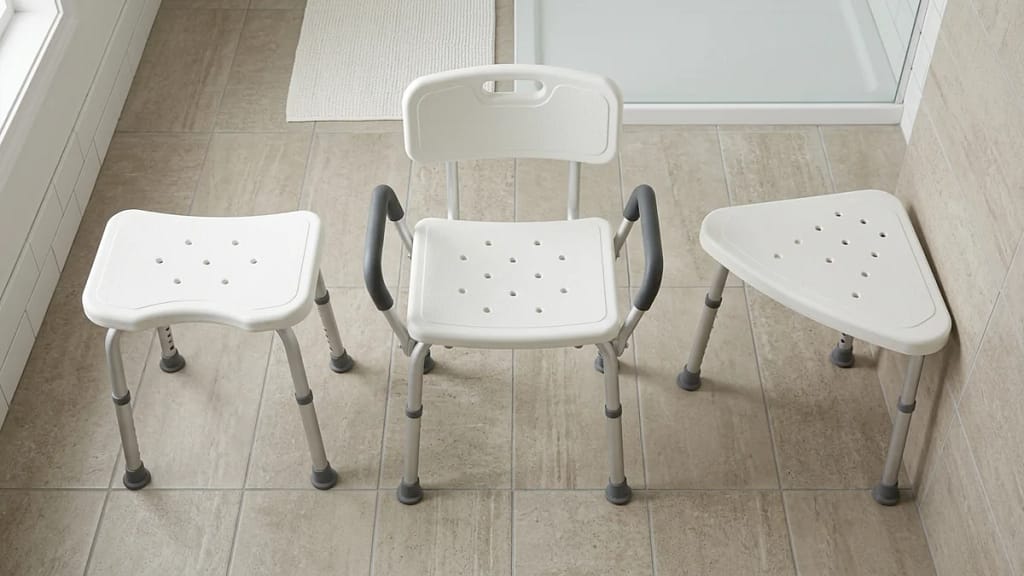
Shower seating comes in a few basic types, and matching the type to the bathroom is the first decision to make:
- Backless stool: the simplest option, works in most stand-alone stalls.
- Backed chair: adds a backrest, sometimes with armrests, for more support during longer showers.
- Corner or triangular design: built for tight or corner-shaped stalls.
- Wall-mounted fold-down seat: a fixed option that folds away when not in use.
A stand-alone shower stall usually works with any of these, while a tub-and-shower combo generally calls for a bath-bench style seat with a full backrest for leaning back safely while seated in the tub — measure the tub’s width before ordering, since fit varies more in a tub than in an open stall. A small or corner-shaped stall favors a triangular or corner-fit design that uses the corner space directly, while a larger stall has more room for a full backed chair with armrests, which adds support at the cost of some floor space.
Weight Capacity, Stability, and Safety Features
A few factors matter more than the label on the box:
- Weight capacity: Rated well above the user’s actual weight, not just barely above it, for a safer margin. See the shower chair weight limit guide for how to read that rating.
- Foot type: Suction feet only grip a smooth floor, while rubber non-slip tips generally work across more floor textures.
- Grab bar pairing: A properly mounted grab bar adds a second point of stability for standing up and sitting down.
Comfort, Grip, and Cost Considerations
A few comfort and cost factors are worth weighing side by side:
- Grip needs: Users with arthritis or a weaker grip may find armrests more useful than a backrest alone, since armrests give the hands something stable to push against during a stand-up transfer.
- Padding: Padded seats, like the option covered above, may help during longer bathing sessions, though they typically cost more than a standard hard-seat design.
Medicare is also part of the cost picture. Medicare Part B may cover a portion of the cost for a shower chair when a doctor documents it as medically necessary durable medical equipment, though coverage details vary and are worth confirming directly with a provider rather than assuming (Banner Health).
Shower Chair vs Transfer Bench: Which Is Safer for You?
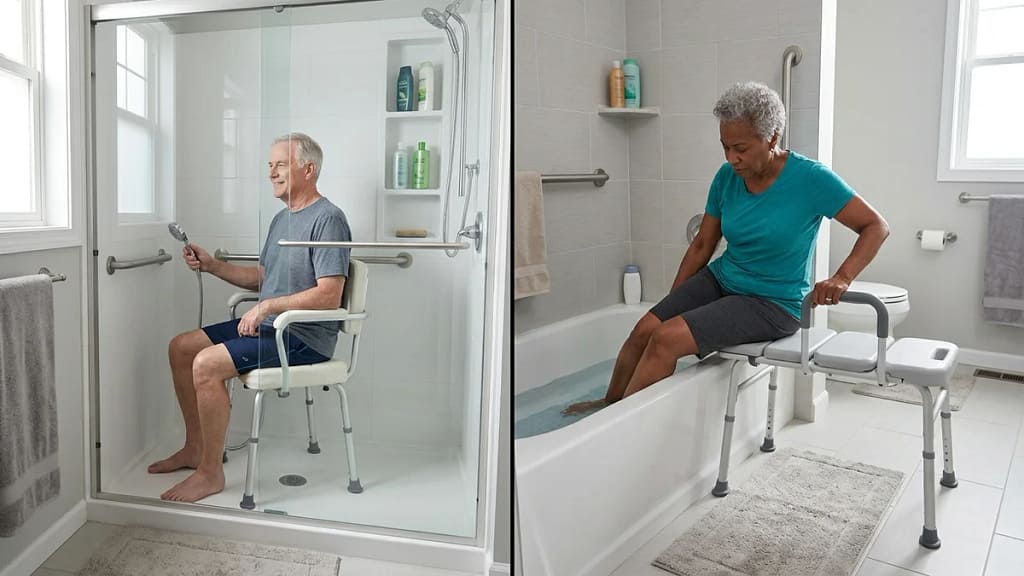
A shower chair and a transfer bench solve related but different problems, and the right choice depends on how the user actually gets in and out of the shower or tub.
- Choose a shower chair when the user can step over a shower threshold or tub wall on their own and mainly needs a stable seat once inside.
- Choose a transfer bench when the user cannot safely lift a leg over a tub wall, since its extended seat lets someone sit down outside the tub first and then slide across without stepping over anything.
Real-life example:
Someone who can still step over a shower threshold independently but tires partway through washing may only need a simple chair for stability once seated. Someone recovering from a hip replacement who cannot yet lift a leg over a tub wall on their own is usually a better match for a transfer bench, since it removes the step-over motion entirely.
A transfer bench also tends to work better when grab bars are not yet installed, since its wider base and extended seat provide more built-in stability on their own. Once grab bars are already in place near the tub or shower entrance, a well-fitted shower chair inside a stand-alone stall is often the simpler option.
Shower chair vs. transfer bench goes deeper into this decision, covering bathroom layout, caregiver support, and stability side by side.
When a Shower Chair Alone May Not Be Enough
A shower chair is designed for someone who can support most of their own weight while transferring, with the chair providing stability rather than doing the lifting. It is not built for every situation, though:
- Non-weight-bearing recovery, such as after certain hip or knee surgeries, generally calls for a transfer bench paired with grab bars rather than a shower chair alone.
- Caregiver-assisted transfers, where someone else is bearing most of the user’s weight, are often better supported with additional equipment such as a bath lift (a battery-powered seat that lowers and raises a person in the tub) or a wider transfer bench alongside the chair.
The right combination usually depends on the specific transfer, not a single product. Reviewing the best grab bars for seniors alongside a shower chair is a reasonable next step for most bathrooms, since the two are frequently used together.
Bathroom Safety Tips for Seniors Using a Shower Chair
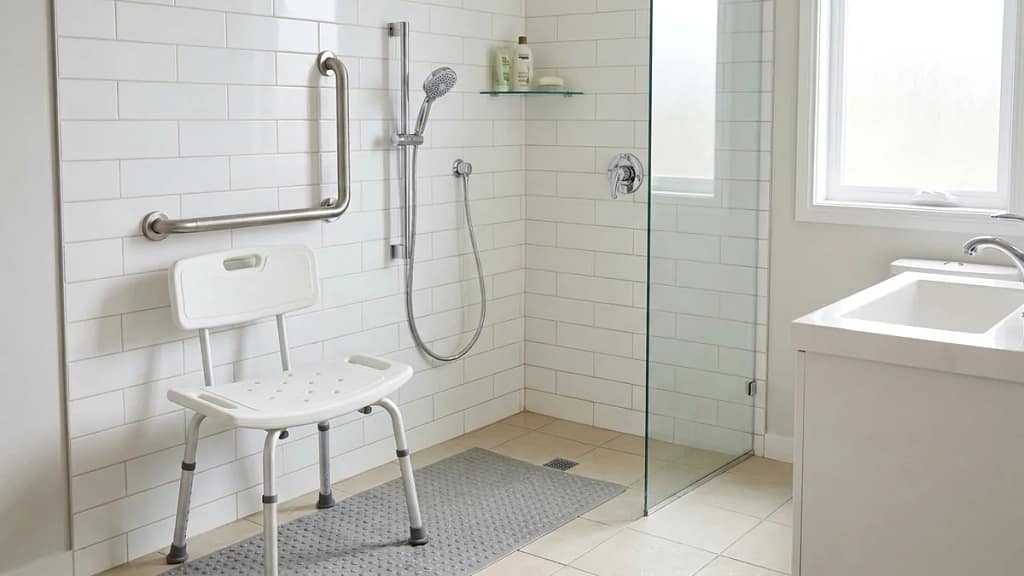
Preventing falls at home starts with addressing the rooms where risk is highest, and the bathroom is consistently one of them (National Institute on Aging). A shower chair is one part of that broader picture, not a stand-alone fix:
- Pair the chair with a securely mounted grab bar positioned where the hand naturally reaches during the sit-to-stand movement. If drilling isn’t an option, a temporary or suction-mounted bar is worth considering, though it needs its own stability check before relying on it.
- Check the chair’s placement before each use so all its feet make full contact with the floor, especially after moving it for cleaning.
- Consider a basic safety belt or strap for a user who leans or shifts significantly while seated.
For a closer look at where a shower chair alone can fall short, see are shower chairs safe for seniors.
Common Shower Chair Buying Mistakes to Avoid
Most shower chair mistakes come from picking a product before confirming three things: how the person actually moves in and out of the shower, what the floor surface is, and how much stall or tub space is available:
- Weight capacity alone: Buying based on weight capacity alone, without checking floor grip or overall stability, is one common mistake.
- Skipping measurements: Skipping bathroom measurements before ordering a full-width chair is another, since a chair that does not fit forces awkward, less stable positioning during use.
- Price alone: Choosing the cheapest listing without reading reviews for fit and durability complaints is a third pattern worth avoiding.
- Floor mismatch: Pairing a chair with a smooth, non-textured shower floor without verifying suction feet actually hold is a mistake that only becomes obvious after a slip.
What I Recommend
I recommend the Medline Shower Chair as the best overall starting point for most households: its listed capacity clears typical adult weight ranges with real margin, it fits a wide range of stall sizes, and the combined arm and back support suits transfers that need more than a bare seat, as long as the larger footprint is checked against a smaller stall first.
Medline Shower Chair
A practical selection process is:
- start with the weight capacity and the actual bathroom footprint, not just the price
- choose armrests or a backrest only when balance or the transfer pattern genuinely calls for them
- match the foot type to the shower floor, since suction feet and non-slip tips are not interchangeable
- measure the stall or tub width before ordering a wider or padded model
- pair the chair with a securely mounted grab bar rather than relying on the chair alone
- consider a transfer bench instead if stepping over the tub wall is the main difficulty
The best choice is not automatically the one with the highest weight rating or the most padding. It should fit the bathroom securely and support the transfer the user actually needs to make.
FAQ
What is a shower chair?
A shower chair is a seat placed inside a shower stall or tub that lets a person sit while bathing instead of standing the entire time. Designs range from a simple backless stool to a chair with a backrest, armrests, or a corner-fitting shape.
Who should use a shower chair?
A shower chair is worth considering for anyone whose balance, stamina, or joint pain makes standing through an entire shower difficult or tiring. It also works well for caregivers assisting a family member, since a seated position is generally easier and safer to help with than a standing one.
Does Medicare cover shower chairs?
Medicare Part B may cover part of the cost when a doctor documents the chair as medically necessary durable medical equipment, though coverage details vary by plan and situation. Checking directly with a provider or Medicare is the most reliable way to confirm coverage for a specific case.
Which shower chair is best overall?
The Medline Shower Chair with Padded Armrests and Back is the best overall pick on this list, based on its combination of arm and back support and its review volume.
What weight capacity should a shower chair have?
A good starting point is a listed capacity well above the user’s actual weight, not just barely above it. Listed capacity should be treated as one part of the decision, since floor grip and frame stability matter just as much in daily use.
How do you use a shower chair safely?
Check that all the chair’s feet make full contact with the floor before each use, especially after moving it. Pairing the chair with a securely mounted grab bar adds a second point of stability during the sit-to-stand movement.
Can you use a shower chair in a bathtub?
Yes, with a bath-bench style seat that has a full backrest — none of the seven picks above are built for tub-and-shower combo use, so measure the tub’s width first. Full details in our shower chair bathtub fit guide.
Why do seniors need a shower chair, what are the safety benefits?
A shower chair cuts down the amount of time spent standing on a wet, slippery surface, which is where most bathroom falls start. It works best paired with non-slip feet, a properly placed grab bar, and a size that actually fits the space.
Final Thoughts
A shower chair that fits well today may not stay the right fit forever. Balance, stamina, and grip strength can change gradually, so it’s worth rechecking the chair against the criteria above (weight capacity, foot grip, and support needs) every year or after any fall, surgery, or new mobility change, rather than treating the first purchase as permanent.
