
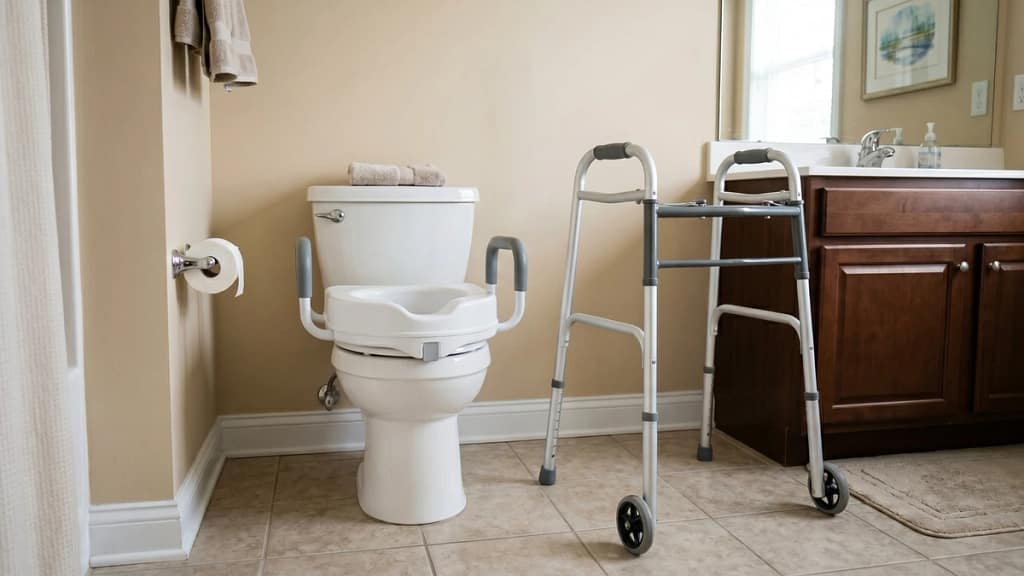
Recovering from surgery can make an ordinary toilet feel much lower and harder to use than it did before. Temporary weakness, movement restrictions, pain, or the use of a walker or crutches can all affect how easily a person sits down and stands back up.
The best raised toilet seats after surgery should provide the amount of height recommended for the user, attach securely to the toilet, and match the level of hand or frame support needed during recovery.
The right choice depends on the procedure, the person’s transfer ability, the existing toilet height, and the instructions provided by the surgeon, physical therapist, occupational therapist, or discharge team. A taller or more supportive-looking seat is not automatically the correct one.
Disclosure: As an Amazon Associate, I earn from qualifying purchases. This post may contain affiliate links. If you purchase through these links, I may earn a small commission at no extra cost to you. I only recommend products I would feel comfortable using in my own home. Learn more.
On This Page
- Which Raised Toilet Seat After Surgery Makes the Most Sense?
- Best Raised Toilet Seats After Surgery: Top Picks
- Why Raised Toilet Seat Choice Changes After Surgery
- Match the Seat to the Recovery Plan
- How to Choose the Best Raised Toilet Seat After Surgery
- Installation, Removal, and Temporary Recovery Use
- When a Raised Toilet Seat May Not Be Enough
- When a Standard Raised Toilet Seat May Be Enough
- Common Mistakes When Choosing a Raised Toilet Seat After Surgery
- What I Recommend
- FAQ
- Final Thoughts
Quick Answer
The best raised toilet seat after surgery is one that provides the recommended height, remains stable during the full transfer, and offers the right type of support without interfering with the user’s movement or mobility aid.
The main things to check are:
- the amount of height recommended for the recovery plan
- secure attachment with no rocking or shifting
- enough support for controlled sitting and standing
- compatibility with the toilet shape and bathroom layout
- space for a walker, crutches, caregiver, or transfer frame
- whether the seat is practical for temporary recovery use
A simple raised seat may be enough when the main difficulty is bending toward a low toilet. Handles or a frame-style setup may make more sense when the person also needs a stable place for the hands during the transfer.
Important recovery note
Do not choose a raised toilet seat by height or product features alone. Use the height and transfer setup recommended by the surgeon, physical therapist, occupational therapist, or discharge team. Instructions can differ between procedures and even between surgical approaches, so general product guidance should not replace the individual recovery plan.
Which Raised Toilet Seat After Surgery Makes the Most Sense?
Compare each pick by its recovery use case, height and support style, main advantage, and most important limitation.
| Product | Best Use Case | Height and Support | Stands Out | Watch-Out | Action |
|---|---|---|---|---|---|
| Our PickBest Overall Lunderg Solva Raised Toilet Seat with Handles |
Balanced height + hand support | 3-in rise; removable handles | Bolt mount; quick-release hinge | 300 lb rated; needs side clearance | Check on Amazon |
| Best High-Capacity Bemis Assurance 3″ Raised Toilet Seat with Handles |
High capacity + hand support | 3-in rise; up to 1,000 lb | Bolt mount; strongest capacity | Higher price; handles fixed in place | Check on Amazon |
| Best Easy-Install KOHLER Hyten 3″ Elevated Toilet Seat |
Added height, no handles needed | 3-inch rise; no handles | Grip-Tight mount; familiar seat design | No hand support; capacity unlisted | Check on Amazon |
| Best Frame-Style HOMLAND Raised Toilet Seat with Handles |
Broader surrounding support | 18.1–23 in adjustable; floor frame | Adjustable height/width; padded arms | Bulkier; more floor clearance needed | Check on Amazon |
Best Overall
Lunderg Solva Raised Toilet Seat with HandlesBalanced height + hand supportCheck on Amazon
Best High-Capacity
Bemis Assurance 3″ Raised Toilet Seat with HandlesHigh capacity + hand supportCheck on Amazon
Best Easy-Install
KOHLER Hyten 3″ Elevated Toilet SeatAdded height, no handles neededCheck on Amazon
Best Frame-Style
HOMLAND Raised Toilet Seat with HandlesBroader surrounding supportCheck on Amazon
Best Raised Toilet Seats After Surgery: Top Picks
These four options address different recovery needs, including balanced height and hand support, higher listed capacity, simpler seat-style installation, and broader frame support.
Best Overall
Lunderg Solva Raised Toilet Seat with Handles
For recovery setups that need both moderate elevation and adaptable hand support, the Lunderg Solva offers the most balanced combination. Its removable handles and secure bolt-mounted design allow the setup to change as recovery progresses without moving directly to a floor-supported frame.
- Moderate 3-inch height increase
- Removable handles provide flexible support
- Quick-release hinge supports easier cleaning
- Approximately 21 inches of space between the handles
- Available in round and elongated versions
The recommended height and transfer method should still come from the individual recovery plan.
Best High-Capacity
Bemis Assurance 3″ Raised Toilet Seat with Handles
The Bemis Assurance stands apart for its unusually high listed capacity and secure bolt-mounted construction. It combines that stronger capacity positioning with a moderate 3-inch rise and integrated handles rather than relying on a taller or floor-supported design.
- Up to 1,000 lb listed support
- Secure bolt attachment
- Approximately 21 inches of space between the arms
- Available in round and elongated versions
- Clean Shield Guard supports easier cleaning around the bowl
A high listed capacity is not a safety guarantee and does not confirm that the seat matches every transfer method.
Best Easy-Install
KOHLER Hyten 3″ Elevated Toilet Seat
When added height is the main need and handles would add unnecessary bulk, the KOHLER Hyten keeps the setup close to a familiar toilet seat. Grip-Tight top-mount hardware and quick-release cleaning access make it the simplest seat-style option in this group.
- Grip-Tight top-mount installation hardware
- Quick-release access supports easier cleaning
- Grip-Tight bumpers help reduce shifting
- Soft-close lid maintains a familiar residential appearance
- Available in round and elongated versions
This option suits situations where added height is enough and the recovery plan does not require hand support.
Best Frame-Style
HOMLAND Raised Toilet Seat with Handles
When a seat-mounted riser does not provide enough surrounding support, the HOMLAND offers a more chair-like, floor-supported alternative. Its adjustable frame and padded arms make it the most substantial transfer-support option in the group.
- 400 lb listed capacity
- Adjustable seat height from approximately 18.1 to 23 inches
- Adjustable width from approximately 19.1 to 23.2 inches
- Non-slip feet provide a floor-supported base
- Support bar adds structure between the four legs
Measure the toilet area, walker path, and caregiver space before choosing a floor-supported frame.
Why Raised Toilet Seat Choice Changes After Surgery
A raised toilet seat used for general aging-in-place support may remain in the bathroom for years. After surgery, the need is often more specific and may be temporary. The seat must support the person’s current recovery stage without creating a new problem with height, foot position, balance, or bathroom clearance.
A post-surgery raised toilet seat may need to account for:
- reduced bending at the hip or knee
- temporary weakness in one or both legs
- slower, more deliberate transfers
- limited weight bearing on one side
- the use of a walker or crutches
- difficulty controlling the lowering movement
- procedure-specific movement precautions
Some people mainly need a higher sitting surface. Others need handles close to the body, a wider frame around the toilet, or help from another person. These are different transfer problems, so they should not all be addressed with the same raised seat design.
Real-life example
A person recovering from knee surgery may be able to sit and stand independently but struggle with the depth of a low toilet. Added height may address the main problem. Another person may have similar difficulty with the toilet height but also need both hands for a controlled push upward. That second situation may require handles or frame-style support rather than height alone.
The raised seat should therefore be selected around the actual transfer movement, not simply around the type of surgery printed on the discharge paperwork.
Match the Seat to the Recovery Plan
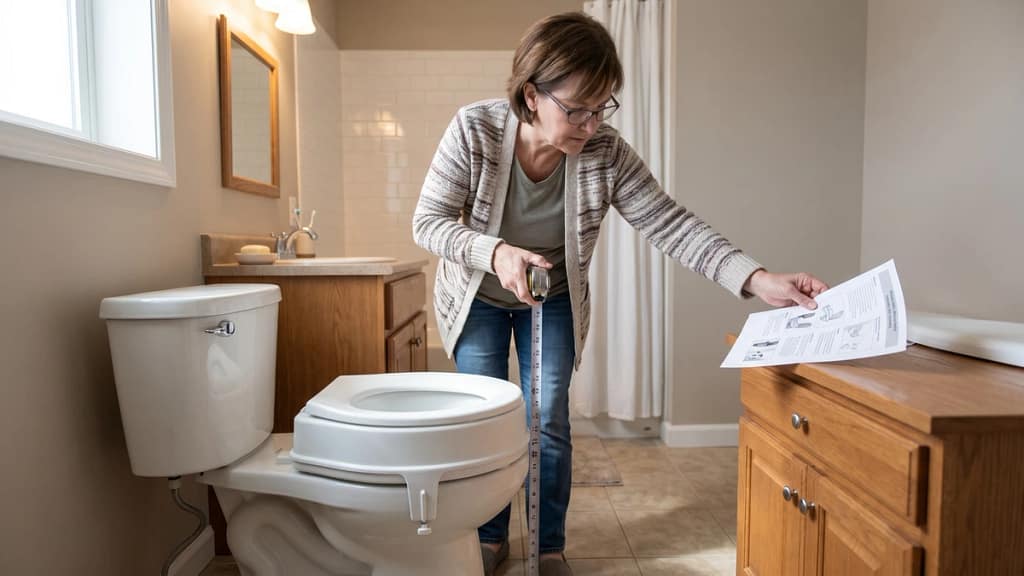
Start with the equipment guidance provided before discharge. A surgeon may establish movement precautions, while a physical or occupational therapist may assess how the person gets on and off the toilet and recommend an appropriate height or support setup.
When Height Is the Main Need
A straightforward raised seat may be suitable when the person can control the transfer but has difficulty reaching a low sitting position. This setup adds height without necessarily adding handles, floor legs, or a wide frame around the toilet.
A no-handle design may also leave more room for a walker and fit more easily beside a wall or vanity. However, it does not provide a place to push from, so it is not automatically suitable for someone who needs hand support.
When Handles May Help
Handles may help when the user needs nearby hand placement while lowering onto the toilet or pushing back to standing. They are most useful when they are reachable without twisting, wide enough for the person’s body position, and supported by a seat that remains stable when pressure is applied.
Seat-mounted handles are generally more compact than a floor-standing frame, but they still require side clearance. A nearby wall, cabinet, toilet-paper holder, or vanity can make one handle difficult to reach or prevent the seat from fitting correctly.
When Frame-Style Support May Make More Sense
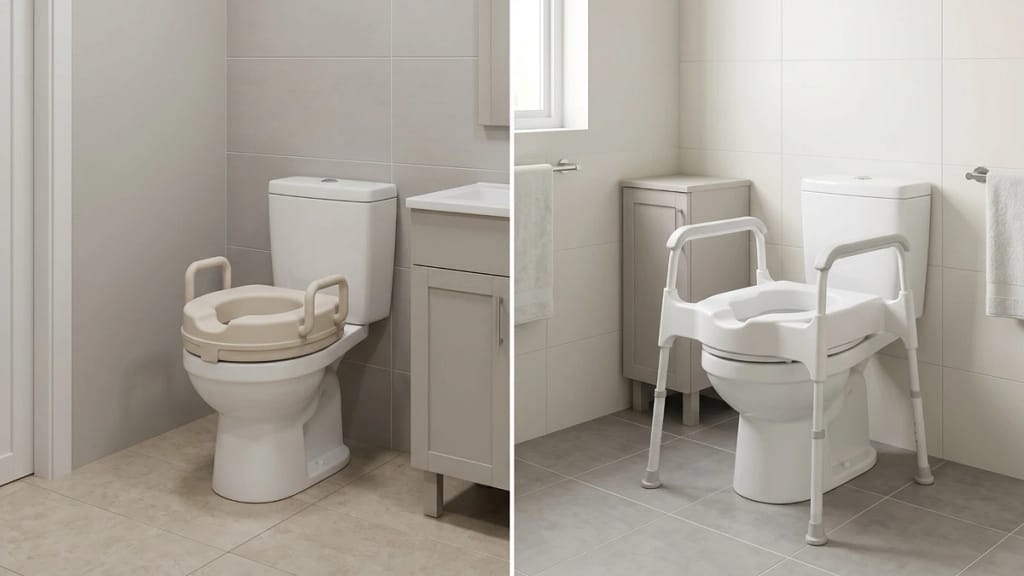
A frame-style raised seat may be more appropriate when the person needs broader support on both sides of the toilet. The armrests are usually part of a wider structure rather than being attached only to the raised seat.
This can provide a more chair-like setup, but it also takes more floor space. The width of the frame, position of the legs, toilet clearance, and path used by a walker or caregiver all need to be checked before choosing this style.
After Hip Surgery
Hip-surgery instructions may include specific limits on low seating, bending, or the position of the knees relative to the hips. These instructions are not identical for every procedure or surgical approach, so a general product height should not replace the height recommended by the care team.
The person may also be taught a particular transfer method, such as extending the operated leg forward while sitting or standing. The raised seat and its handles must leave enough room to use that method correctly.
For a closer look at these procedure-specific considerations, this guide on raised toilet seats after hip surgery explains how height, precautions, and transfer support may affect the setup.
How to Choose the Best Raised Toilet Seat After Surgery
Compare each seat against four practical requirements: the recommended height, the amount of hand support needed, the toilet’s shape and attachment points, and the space required for the full transfer. A product should satisfy all four rather than performing well in only one area.
Start With the Recommended Height
Raised toilet seats commonly add several inches, but more height is not always better. A seat that is too low may require excessive bending, while one that is too high can leave the feet poorly supported or make the person feel as though they are sliding forward.
The appropriate total sitting height depends on the existing toilet, the user’s leg length, the procedure, and the position recommended for recovery. Measure the toilet before assuming that a particular riser height will produce the right result.
This guide on what height raised toilet seat you need explains how toilet height, body position, and transfer comfort affect that decision.
Match the Support to the Transfer Pattern
Watch how the person has been instructed to sit and stand. The support must be positioned where the hands can reach it without leaning, twisting, or pulling on an unstable bathroom fixture.
A simple way to separate the options is:
- No handles: best considered when added height is the main need and the person can transfer without pushing heavily through the arms.
- Seat-mounted handles: useful when nearby hand placement is needed but a full frame would be unnecessarily bulky.
- Frame-style arms: worth considering when the person needs broader support or a more chair-like structure around the toilet.
Handles should not be treated as automatically safer. Their value depends on whether the seat stays secure and whether the user can apply pressure in the intended direction without causing movement.
Check Toilet Shape and Attachment
Toilets may have round or elongated bowls, and raised-seat designs attach in different ways. Some clamp to the bowl, some replace the existing toilet seat, some use the toilet-seat bolt holes, and frame-style models may stand over the toilet without attaching in the same way.
Before ordering, check:
- whether the product matches a round or elongated toilet
- whether the existing toilet seat must be removed
- whether the rim shape allows the attachment to sit flat
- whether a bidet attachment, washlet, or unusual hinge will interfere
- whether the seat remains level after installation
- whether the listed capacity is suitable for the intended user
A raised seat that rocks, tilts, or loosens when the user pushes on it should not be accepted as a good fit.
Measure the Full Bathroom Clearance
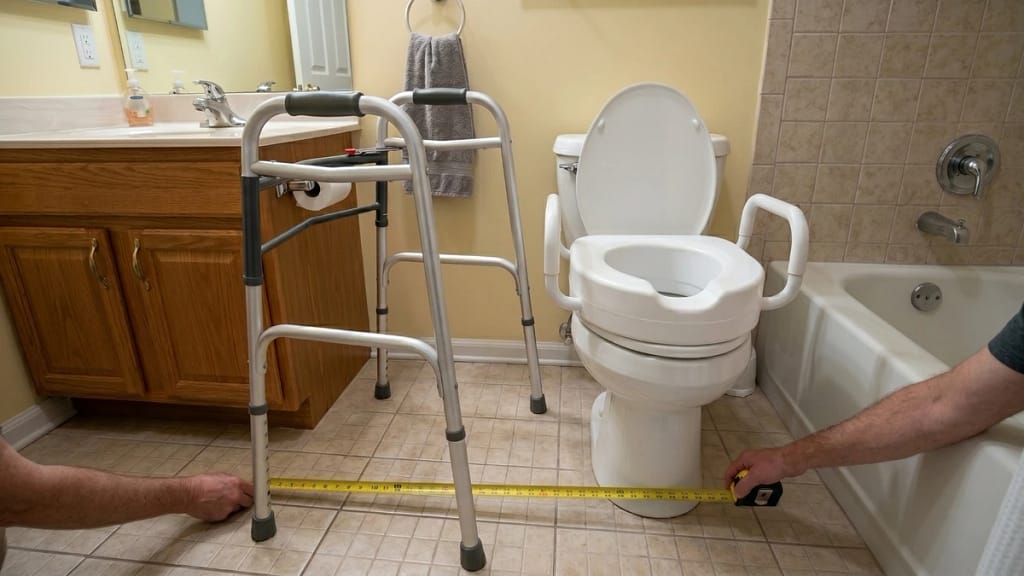
The toilet itself is only one part of the measurement. The transfer area must also accommodate the person, the support equipment, and any mobility aid being used.
Check the available space:
- between the toilet and each side wall
- between the toilet and a vanity or cabinet
- in front of the toilet for foot placement
- for turning or parking a walker
- for a caregiver to assist without becoming trapped beside the toilet
- around any floor legs used by a frame-style model
Handles that technically fit beside the bowl may still crowd the user’s hips or block the movement needed to approach the toilet.
Consider Cleaning and Shared Use
Some raised seats remain installed throughout recovery, while others are removed for cleaning or when another household member uses the bathroom. Hinges, clamps, handles, and frame legs can all create additional surfaces that need regular cleaning.
In a shared bathroom, consider whether the equipment leaves the toilet comfortable for other users and whether frequent removal would weaken the attachment or make correct reinstallation less likely.
Prioritize the Care Plan Over Extra Features
Features such as padding, adjustable arms, extra height, or a high listed capacity may be useful, but they do not make a product appropriate by themselves. The seat must still support the transfer method prescribed for the individual recovery.
The broader guide on how to choose a raised toilet seat explains how height, fit, stability, support, and bathroom space should be considered together.
Installation, Removal, and Temporary Recovery Use
Post-surgery equipment is often installed before the person returns home and removed after it is no longer needed. That makes both parts of the process important. The seat must be practical to install securely at the beginning, and it must also be realistic to remove later for cleaning, shared bathroom use, or the end of the recovery period.
These are related but separate questions. A seat can be easy to install yet inconvenient to remove, while another may lift away quickly but require careful repositioning each time it is put back.
Decide Who Will Install the Seat
The person recovering from surgery may be restricted from bending, kneeling, lifting, or working around the base of the toilet. Even when the product is advertised as simple to install, a family member, caregiver, or other helper may need to complete the setup before it is used.
Tool-free installation can reduce the number of parts and steps involved, but it does not remove the need to check the fit. Clamps, adjustment knobs, locking mechanisms, and frame legs still need to be positioned correctly and retested after the first few uses.
For a closer look at the setup differences, this guide explains whether a raised toilet seat can be used without tools and what tool-free installation does, and does not, mean for stability.
Plan for Removal Before Choosing the Attachment
Removal matters when the bathroom is shared, when the seat needs frequent cleaning, or when it is intended only for a limited recovery period. A clamp-on riser may remove differently from a hinged replacement seat, a bolt-mounted model, or a frame that stands over the toilet.
Frequent removal is only practical when the product can be returned to the correct position and checked each time. A seat should not be assumed secure simply because it was fitted properly during the previous use.
This guide on whether raised toilet seats can be removed easily compares the practical differences between removable risers, attached seats, and frame-style options.
Whichever design is used, the seat should be checked after installation, after removal and reinstallation, and whenever the user notices new movement, noise, tilting, or looseness.
When a Raised Toilet Seat May Not Be Enough
A raised toilet seat addresses the height of the sitting surface. It does not automatically solve balance problems, severe weakness, uncontrolled lowering, or the need for substantial assistance during transfers.
A different or more supportive setup may be needed when:
- the person cannot lower onto the seat in a controlled way
- the person pulls or leans heavily on seat-mounted handles
- the raised seat moves despite correct installation
- one-sided weakness makes the transfer uneven
- a walker cannot be positioned close enough to the toilet
- the user needs physical help from a caregiver
- the care team has recommended a commode or toilet frame instead
Possible alternatives include a toilet safety frame, a combined raised seat and frame, an over-toilet commode, or a bedside commode. The better option depends on whether the main problem is height, hand support, balance, access to the bathroom, or the transfer itself.
When added height is not enough
If added height allows the person to complete the taught transfer safely and consistently, a raised seat may address the main problem. If the person still needs heavy pulling, hands-on help, or significant balance support, the care team should reassess the equipment rather than simply adding more height.
When a Standard Raised Toilet Seat May Be Enough
A standard raised toilet seat may be enough when the care plan calls mainly for temporary added height and the person can complete the transfer without substantial hand support, a surrounding frame, or caregiver assistance.
A broader option may also provide:
- a less bulky fit in a small bathroom
- a more normal toilet-seat appearance
- easier cleaning in a shared bathroom
- a lower height increase when a tall riser is unnecessary
- better compatibility with a round or elongated toilet
The fact that the seat is being used after surgery does not automatically mean the largest or most medical-looking option is better. The product still needs to match the user’s actual support requirement and the guidance given by the care team.
For readers who do not need a surgery-specific support setup, this guide to the best raised toilet seats for seniors compares broader options by height, support, fit, and everyday usability.
Broader comparisons are most useful after the required height and transfer method have already been established.
Common Mistakes When Choosing a Raised Toilet Seat After Surgery
Post-surgery equipment should make the recommended transfer easier without introducing a new fit or stability problem. Several common mistakes can prevent that.
- Choosing height without checking the recovery instructions
A taller seat may reduce bending, but it can also create poor foot contact or an unsuitable sitting position. - Assuming handles are always better
Handles take up space and only help when the user can reach them properly and the seat remains stable under pressure. - Ignoring the existing toilet height
The final sitting height includes both the toilet and the riser. The same product can feel very different on two toilets. - Ordering before checking toilet shape
A round or elongated mismatch can prevent the seat from sitting flat or attaching correctly. - Installing the equipment after the person returns home
The seat is more useful when it is ready, fitted, and checked before the first bathroom transfer at home. - Using nearby furniture as transfer support
Towel bars, toilet-paper holders, counters, and movable furniture should not be assumed to provide safe hand support. - Choosing by features instead of the transfer problem
The main need may be height, handles, frame support, caregiver access, or a different toileting setup entirely. - Stopping use according to a general timeline
The equipment should be discontinued according to individual recovery guidance rather than an arbitrary number of days or weeks.
The best choice is the one that supports the person’s current recovery needs and can be used consistently without rocking, crowding, or encouraging an incorrect transfer method.
What I Recommend
For many post-surgery recovery setups, the Lunderg Solva Raised Toilet Seat with Handles is the best overall starting point. Its 3-inch rise provides moderate elevation, the bolt-mounted design offers a secure seat-style setup, and the removable handles allow the level of hand support to change as recovery progresses.
Lunderg Solva Raised Toilet Seat with Handles
A practical selection process is:
- start with the toilet height and transfer position recommended by the care team
- choose a seat with handles only when nearby hand support is genuinely needed
- confirm whether the toilet requires a round or elongated version
- check the listed capacity and available space between the handles
- measure side clearance for walls, cabinets, and mobility equipment
- consider a floor-supported frame when a seat-mounted option does not provide enough surrounding support
- make sure the attachment can be checked easily during temporary recovery use
The best choice is not automatically the tallest or most supportive-looking model. It should match the recommended height, fit the toilet securely, and support the transfer method the person has been taught.
FAQ
How high should a raised toilet seat be after surgery?
There is no single correct height for every person. The appropriate height depends on the existing toilet, body dimensions, procedure, movement precautions, and guidance from the surgical or rehabilitation team.
Are handles helpful after surgery?
Handles can help when the user needs nearby hand support during sitting and standing. They must be reachable, stable, and suitable for the person’s transfer method.
Do raised toilet seats fit every toilet?
No. Toilet shape, rim design, attachment method, existing hinges, bidet equipment, and bathroom clearance can all affect compatibility.
Can a raised toilet seat be installed before surgery?
Yes. When a raised seat has been recommended, installing and checking it before the person returns home can prevent the first bathroom transfer from becoming an equipment setup test.
How long is a raised toilet seat needed after surgery?
The duration varies according to the operation, recovery progress, movement precautions, and individual guidance. The surgeon or rehabilitation professional should advise when returning to the regular toilet height is appropriate.
When is a toilet safety frame better than a raised toilet seat?
A frame may be more appropriate when the person needs broader side support, stronger hand placement, or a more chair-like structure than a basic raised seat can provide.
Can a raised toilet seat be removed when recovery is complete?
Most designs can be removed, but the process differs between clamp-on risers, bolt-mounted seats, replacement seats, and frame-style models. Follow the product instructions and the care team’s guidance before returning to the regular toilet height.
Final Thoughts
The best raised toilet seats after surgery should make the bathroom transfer more manageable while respecting the height, movement, and support guidance provided for the individual recovery.
Start with the recommended sitting position, then check the toilet shape, attachment method, transfer space, and level of hand support. A simple raised seat may be enough for one person, while another may need handles, a frame, or a different toileting setup.
The final test is not how many features the product has. It is whether the complete setup feels secure, supports the taught transfer method, and remains practical throughout recovery.
