
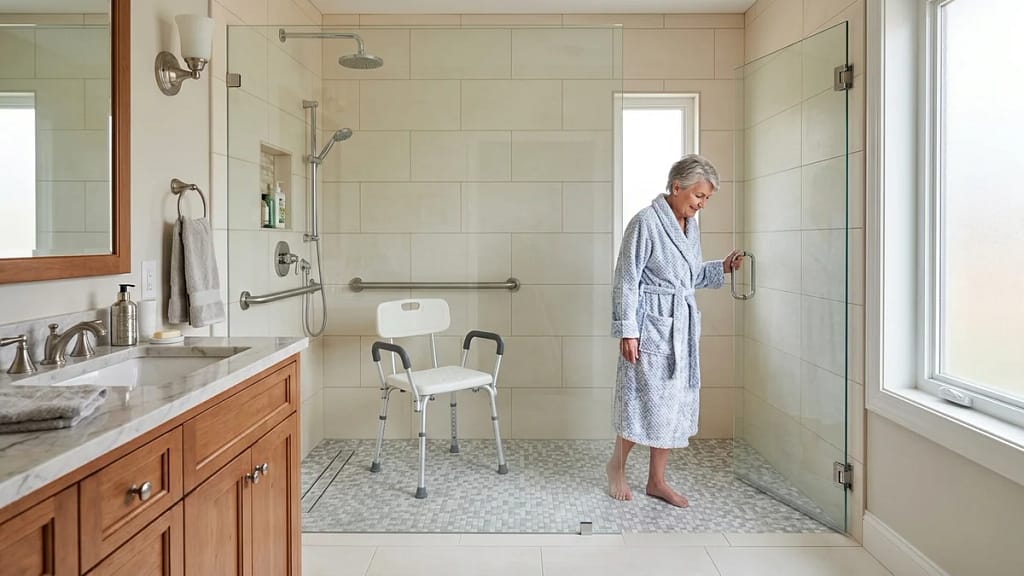
How to choose a shower chair for elderly use isn’t about finding the highest-rated model online. It’s about matching a chair’s support level, size, and stability to how the user actually moves in the bathroom. More than one out of four older adults falls each year, and bathrooms remain one of the most common places it happens, according to the CDC. A shower chair can reduce that risk, but only when it’s chosen to fit the user’s actual balance, strength, and bathroom layout, not just their general age.
The right chair for one person can be the wrong chair for another, even if both are shopping for a parent of a similar age. What matters is the specific movement the chair needs to support: standing up unassisted, crossing a tub wall, or simply having somewhere stable to sit while bathing.
Disclosure: As an Amazon Associate, I earn from qualifying purchases. This post may contain affiliate links. If you purchase through these links, I may earn a small commission at no extra cost to you. I only recommend products I would feel comfortable using in my own home. Learn more.
On This Page
- Types of Shower Seating: Chair, Stool, or Transfer Bench?
- Arms and a Backrest: When You Need Them (and When You Don’t)
- Seat Width, Height, and Weight Capacity: Getting the Fit Right
- Non-Slip Feet and Stability: What to Check Before You Buy
- Bathtub vs. Walk-In Shower: Making Sure It Actually Fits
- Common Mistakes When Choosing a Shower Chair for an Elderly Parent
- What I Recommend
- FAQ
- Final Thoughts
Quick Answer
The right shower chair for elderly use is the one that matches the user’s actual support needs, fits the tub or shower safely, and holds their weight with a real margin to spare, usually a model with arms and a backrest for anyone who needs help sitting or standing, plus a wide, non-slip base for anyone whose balance is inconsistent.
- Support level matters more than style. Arms and a backrest reduce strain during the sit-to-stand transfer, which is when most bathroom falls happen.
- Weight capacity needs real margin. The listed capacity should clear the user’s actual weight by a comfortable margin, not just meet it.
- The base matters as much as the seat. A wide, non-slip footprint often prevents more slips than the seat material itself.
- Bathroom fit comes before features. The chair needs to fit the tub or shower’s actual width and door swing, not just look compact in photos.
These factors interact with each other. A chair with arms and a backrest is only as safe as its base is stable, and a wide base is only useful if it actually fits the tub or shower stall it’s going into.
The sections below walk through each factor individually, plus when a stool or transfer bench makes more sense than a standard shower chair.
Types of Shower Seating: Chair, Stool, or Transfer Bench?

Shower seating for elderly use falls into three basic categories, and the right one depends on how the user moves, not just their age.
A shower chair has a full seat, typically with a backrest and often with arms, and sits entirely inside the shower or tub. A shower stool is a smaller, backless option, usually chosen when the user can balance without back support but still needs to sit rather than stand.
A transfer bench extends over the tub wall, so the user can sit down outside the tub and slide across, rather than stepping over the wall while standing.
The decision usually comes down to one question: can the user step over the tub wall safely while standing, or does that movement need to happen while seated? If stepping over the wall is the risky part, a transfer bench addresses that directly. If the user can get into the shower or tub safely but needs support once seated, a shower chair or stool is usually enough.
Quick Comparison of Shower Seating Types
← Swipe to see more →
| Feature | Shower Chair | Shower Stool | Transfer Bench |
|---|---|---|---|
| Support level | Full seat, often arms + backrest | Seat only, no backrest | Full seat, arms optional, spans the tub wall |
| Best-fit bathroom | Walk-in showers, tubs with an easy step-over | Walk-in showers, users with reliable balance | Bathtubs where stepping over the wall is the main risk |
| Typical use case | General mobility support, post-surgery recovery | Fatigue or balance concerns without a fall history | Limited hip or knee mobility, higher fall risk crossing the tub wall |
A closer side-by-side on shower chairs specifically versus transfer benches is worth reading once the basic category is clear, since the trade-offs between the two go beyond what fits in a single table.
Arms and a Backrest: When You Need Them (and When You Don’t)

Arms and a backrest add real support during the sit-to-stand transfer, which is when most bathroom falls happen (not while someone is already seated and stationary). Occupational therapist Mayra Mendez-Schiaffino of Banner Home Care & Hospice recommends chairs with a back and armrests specifically because they provide more control while sitting down and standing back up.
Arms are not automatically necessary for every user. Someone with reliable balance and enough leg strength to sit and stand without pushing off may do fine with a backless stool. However, once sitting or standing starts to feel effortful, or the user tends to reach for a wall or towel bar for support, that’s usually a signal that arms and a backrest belong in the decision, not just a nice-to-have.
- Needs help pushing up to stand → arms are worth prioritizing.
- Tires or leans back mid-shower → a backrest matters more than extra padding.
- Balances well and just wants a seated option → a stool may be enough.
- Recovering from surgery or a recent fall → both arms and a backrest are usually the safer starting point.
A swivel or rotating seat can also help during the transfer itself, letting the user turn to face the tub wall before standing rather than twisting from a fixed seated position. That feature matters most for anyone whose hips or knees make twisting uncomfortable.
Seat Width, Height, and Weight Capacity: Getting the Fit Right
Seat width, height, and weight capacity are the three measurements that determine whether a shower chair actually works for its user, and they should be checked before any feature comparison. The U.S. Access Board’s accessibility guidelines for shower seating call for a seat height of 17 to 19 inches and a depth of 15 to 16 inches, along with a structural capacity of at least 250 pounds at any point on the seat, a useful baseline even for a chair used at home rather than in a commercial setting.
Listed weight capacity should be treated as a baseline, not a guarantee margin. A chair rated for exactly the user’s weight is a narrower fit than one rated well above it, since normal movement (shifting weight, leaning to reach a washcloth) adds load beyond someone’s static weight.
- Seat height: should let feet rest flat on the shower or tub floor, not dangle or force the knees too high.
- Seat width: should comfortably clear the user’s hips with a little room to spare, especially for anyone who shifts position while bathing.
- Weight capacity: choose a rated capacity meaningfully above the user’s actual weight, not the closest match. See our guide to shower chair weight limit for how manufacturers set these numbers.
- Adjustability: height-adjustable legs are worth prioritizing when more than one person might use the same chair.
The exact height math and how to measure for a non-adjustable model are worth covering in more depth separately, along with sizing guidance for a specific bathroom. As a general rule, if a chair looks borderline on any of these three measurements in a product listing, it’s worth measuring the actual person and bathroom before ordering rather than assuming an average size will work.
Non-Slip Feet and Stability: What to Check Before You Buy
A shower chair’s base does as much safety work as its seat, but it gets far less attention in most buying guides. Rubber or non-slip feet reduce sliding on wet tile or a smooth tub floor, but “non-slip” on a product listing is a description, not a test result. It’s still worth checking stability in person or in early use rather than assuming it from the label.
Important note
Test a new shower chair’s stability by sitting down and standing up on it, in the actual shower or tub, before relying on it for daily use, especially on textured tile, a curved tub floor, or with a bath mat underneath that could shift the base.
Signs of a sturdy base worth checking before buying:
- A wide stance across four evenly weighted legs, rather than a narrow footprint.
- Rubber tips built into the leg itself, not glued-on caps that can loosen over time.
- Feet designed to grip textured tile and curved tub floors, not just flat, dry surfaces.
- Suction-cup feet reserved for flat, non-textured surfaces; they’re less reliable elsewhere.
Shower seating is only one part of bathroom stability. Pairing a stable chair with properly placed grab bars for bathroom safety addresses the transfer movement a chair alone can’t. Reaching for support while standing up is a different motion than sitting down, and it usually needs a fixed, wall-mounted point of contact rather than the chair itself.
Bathtub vs. Walk-In Shower: Making Sure It Actually Fits
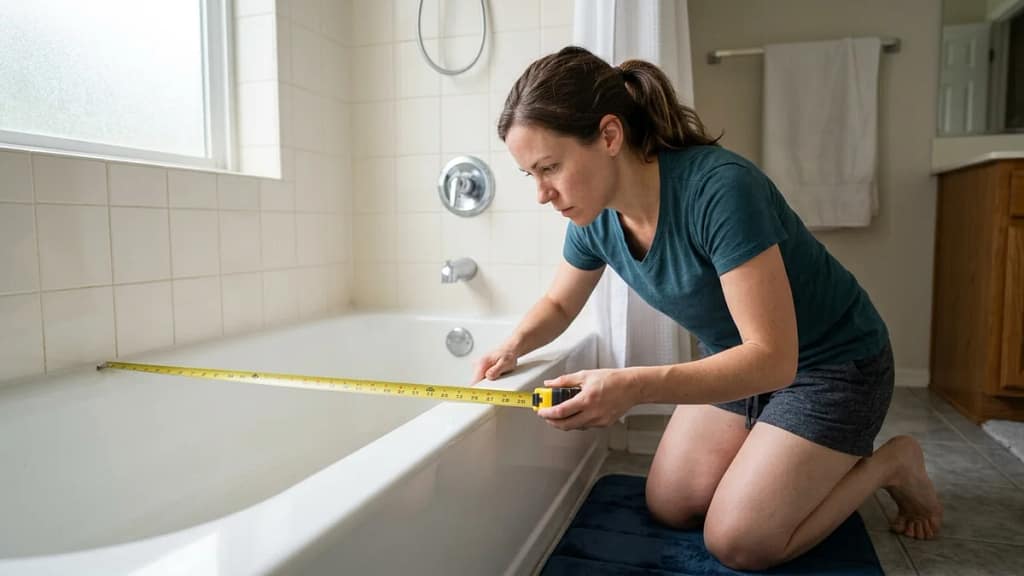
A shower chair that fits a walk-in shower doesn’t necessarily fit a bathtub, and the difference comes down to floor shape and available width, not just overall size. There’s a whole set of bathtub compatibility questions worth covering on their own. A bathtub floor is narrower and often curved, while a walk-in shower usually offers a flatter, wider footprint. Measuring the actual space before ordering matters more than checking a product’s general size category.
- Measure the tub or shower floor’s usable width, not the outer edge of the tub or enclosure.
- Check the chair’s leg spread against that measurement, including a small safety margin on each side.
- Account for any curve in the tub floor, since a curved surface can reduce the chair’s effective footprint compared to a flat shower floor.
- Confirm door swing and shower curtain clearance don’t interfere with getting in and out once the chair is in place.
Real-life example
A caregiver ordered a wide, heavy-duty shower chair for her father’s bathtub without measuring the tub floor first. The chair’s legs were too wide for the tub’s curved base, and two of the four feet ended up resting on the sloped sides instead of flat on the bottom, creating exactly the instability she was trying to prevent. Measuring the tub floor before ordering would have caught the mismatch.
A full measuring walkthrough, including how to handle a curved tub floor, is available separately for anyone setting this up for the first time, covered in how to measure for a shower chair. In the meantime, a tape measure and five minutes in the bathroom will catch most fit problems before they become a return shipment.
Common Mistakes When Choosing a Shower Chair for an Elderly Parent
The same handful of oversights account for most shower chair returns and near-misses:
- Ordering before measuring the tub or shower floor, then discovering the chair’s base doesn’t fit.
- Matching weight capacity to the user’s current weight exactly, instead of leaving a real margin.
- Choosing a backless stool when the actual problem is standing back up, not just sitting down.
- Assuming “non-slip” feet remove the need to test stability in the actual bathroom.
- Overlooking door swing and shower curtain clearance until the chair is already in place.
- Buying the same chair a friend or relative used without checking whether the bathroom layout is actually similar.
Most of these mistakes share a root cause: choosing based on the product listing instead of the specific person and bathroom. Working through the checks above in order (support needs, weight capacity, base stability, and bathroom fit) catches nearly all of them before a purchase is made.
What I Recommend
I recommend starting with the arms-and-backrest question and the weight-capacity check before comparing specific chairs, since those two factors rule out more options than style or price ever will. Once those are settled, fit the chair to the actual tub or shower floor rather than to a general size category.
A practical selection process is:
- decide between a shower chair and a transfer bench based on how the user enters the shower or crosses the tub wall, not personal preference alone
- confirm whether the user needs arms and a backrest, or can manage with a stool
- rule out any chair whose listed weight capacity doesn’t clear the user’s weight with real margin
- check for a wide, evenly weighted base rather than assuming non-slip feet are enough on their own
- measure the tub or shower floor before comparing specific models
The most expensive or highest-rated chair isn’t automatically the right one. The one exception worth naming: if stepping over the tub wall while standing is the harder movement, a transfer bench is usually worth choosing over a chair, even if the checklist above still leans toward a standard shower chair on paper. For a full roundup of specific models weighed against these criteria, see our picks for the best shower chairs for seniors.
FAQ
What weight capacities do shower chairs support?
Most shower chairs list a weight capacity between 300 and 400 pounds, with heavy-duty or bariatric models rated higher. Treat the listed number as a starting point and choose a capacity that clears the user’s actual weight with a comfortable margin, not the closest match.
What is the difference between a shower chair and a transfer bench?
A shower chair sits entirely inside the shower or tub and requires stepping over the tub wall while standing. A transfer bench extends over the tub wall, so the user can sit down outside the tub and slide across without stepping over it while upright.
Is a shower chair or a shower stool better for seniors?
It depends on whether the user needs back support. A shower stool works well for someone with reliable balance who just wants to sit rather than stand. A shower chair’s backrest, and often its arms, is usually the safer choice for anyone who tires, leans back, or needs help with the sit-to-stand transfer.
Do shower chairs need arms and a backrest, or are those optional?
They’re not required for every user, but they matter most for anyone who needs help pushing up to stand or who leans back while seated. Someone with strong balance and leg strength may be fine with a backless stool instead.
What size shower chair do I need for an elderly parent?
Seat width should clear the hips with a little room to spare, and seat height should let the feet rest flat on the floor without dangling or forcing the knees up. The exact measurements depend on the user and the specific tub or shower, which is worth confirming before ordering rather than relying on a general size chart.
Does Medicare cover shower chairs?
Coverage depends on the specific plan and whether a doctor documents medical necessity. Standard Medicare Part B doesn’t automatically cover most shower chairs as durable medical equipment. The coverage rules and how to check eligibility are covered in more detail separately.
Final Thoughts
How to choose a shower chair for elderly use isn’t a one-time decision. A chair that fits well today may need a second look if the user’s balance, strength, or living situation changes, so it’s worth revisiting the choice occasionally rather than assuming one purchase settles it for good.
