
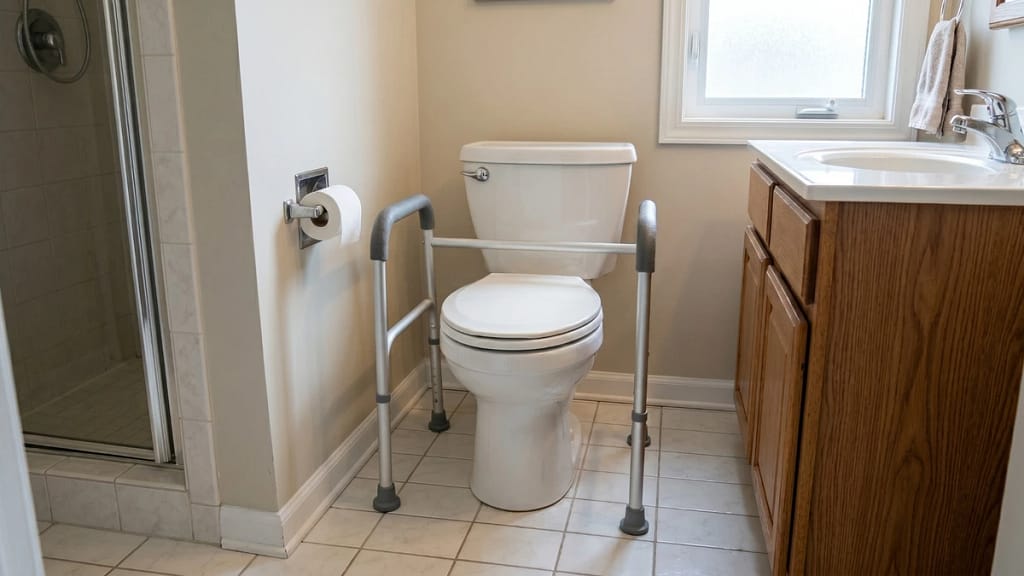
Small bathrooms can make toilet support difficult. A toilet safety frame may help with sitting and standing, but many frames are too wide, too bulky, or difficult to position around a tight toilet area.
The best toilet safety frames for small bathrooms should provide stable support without blocking the transfer path. The right choice depends on bathroom width, toilet placement, handle position, frame stability, and whether the frame needs to stay in place or move between uses.
This guide explains what to look for before choosing a small-bathroom toilet safety frame and compares compact options based on support, clearance, stability, and everyday usability.
Disclosure: As an Amazon Associate, I earn from qualifying purchases. This post may contain affiliate links. If you purchase through these links, I may earn a small commission at no extra cost to you. I only recommend products I would feel comfortable using in my own home. Learn more.
On This Page
- Quick Answer: Best Toilet Safety Frames for Small Bathrooms
- Which Toilet Safety Frame Makes the Most Sense for a Small Bathroom?
- Best Toilet Safety Frames for Small Bathrooms: Top Picks
- Why Small Bathrooms Make Toilet Safety Frame Choice Harder
- What to Measure Before Choosing a Small-Bathroom Frame
- How to Choose a Toilet Safety Frame for a Tight Layout
- Folding Frames vs Fixed Frames in Small Bathrooms
- Toilet Safety Frame vs Raised Toilet Seat in a Small Bathroom
- When a Raised Toilet Seat May Be a Better Small-Bathroom Option
- When Grab Bars May Work Better Than a Toilet Safety Frame
- Common Mistakes When Choosing a Small-Bathroom Toilet Safety Frame
- What I Recommend
- Final Thoughts
- FAQ
Quick Answer: Best Toilet Safety Frames for Small Bathrooms
The best toilet safety frames for small bathrooms are compact, stable, and narrow enough to fit around the toilet without blocking the user’s sitting and standing movement. A good frame should provide reachable hand support while leaving enough side and front clearance for safe daily use.
- Compact frames often work better than wide support frames in tight layouts
- Folding frames may help in shared or space-limited bathrooms
- Stability matters more than choosing the narrowest possible frame
- Handle spacing should match the user’s transfer pattern
- Some bathrooms may work better with grab bars or a raised toilet seat instead
A small-bathroom frame should not simply be smaller. It should still feel steady when the user pushes down on the handles, shifts weight, or stands up from the toilet.
The right choice depends on both the bathroom and the user. A frame that fits the space but feels weak is not a good solution, and a strong frame that crowds the toilet area may create a new problem.
Which Toilet Safety Frame Makes the Most Sense for a Small Bathroom?
This table compares the top options based on support level, ideal use case, and the trade-offs that matter most in real use.
| Product | Best Use Case | Support Level | Why It Stands Out | Watch-Out | Action |
|---|---|---|---|---|---|
| PELEGON Toilet Safety Rail | Best overall for small bathrooms | Higher | Adjustable fit with 350 lb listed capacity | Not the most compact or folding-focused choice | Check on Amazon |
| Carex Toilet Safety Frame | Best narrow frame | Moderate | 18"–20" adjustable width for tight layouts | Bolt-mounted setup; check toilet compatibility | Check on Amazon |
| Lianjindun Toilet Safety Rail | Best folding option | Moderate | Foldable, adjustable, and easier to move or store | Still takes floor space while open | Check on Amazon |
| Vive Toilet Safety Rail | Best for shared bathrooms | Moderate | Lower-profile support with no floor-leg footprint | May not suit unusual toilets or bidet-style setups | Check on Amazon |
| Medline Toilet Safety Rail | Best adjustable support | Light to moderate | Adjustable height and width with folding storage | 250 lb listed capacity; not for heavier support needs | Check on Amazon |
Best Toilet Safety Frames for Small Bathrooms: Top Picks
These toilet safety frames were selected for small-bathroom situations where support, clearance, handle position, and daily usability all matter.
BEST OVERALL
PELEGON Toilet Safety Rail
The PELEGON Toilet Safety Rail is the best overall pick for small bathrooms that still have enough room for a full support frame. It offers a strong balance of adjustability, support, and daily-use practicality, but it is not the most compact or folding-focused choice.
Best for: Small bathrooms where reliable side support matters and there is still enough clearance for a full frame.
Watch-outs: This is not clearly a folding frame, so it may not be ideal when storage between uses is the main priority.
Why it stands out:
- Adjustable height and width help match different toilets and users
- 350 lb listed capacity gives stronger reassurance than many lighter options
- Lightweight aluminum build may be easier to position than heavier frames
- Tool-free assembly is practical for seniors and caregivers
Measure side clearance before choosing any full-frame design for a small bathroom.
BEST NARROW FRAME
Carex Toilet Safety Frame
The Carex Toilet Safety Frame is a strong fit for narrow layouts where a standard freestanding frame may feel too wide. Its adjustable 18″ to 20″ mounting width makes it especially relevant when side clearance is limited, and it bolts directly to the toilet instead of relying on floor legs.
Best for: Users who need two-sided toilet support but have limited side clearance around the toilet.
Watch-outs: Secure bolt-mounting and toilet compatibility matter, since this style is toilet-mounted rather than fully freestanding.
Why it stands out:
- Adjustable width fits tighter toilet areas than most freestanding frames
- Bolts directly to the toilet, keeping the floor footprint minimal
- Cushioned Hypalon hand grips add comfort during transfers
- Established Carex brand with a strong marketplace track record
Check toilet compatibility and side clearance before relying on this style for daily support.
BEST FOLDING OPTION
Lianjindun Toilet Safety Rail
The Lianjindun Toilet Safety Rail is the best folding option for small bathrooms where space flexibility matters. Its foldable design, adjustable height and width, and 300 lb listed capacity make it a practical choice when the frame may need to be moved, folded, or stored between uses.
Best for: Small or shared bathrooms where a full-time frame may feel too intrusive.
Watch-outs: It still takes up floor space while open, so it should not be treated as the smallest option for every tight layout.
Why it stands out:
- Foldable design helps reduce bulk when the frame is not in use
- Adjustable height and width improve fit across different setups
- Padded handles and rubber feet support comfort and stability
- Strong marketplace validation compared with similar folding options
A folding frame should still be tested while fully open before regular use.
BEST FOR SHARED BATHROOMS
Vive Toilet Safety Rail
The Vive Toilet Safety Rail is a lower-profile option for shared bathrooms because it adds toilet-side hand support without floor legs around the toilet. It works best when users want support without making the bathroom feel dominated by a full freestanding frame.
- Compact side-rail structure keeps the floor area more open
- Padded handles support comfort during sitting and standing
- Practical middle ground between a full frame and no support
Best for: Shared bathrooms where floor space needs to stay open and a bulky freestanding frame would feel intrusive.
BEST ADJUSTABLE SUPPORT
Medline Toilet Safety Rail
The Medline Toilet Safety Rail is the best budget-friendly pick for users who want simple support without paying more for premium features. It is best positioned for light-to-moderate support needs rather than heavier daily support.
- Budget-friendly option with strong review volume
- Simple, easy-to-understand support frame design
- Adjustable height and width for basic fit flexibility
Best for: Budget-conscious users who need simple light-to-moderate toilet support in a smaller bathroom.
After comparing products, the next step is checking whether the frame style fits the actual bathroom space and transfer movement. In small bathrooms, the best-looking product can still be the wrong choice if it crowds the toilet area.
Why Small Bathrooms Make Toilet Safety Frame Choice Harder
Small bathrooms make toilet safety frame selection harder because the frame has to support the user without taking over the limited space around the toilet. A frame can look practical online but feel too wide once placed next to a wall, vanity, cabinet, or narrow doorway.
Common small-bathroom issues include:
- limited side clearance
- narrow space between the toilet and vanity
- little room in front of the toilet
- awkward handle placement
- difficulty cleaning around the frame
- shared access for other bathroom users
For example, a frame with wide arms may provide good support but still make the toilet area harder to enter or exit. If one handle sits too close to a cabinet, the user may not be able to grip both sides evenly during standing.
In small bathrooms, the best frame is not always the smallest frame. It is the frame that gives enough support while still allowing the user to move naturally around the toilet.
What to Measure Before Choosing a Small-Bathroom Frame
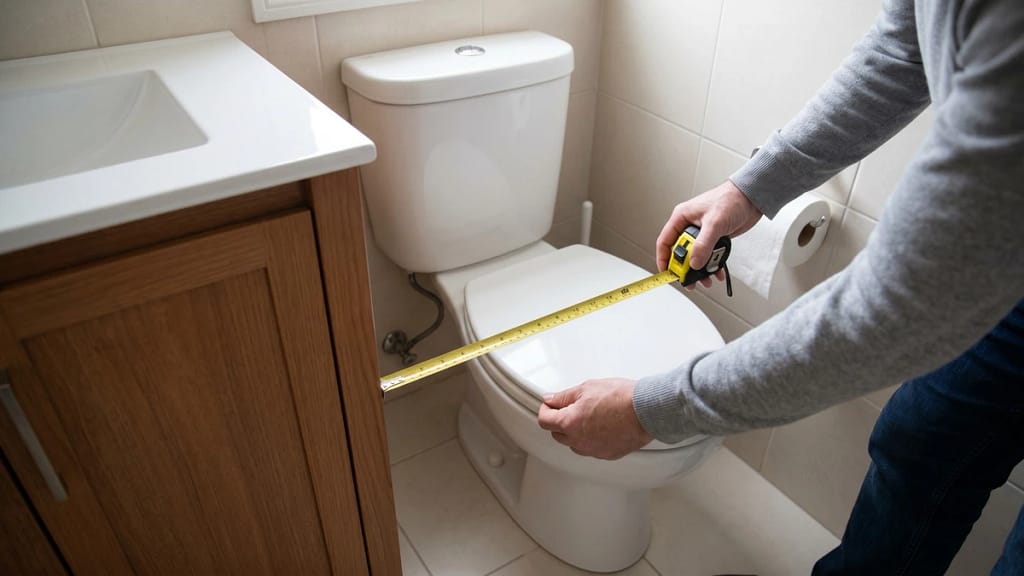
Measurements matter more in a small bathroom because small differences in width or handle position can affect daily use. A few inches can decide whether the frame feels helpful or crowded.
Before choosing a toilet safety frame, check:
- toilet width
- side clearance on both sides
- front clearance for knees and feet
- distance to a wall, vanity, or cabinet
- toilet paper holder position
- whether the frame can stay in place
- whether the user can reach both handles comfortably
Side clearance is especially important. A frame may fit around the toilet but still leave one handle too close to the wall. That can make the support uneven, which may affect how controlled the transfer feels.
How to check the space:
Stand in front of the toilet and picture the full sit-to-stand movement. There should be enough room for the user’s feet, knees, hands, and turning space without the frame hitting a vanity, wall, cabinet, toilet paper holder, or doorway.
Small-bathroom planning should include the toilet, surrounding fixtures, and the user’s movement path. This guide on toilet safety frames for small bathrooms explains how limited layout space affects frame placement and support choices.
Once the available space is clear, the next step is choosing a frame style that matches both the layout and the user’s support needs.
How to Choose a Toilet Safety Frame for a Tight Layout
Choosing a toilet safety frame for a tight layout requires more than finding the narrowest frame. The frame needs to fit the bathroom, support the user’s transfer, and leave enough room for normal sitting, standing, and cleaning.
Start With the Available Clearance
The first step is checking how much usable space exists around the toilet. Side clearance matters most, but front clearance also affects how easily the user can position their feet, knees, and body during the transfer.
- Measure the space between the toilet and nearby walls or vanities
- Check whether both handles can be reached comfortably
- Make sure the frame does not block the user’s transfer path
- Consider whether other people need to use the bathroom without the frame in place
A frame that technically fits around the toilet can still feel awkward if one handle sits too close to a cabinet or wall. The frame should leave enough space for the user to move naturally, not just enough space for the product to fit.
Match the Frame to the User’s Support Needs
Compact size should not come at the expense of support. A narrow frame may look better for a small bathroom, but it still needs to feel steady when the user pushes down on the handles.
The frame should match how the person actually transfers:
- Light support may be enough when the user only needs balance help
- Stronger support may be needed when standing up requires more push-off force
- Wider hand placement may feel better for some users, even in a small bathroom
- Handles should be easy to reach from both seated and standing positions
The best frame is not always the smallest one. It is the one that provides enough support without making the bathroom too crowded.
Think About Daily Access and Cleaning
Small bathrooms can become harder to use if the frame blocks the toilet area throughout the day. Shared bathrooms, narrow layouts, and tight spaces near vanities may require a frame that is easier to move, adjust, or clean around.
Before choosing, consider:
- whether the frame needs to stay in place all day
- whether it blocks access for other bathroom users
- whether the floor and toilet area can still be cleaned easily
- whether folding or removable support would make daily use easier
This broader decision process is easier when support level, frame type, bathroom layout, and stability are considered together. This guide on how to choose a toilet safety frame explains how to evaluate those factors in more detail.
Once clearance and support needs are clear, the next decision is whether a folding frame or a fixed frame makes more sense for the bathroom.
Folding Frames vs Fixed Frames in Small Bathrooms
Folding frames can be helpful in small bathrooms because they may be easier to move, store, or fold away between uses. This can matter in shared bathrooms or bathrooms where a frame cannot stay in place all day.
A folding frame may make sense when:
- the bathroom is shared
- the frame needs to move between uses
- the space around the toilet is very limited
- the support need is temporary
- storage matters as much as daily use
A fixed frame may make more sense when:
- the user needs support every day
- stability is more important than storage
- the bathroom has enough space
- the frame should stay in the same position
The tradeoff is simple. Folding frames can improve flexibility, while fixed frames often feel more predictable for users who rely heavily on support. The right choice depends on whether space flexibility or daily rigidity matters more.
For a deeper look at foldable designs, this guide on folding toilet safety frames explains when folding support works well and what stability checks matter.
In a small bathroom, folding can help with space, but it should not replace the need for secure support during transfers.
Toilet Safety Frame vs Raised Toilet Seat in a Small Bathroom
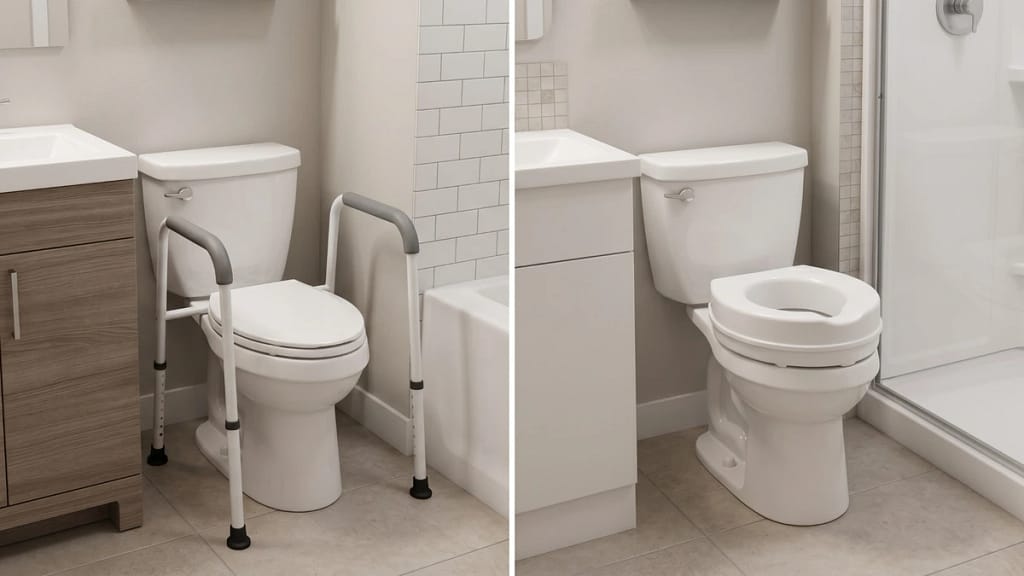
A toilet safety frame and a raised toilet seat solve different problems. In a small bathroom, choosing the wrong one can make the setup feel more crowded without solving the main issue.
A toilet safety frame is usually better when:
- the user needs side support
- standing up feels unsteady
- hand placement near the toilet is important
- height is not the main problem
A raised toilet seat is usually better when:
- the toilet feels too low
- bending is the main difficulty
- a frame would crowd the space
- the user does not need much side support
For example, a person who mainly struggles because the toilet is too low may not need a frame at all. A compact raised toilet seat may solve the height problem without adding side structure around the toilet.
On the other hand, a person who needs steady hand support while standing may not get enough help from height alone. In that case, a toilet safety frame may be more appropriate if the bathroom has enough clearance.
This choice depends on whether the main issue is height or support. This guide on toilet safety frames vs raised toilet seats explains how to compare the two options more clearly.
A small bathroom should not automatically push the decision toward the smallest product. It should push the decision toward the product that solves the right problem with the least space conflict.
When a Raised Toilet Seat May Be a Better Small-Bathroom Option
A raised toilet seat may be the better small-bathroom option when the main issue is low toilet height rather than side support. In tight layouts, this can sometimes be simpler than adding a frame around the toilet.
This may be the better direction when:
- the toilet feels too low
- the user can stand safely with minimal side support
- frame arms would crowd the bathroom
- side clearance is very limited
- a compact height solution would solve the main difficulty
For example, a narrow bathroom may not leave enough space for a full frame with side handles. If the person mainly needs the toilet to feel higher, a compact raised seat may be easier to fit and easier to use.
This does not mean a raised seat is always better. If the user needs stable hand support during transfers, a frame or wall support may still be needed. But when height is the main issue, comparing small-bathroom raised seat options can be a more useful next step.
For readers who need a compact height-focused alternative, this guide to the best raised toilet seats for small bathrooms compares options designed for tighter layouts.
The best small-bathroom setup depends on whether the user needs more height, more support, or both.
When Grab Bars May Work Better Than a Toilet Safety Frame
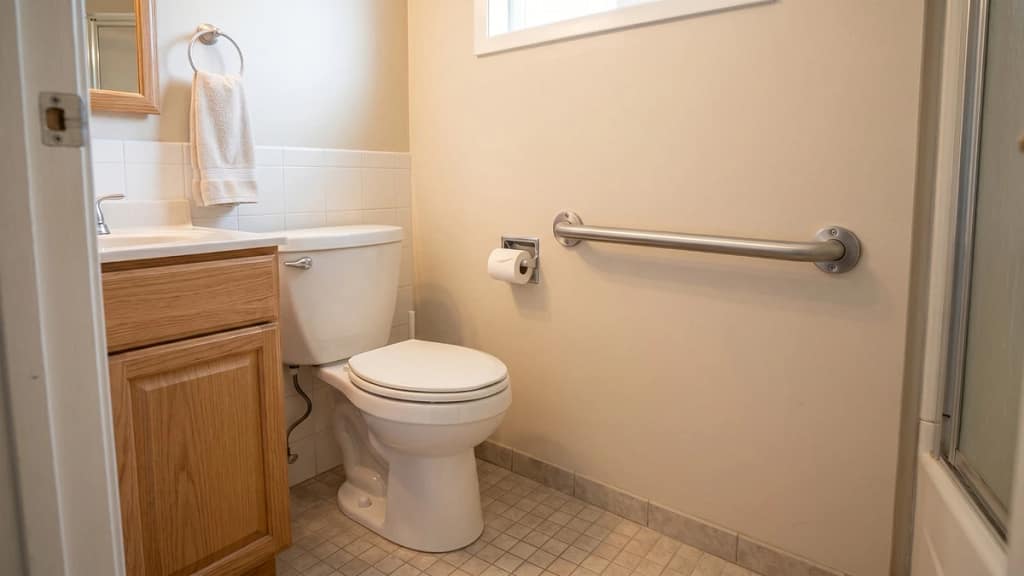
Grab bars may work better than a toilet safety frame when the bathroom is too tight for a frame or when wall-mounted support can be placed in a better position. This is common in bathrooms where a frame would block the transfer path or crowd the toilet area.
Grab bars may be worth considering when:
- there is not enough room for frame arms
- wall placement is available near the toilet
- the user needs support without a floor footprint
- the frame would block cleaning or shared access
- fixed support feels more practical than removable support
For example, a small bathroom with a vanity close to the toilet may not allow a frame to sit comfortably on both sides. If the wall beside the toilet can support proper installation, a grab bar may provide support without adding bulk around the toilet base.
This is an alternative support path, not a direct replacement in every case. A toilet safety frame keeps support close to both sides of the body, while grab bars depend on wall position and installation quality.
If wall support is the better fit for the bathroom, this guide to the best grab bars for small bathrooms compares options that may work better when floor or side clearance is limited.
A frame is often useful when close two-sided support is needed. Grab bars may be better when the bathroom needs support without adding another structure around the toilet.
Common Mistakes When Choosing a Small-Bathroom Toilet Safety Frame
Small-bathroom frame mistakes usually happen when the frame is chosen by size alone. A narrow or folding frame can still be the wrong choice if it does not support the user well.
Common mistakes include:
- Choosing the narrowest frame without checking stability
A frame still needs to feel secure during sitting and standing. - Ignoring side clearance
The frame may fit the toilet but still sit too close to a wall or vanity. - Assuming folding always solves space issues
Folding helps with storage, but the frame still needs room when opened. - Choosing a frame that blocks transfer movement
The user still needs space for feet, knees, and hand placement. - Ignoring whether height or support is the real problem
A frame may not help enough if the main issue is low toilet height.
A good small-bathroom choice should be judged by the full transfer, not only the frame dimensions.
What I Recommend
For most small bathrooms, the best toilet safety frame is the one that provides stable hand support without blocking the transfer path.
The PELEGON Toilet Safety Rail is the best overall starting point when there is enough side clearance for a full support frame. Compact size matters, but stability, handle access, and transfer space matter more.
A practical decision process is:
- measure side and front clearance first
- choose a compact frame only if it still feels stable
- consider folding if the bathroom is shared or storage matters
- consider a raised toilet seat if height is the main issue
- consider grab bars if a frame would crowd the toilet area
The right small-bathroom setup should solve the user’s main movement problem while keeping the toilet area usable for daily routines.
Final Thoughts
The best toilet safety frames for small bathrooms are not simply the smallest frames available. They need to balance compact footprint, stability, handle access, and real transfer comfort.
A frame that fits the bathroom but feels unstable is not a good choice. A frame that feels supportive but blocks movement may also create problems.
The best option is the one that gives the user dependable support while preserving enough space to sit, stand, turn, clean, and use the bathroom comfortably.
FAQ
What is the best toilet safety frame for a small bathroom?
The best option is usually a compact, stable frame that fits around the toilet without blocking the user’s transfer path.
Are toilet safety frames too wide for small bathrooms?
Some are. Side clearance should be measured before choosing a frame, especially near walls, vanities, or cabinets.
Are folding toilet safety frames better for small bathrooms?
They can be better when the bathroom is shared or the frame needs to be stored between uses. They still need to feel stable when opened.
Should a small bathroom use grab bars instead of a frame?
Grab bars may work better when a frame would crowd the toilet area and proper wall support is available.
Can a raised toilet seat work better than a toilet safety frame in a small bathroom?
Yes, if the main issue is low toilet height rather than side support. A raised seat may take up less side space than a frame.
