
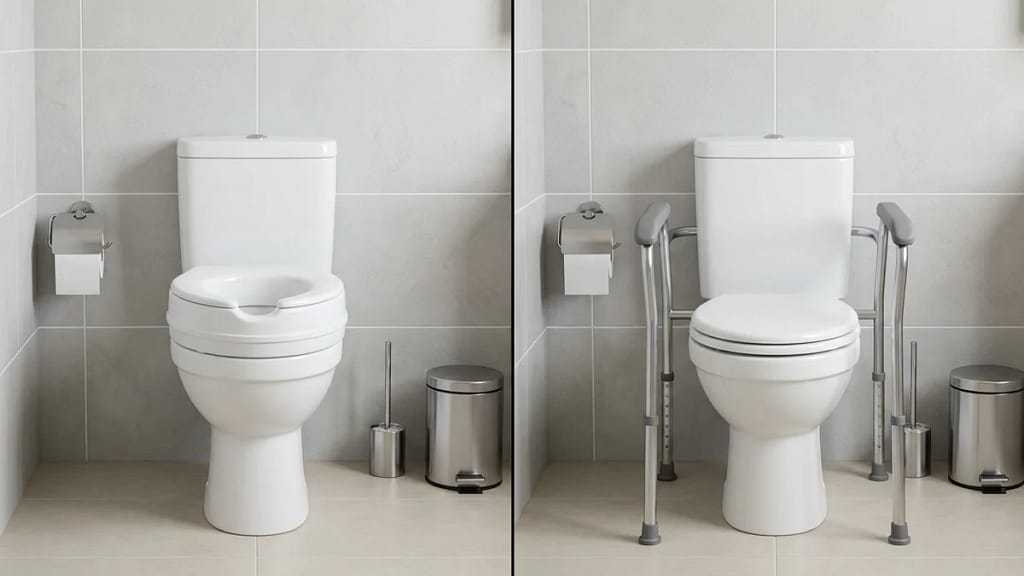
Difficulty sitting down and standing up from the toilet is one of the most common safety challenges in the bathroom. This is especially true for seniors, people recovering from surgery, or anyone experiencing reduced strength, balance, or joint mobility.
These everyday movements—lowering onto the seat and standing back up—require a combination of leg strength, balance, and control. When one of these is limited, the risk of instability increases.
To solve this, two common solutions are widely used: toilet safety frames and raised toilet seats. While they are often grouped together, they address different problems in real-life use.
Understanding the difference between toilet safety frames vs raised toilet seats helps ensure that the solution you choose actually improves safety, rather than just adding equipment that doesn’t match your needs.
Disclosure: As an Amazon Associate, I earn from qualifying purchases. This post may contain affiliate links. If you purchase through these links, I may earn a small commission at no extra cost to you. I only recommend products I would feel comfortable using in my own home. Learn more.
On This Page
- What Is a Toilet Safety Frame?
- What Is a Raised Toilet Seat?
- Key Differences Between Toilet Safety Frames and Raised Toilet Seats
- When Toilet Safety Frames Are the Better Choice
- When Raised Toilet Seats Are the Better Choice
- Can You Use Both Together?
- How to Choose the Right Option for Your Situation
- Alternatives to Consider
- What I Recommend
- FAQ
- Final Thoughts
Quick Answer
Toilet safety frames provide side handles that improve balance and support during sitting and standing, while raised toilet seats increase the height of the toilet to reduce bending and make movement easier for users with limited mobility or joint discomfort.
- Toilet safety frames focus on stability and arm support
- Raised toilet seats focus on height and reduced bending
- Safety frames help with pushing up and balance control
- Raised seats help with easier sitting and standing motion
- The right choice depends on whether strength or mobility is the main limitation
In practical use, people who feel unsteady benefit more from safety frames, while those who struggle with bending or lowering themselves benefit more from raised toilet seats.
Understanding this distinction early helps avoid choosing the wrong type of support.
If you’re unsure whether a raised seat will feel stable enough in real use, this guide on whether raised toilet seats are safe for seniors explains what affects safety most.
What Is a Toilet Safety Frame?
A toilet safety frame is a support structure placed around the toilet with handles on both sides. These handles allow users to stabilize themselves and push up when standing.
Unlike raised seats, safety frames do not change the height of the toilet. Their primary role is to improve control during movement.
How It Works in Real Life:
- When standing up, users push down on the handles instead of relying only on leg strength
- This reduces strain and creates a more controlled upward motion
- When sitting down, the handles help slow the descent
- This prevents sudden drops that can feel unstable
- During movement, the frame provides a stable grip point on both sides
- This is especially helpful for users who feel unbalanced
For example, someone with reduced leg strength may struggle to stand from a low position. With a safety frame, they can use both arms to assist, making the movement safer and more predictable.
If you want a broader framework before comparing specific models, a guide on how to choose a toilet safety frame can help explain which frame styles fit different support needs and bathroom layouts.
In summary, safety frames improve control and stability rather than changing the physical height of the toilet.
What Is a Raised Toilet Seat?
A raised toilet seat is an attachment placed on top of the existing toilet seat to increase its height. This reduces how far a person needs to lower themselves when sitting down.
This change directly affects how the movement feels, especially for users with joint limitations.
How It Works in Real Life:
- Sitting down requires less knee and hip bending
- This makes the motion easier and less painful
- Standing up becomes easier due to reduced vertical distance
- Less effort is needed to rise from the seat
- Movement feels smoother and more controlled
- Especially important for post-surgery recovery
For example, someone recovering from hip surgery may be advised to avoid deep bending. A raised toilet seat helps maintain a safer position by limiting how low the body needs to go.
Since a raised toilet seat works by adding height to the toilet, it also helps to understand how much elevation different models actually provide. This guide on how much height a raised toilet seat adds breaks that down in practical terms.
In short, raised toilet seats improve ease of movement by reducing how far the body needs to travel.
Key Differences Between Toilet Safety Frames and Raised Toilet Seats
When comparing toilet safety frames vs raised toilet seats, the differences become clearer when you look at how each option supports movement in real-life situations.
Support vs Height
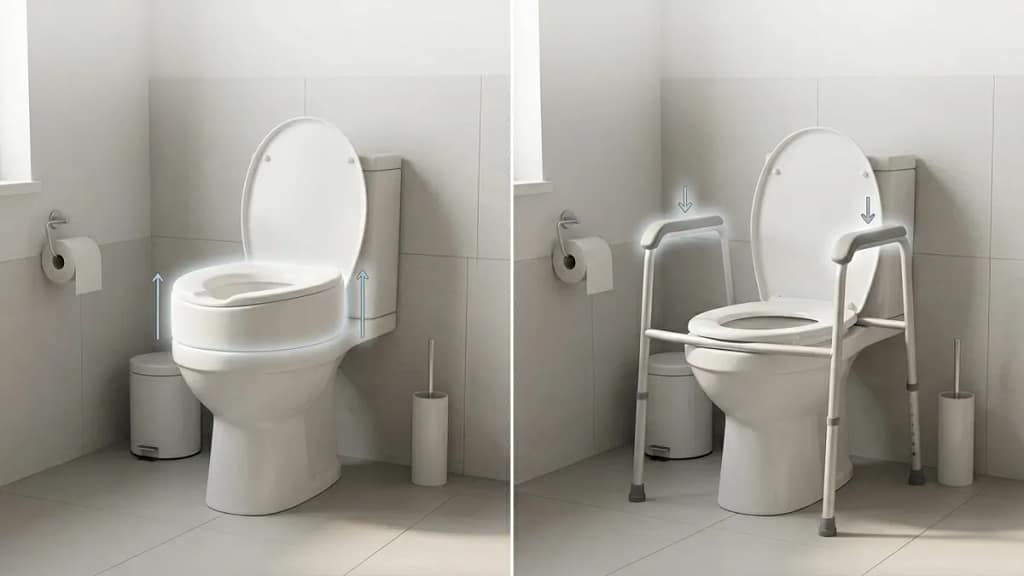
This is the most important distinction.
- Safety frames → improve support and balance
- Raised seats → improve height and movement ease
A person who struggles to push themselves up needs support, while someone who struggles to lower themselves needs height.
If a raised seat seems like the better direction, it also helps to understand how much weight a raised toilet seat can hold, especially when the user places significant pressure through the seat during transfers.
Stability and Balance
Safety frames provide direct physical support through handles, which improves balance during movement.
Raised toilet seats:
- do not provide side support
- rely more on the user’s balance
Real-life example:
- Standing up slowly → safety frame provides grip
- Sitting down comfortably → raised seat reduces effort
Ease of Installation

Both options are designed for accessibility and quick setup.
- Safety frames → placed around or secured to the toilet
- Raised seats → attached directly to the bowl
For those unfamiliar with setup, understanding installation steps can prevent instability issues. This guide on How to Install a Toilet Safety Frame explains how to ensure proper placement.
Comfort and Usability
Each option improves comfort in different ways.
- Raised seats → reduce strain on joints
- Safety frames → improve confidence and control
Bridge insight:
Comfort depends on whether the difficulty occurs when lowering down or pushing up, as each requires a different type of support.
Bathroom Space Requirements
Bathroom layout can influence the decision.
- Safety frames → require more side space
- Raised seats → remain compact
This becomes especially important in smaller bathrooms where space is limited.
Overall, these differences highlight that the two solutions are not interchangeable—they solve different problems.
When Toilet Safety Frames Are the Better Choice
Toilet safety frames are the better choice when the main issue isn’t getting lower—but staying stable throughout the entire movement.
For many users, the real challenge is not height, but feeling secure while sitting down or pushing back up. In these situations, having something solid to hold onto makes a noticeable difference in both safety and confidence.
Choose a safety frame if:
- You feel unsteady when sitting down or standing up
- You need support on both sides to maintain balance
- You rely on arm strength to assist with standing
These challenges often show up during everyday use in ways that aren’t always obvious at first. Instead of a single point of difficulty, the entire motion can feel uncertain or unstable.
Real-life situations where safety frames help:
- Standing up slowly while pushing off stable handles instead of straining your legs
- Lowering yourself down in a controlled way without dropping onto the seat
- Stabilizing your body after sitting, especially if balance shifts side to side
For example, someone with reduced balance or muscle weakness may hesitate before using the toilet—not because of height, but because there’s nothing to grab onto.
A safety frame removes that hesitation by providing consistent, predictable support exactly where it’s needed.
If the user relies heavily on the frame while pushing up, an article on how much weight a toilet safety frame can hold can help explain when basic support is enough and when a sturdier design may be the safer choice.
If a safety frame clearly sounds like the better fit overall, this guide on Best Toilet Safety Frames for Seniors compares common styles based on stability, ease of setup, and everyday use.
In practical terms, if the movement feels unstable or requires you to “catch yourself” at any point, adding support will usually have a much bigger impact than simply raising the seat height.
When Raised Toilet Seats Are the Better Choice
Raised toilet seats are the better choice when the main difficulty comes from how far your body has to move, not how stable you feel.
If sitting down feels too low or standing up requires excessive effort, the problem is usually range of motion—not balance. By increasing the seat height, raised toilet seats reduce how much your knees and hips need to bend, making the entire movement more manageable.
Choose a raised seat if:
- Bending your knees or hips is difficult or painful
- Sitting down feels too low or requires too much control
- You want to reduce strain on joints during everyday use
These limitations often become more noticeable over time, especially after surgery or with conditions like arthritis, where even small reductions in movement can make a meaningful difference.
Real-life situations where raised seats help:
- Lowering yourself onto the seat with less discomfort and better control
- Standing up with reduced effort, especially without relying heavily on arm strength
- Maintaining a more upright posture that feels natural and less restrictive
For example, someone recovering from hip or knee surgery may be advised to avoid deep bending. In that situation, even a few inches of added height can make sitting and standing feel significantly safer and more comfortable.
If a raised seat clearly sounds like the better fit, it also helps to compare best raised toilet seats for seniors based on height options, stability, and ease of everyday use.
In practice, if the movement feels like you’re dropping too low or pushing too hard to stand, reducing the distance your body has to travel will have the most immediate and noticeable impact.
Can You Use Both Together?
In some situations, choosing between a toilet safety frame and a raised toilet seat isn’t necessary. If both stability and movement are challenging, combining the two can create a more complete and practical support setup.
Instead of solving just one part of the problem, this approach addresses both how you move and how secure you feel while doing it.
When combination works best:
- Limited mobility combined with balance issues
- Recovery from surgery where both strength and flexibility are reduced
- Situations where you need both added height and reliable support
In these cases, the difficulty usually isn’t isolated to a single moment. Sitting down, stabilizing, and standing back up can all feel challenging in different ways, which is why a combined setup often feels more natural in daily use.
Real-life example:
- A raised seat reduces how far you need to bend, making sitting and standing easier
- A safety frame provides stable hand support, improving control and balance
Together, these two adjustments create a smoother and more controlled movement from start to finish, rather than forcing you to compensate at different stages.
If you’re considering a combined setup, an article on can you use a raised toilet seat with a toilet safety frame can help explain when the two work well together and what to check before pairing them.
If you’re comparing different ways to add support around the toilet, it also helps to understand how fixed options fit into the picture.
Some setups rely on permanent solutions like wall-mounted bars instead of freestanding frames. This comparison of toilet grab bars vs toilet safety frames explains how those alternatives differ and when they might be a better fit.
In practice, combining solutions makes the most sense when a single change doesn’t fully solve the problem—especially when both movement effort and stability are limiting factors.
How to Choose the Right Option for Your Situation
Choosing between toilet safety frames vs raised toilet seats depends on identifying the specific movement that feels difficult.
Decision Guide:
- Unstable or unbalanced: choose a toilet safety frame
- Too much bending required: choose a raised toilet seat
- Both issues present: combine both solutions
While this simple breakdown works as a quick reference, real-life situations are often a bit more nuanced. The same person may experience different challenges at different points in the movement.
Real-life decision examples:
- Weak legs → raised seat helps reduce effort when standing
- Poor balance → safety frame provides stability and control
- Both → combination creates a safer, more consistent movement
If you’re unsure how to fine-tune your setup—especially when it comes to selecting the right height—it helps to look at how different elevations affect comfort and movement. This guide on how to choose a raised toilet seat walks through the key factors in more detail.
In practice, the best choice usually becomes clear once you focus on the exact moment that feels difficult—whether it’s lowering down, pushing up, or staying steady in between—and match the solution directly to that point.
Alternatives to Consider
In some cases, toilet safety frames or raised seats may not fully address the problem. Other support options can be used depending on space, mobility, and preference.
Additional Alternatives:
- Wall-mounted grab bars near the toilet
- Swing-away grab bars for flexible access
- Comfort-height toilets (built-in elevation)
- Bedside commodes (for limited mobility situations)
These options can be used alone or combined with other solutions.
When considering fixed support options, grab bars can provide reliable stability without adding bulk. This is especially useful for users who prefer minimal setups.
When bathroom access itself becomes part of the problem, a bedside commode may be more practical than either a safety frame or a raised seat alone. This comparison of raised toilet seat vs bedside commode explains when each option makes more sense.
Exploring alternatives helps create a setup that matches both space and mobility needs.
What I Recommend
For most situations, the right choice comes down to how the movement actually feels during everyday use—not just what seems logical on paper. Paying attention to where you feel strain, instability, or hesitation will usually point you toward the better option.
- If balance is the main issue → choose a toilet safety frame for stable hand support
- If bending is the main issue → choose a raised toilet seat to reduce movement distance
In many real-life cases, these challenges don’t exist in isolation. Someone might struggle to lower themselves comfortably and also feel unsteady when standing back up.
When both issues are present, combining a raised seat with a safety frame often provides a more complete solution—making the entire movement smoother, more controlled, and less physically demanding.
The key is to focus on the exact point where the movement feels difficult and choose a solution that directly improves that moment. This approach leads to better comfort, more confidence, and safer daily use over time.
FAQ
What is the difference between toilet safety frames vs raised toilet seats?
Toilet safety frames provide support through handles, while raised toilet seats increase height to make sitting and standing easier.
Can you use toilet safety frames and raised toilet seats together?
Yes, combining both can improve safety when both mobility and balance are concerns.
Which option is better for seniors?
It depends on the situation. Safety frames are better for stability, while raised seats are better for reducing bending.
Do raised toilet seats feel stable?
When properly installed, they are generally stable, but they do not provide side support like safety frames.
Are toilet safety frames easy to install?
Most models are designed for simple setup and can be adjusted to fit standard toilets.
Final Thoughts
Understanding toilet safety frames vs raised toilet seats comes down to identifying which part of the movement needs support—stability, height, or both.
The most effective approach is to evaluate real-life movement:
- Sitting down
- Standing up
- Maintaining balance
Choosing the option that improves these actions leads to better comfort and reduced risk.
A practical, movement-focused approach is the best way to improve bathroom safety.
