

A shower chair listed with a 300-pound weight limit looks like a hard safety line: printed once, true forever. In practice, a shower chair weight limit is closer to a starting point than a finish line.
Falls are a major concern in bathroom mobility, so choosing a shower chair with an appropriate weight rating matters. But the printed number alone does not guarantee stability.
This article breaks down what a shower chair weight limit actually means, and what else determines whether a chair stays stable in real use: frame material, seat width, leg spread, and how the chair is used during a normal shower routine.
Disclosure: As an Amazon Associate, I earn from qualifying purchases. This post may contain affiliate links. If you purchase through these links, I may earn a small commission at no extra cost to you. I only recommend products I would feel comfortable using in my own home. Learn more.
On This Page
- What a Shower Chair’s Weight Limit Actually Means
- Stated Capacity vs. Real Stability
- Frame Material and Construction
- Seat Width and Leg Spread: Why Footprint Matters as Much as the Number
- How User Movement Adds Load Beyond Body Weight
- Mistakes That Undermine a Chair’s Weight Rating
- Why Heavier-Duty May Be Better, Even Without Bariatric Needs
- What I Recommend
- FAQ
- Final Thoughts
Quick Answer
A shower chair’s weight limit is the maximum load the manufacturer rates the chair to support under normal use. It is an important starting point, but it does not guarantee stability during every type of movement.
- Listed capacity describes the load the manufacturer rates the chair to support, not how it will behave during every type of movement.
- Frame material and construction, aluminum, steel, or plastic, welded or snap-fit, affect how a chair holds up under repeated daily use.
- Seat width and leg spread determine tip-over resistance at a given weight, not just the number on the box.
- Movement such as reaching, shifting weight, or standing up adds force beyond a person’s static body weight.
- A safety margin between actual body weight and listed capacity is usually the safer choice over cutting it close.
None of this means a shower chair’s weight rating is unreliable. It means the number describes what the chair is built to hold, not how it will behave under every condition.
Quick Rule:
Choose a chair whose listed capacity is comfortably above the user’s actual weight, rather than shopping right up to the stated limit. The more margin you have, the less likely normal movement and transfers are to put you near the chair’s rated ceiling. The manufacturer’s instructions and the chair’s design should take priority.
The sections below explain what shapes real stability beyond that number, and how much of a safety margin is worth building in.
What a Shower Chair’s Weight Limit Actually Means
Manufacturers list a maximum weight capacity so buyers can match a chair to the person who will use it. That number reflects what the frame, seat, and joints are built to hold under normal use, tested by the manufacturer before the product goes to market.
Standard shower chairs are typically rated between 250 and 400 pounds, with bariatric or heavy-duty models rated up to 900 pounds. The rating describes a working ceiling, not a threshold a chair meets right up until the exact moment it fails. A chair rated for 300 pounds is built and tested to hold that weight under normal, static use, not guaranteed to feel stable at 299 pounds and unsafe at 301.
The exact safety margin behind a manufacturer’s stated capacity is not usually published for consumer shower chairs. That is why the listed figure should be treated as a ceiling for normal use, not as a number to approach on purpose. Treating the rating as a target rather than an upper boundary is an easy way to misread what the number actually tells you.
Listed capacity should not be treated as the only safety check worth making. It is a starting filter: two chairs with the identical rating on the label can still behave very differently once frame quality and footprint enter the picture.
Stated Capacity vs. Real Stability
Two shower chairs with the same listed capacity can behave differently in a real bathroom. The number describes load tolerance, not the chair’s actual footprint, joint quality, or how it holds up over months of use. Capacity is just one piece of that decision, covered more fully in how to choose a shower chair for elderly.
Rubber feet and suction cups are a common example. According to an occupational therapist’s guide to bathing equipment, suction feet can degrade over time, particularly when exposed to oil-based soaps or lotions, and a degraded suction foot can slip even on a chair well within its weight rating. A worn or poorly maintained base can undercut stability regardless of how high the printed capacity is.
Water exposure affects more than the feet. Hard water deposits, soap residue, and repeated wet-dry cycles can gradually corrode unprotected metal joints or stiffen the plastic bushings some chairs use at pivot points. A chair that felt solid when new can develop small amounts of play at those joints after a year or two of daily use, well before it reaches its rated capacity in a single sitting.
Common factors that create a gap between a chair’s rated capacity and its real stability include:
- Worn or degraded rubber feet and suction cups, which can lose grip well before the frame nears its rated capacity
- Corrosion or stiffening at metal joints and plastic bushings from repeated water exposure
- A different, separately-rated product, such as grab bars, mistakenly assumed to share the same safety margin
- Loose or worn locking hardware on folding or height-adjustable models
Weight capacity is not unique to shower chairs, either. Grab bar weight capacity follows the same basic logic: a stated number is a starting point for a decision, not the entire decision.
Weight rating is one piece of a shower chair’s overall safety, which is covered more broadly in are shower chairs safe for seniors.
Shower Chairs vs. Transfer Benches: Do Weight Limits Differ?
Transfer benches, which extend outside the tub or shower for a seated entry, are rated using the same general approach as shower chairs: a maximum load figure based on frame and seat construction. The two products are not interchangeable, and their listed capacities should be checked separately rather than assumed to match.
A transfer bench also distributes weight differently than a shower chair, since part of the bench sits outside the tub or shower on dry flooring while the rest sits inside. That split base can change how leg spread and footprint affect stability compared with a shower chair that sits entirely on one surface.
Frame Material and Construction
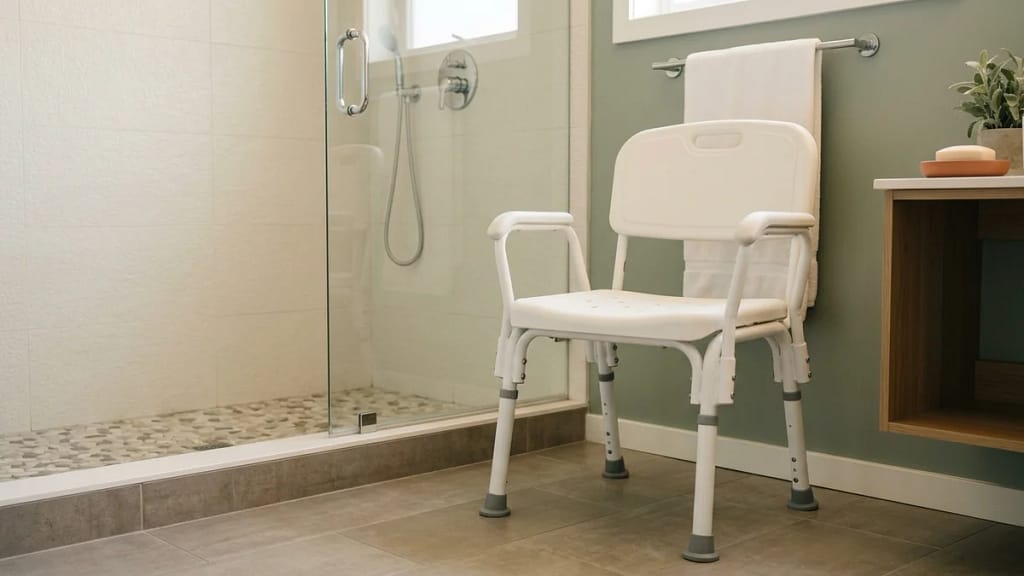
Frame material affects how a chair performs at or near its rated capacity over time, not just on day one. The three common materials trade off differently between weight, corrosion resistance, and typical rated capacity:
- Aluminum: resists corrosion, stays relatively light, but gauge and joint quality vary by manufacturer
- Steel: typically heavier and can feel more solid, but needs a rust-resistant coating to hold up in a shower
- Plastic: usually the lightest and least expensive, generally rated for lower maximum weights
- Welded joints: typically hold shape better over time than snap-fit connectors or plastic clips
Tubing gauge, meaning the thickness of the metal itself, plays into this as much as the base material. A thicker-gauge aluminum tube can outperform a thin-gauge steel tube in both weight rating and long-term rigidity, even though steel is the denser material. Checking the listed capacity alongside the frame description, rather than assuming steel always means sturdier, gives a clearer picture than the material name alone.
Joint construction matters as much as the material itself. A welded frame usually holds its shape better under repeated sitting and standing than a frame held together with snap-fit connectors or plastic clips, which can loosen with daily use. Chairs that fold or adjust in height typically rely on a locking pin or clamp at each adjustable joint, and that hardware is worth checking specifically, since it tends to wear faster than the frame tubing around it.
Real-life example:
A caregiver helping a parent who leans on the armrest while pushing up to stand puts extra sideways force on that one joint, not just downward weight on the seat. A frame with a loose or plastic-clip armrest joint may flex under that motion even if the chair’s overall weight rating is more than enough for the person’s body weight.
Occupational therapists commonly recommend a shower chair with both a backrest and armrests over a bare seat. Banner Health’s shower chair guide for older adults notes that the added support provides more control and sturdiness during sitting and standing motions. That guidance applies directly to weight capacity: a chair with a backrest and armrests distributes force across more contact points instead of concentrating it on the seat alone.
Seat Width and Leg Spread: Why Footprint Matters as Much as the Number
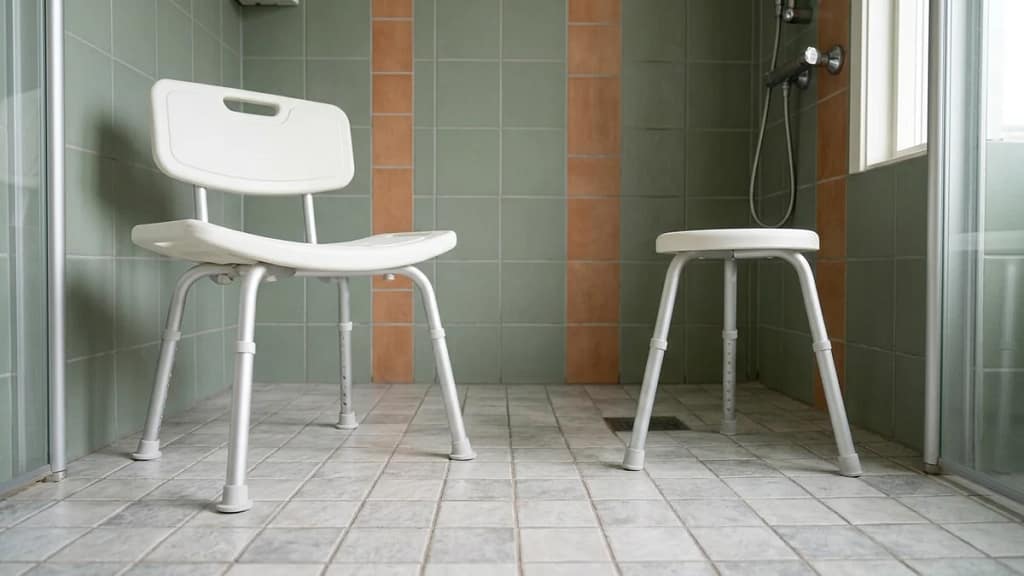
A chair’s footprint, meaning the distance between its legs and the width of the seat, affects how much force it takes to tip the chair sideways. Two chairs rated for the same weight can have very different footprints, and the narrower one generally has less tip-over resistance.
Four-legged shower chairs and three-legged shower stools handle this differently. A four-legged design typically spreads weight across a wider base and tends to feel steadier for a user who shifts weight side to side while washing. A three-legged stool can be easier to maneuver in a tight shower stall, but its smaller footprint generally leaves less margin if the user leans or reaches toward one side.
- A wider leg spread lowers the chair’s center of gravity relative to its base, which usually improves side-to-side stability.
- A seat that is too narrow for the user can shift body weight toward one edge, concentrating force unevenly.
- Legs with larger rubber feet generally distribute weight over more surface area than narrow feet or tips.
- A chair placed on a flat, even shower floor keeps all legs in full contact; an uneven surface can leave one leg partially unsupported.
Checking footprint before buying usually just means comparing the seat width and base measurements listed in the product description against the shower or tub’s actual dimensions, not relying on a photo alone.
Footprint is only the tip-over piece of the sizing question; seat width, base measurements, and bathroom fit are covered together in what size shower chair do I need.
How User Movement Adds Load Beyond Body Weight

A shower chair’s listed capacity is typically based on a static load: the chair supporting a still, seated weight. Real use is rarely static. Sitting down, standing up, reaching for a washcloth or shampoo, and shifting weight to wash all add force beyond the user’s plain body weight, sometimes briefly and unevenly.
For example, standing up from a shower chair usually involves pushing down and slightly forward through the arms and legs before the body clears the seat. That push adds momentary force well above resting body weight, concentrated on whichever part of the frame is being used for leverage.
When a caregiver provides physical support during a transfer, such as bracing the person’s arm or holding the chair steady, some of that force can pass through the chair as well, not just through the caregiver’s own body. A chair chosen with only the user’s body weight in mind may have less margin left for that added, shared load than the rating alone suggests.
Movements that add force beyond resting body weight include:
- Sitting down, which adds a brief downward force as the body’s weight settles onto the seat
- Standing up, which adds forward and downward force through the arms and legs during the push
- Reaching sideways or forward, which shifts the tipping force toward whichever legs are closest to that side
- Shifting weight while washing, which moves load across the seat unevenly for a moment at a time
Reaching adds a different kind of load. A person leaning sideways or forward to reach a shampoo bottle on a shelf shifts their center of gravity away from the middle of the seat, which increases the tipping force on the legs closest to that side, even though total body weight has not changed. A wider leg spread and a lower center of gravity, discussed above, are what typically absorb that shift without the chair rocking.
Technique reduces this kind of added strain as much as the chair’s own construction does. Pushing up with both hands on the armrests, rather than reaching for a towel bar or wall for leverage, keeps that force on the chair’s designed support points instead of a surface that was never built to bear it. That technique is covered in more detail in how to use a shower chair safely.
Mistakes That Undermine a Chair’s Weight Rating
A rating alone does not guarantee stability. These are the most common ways real-world stability falls short of the number on the label, even when the chair is technically within its rated capacity:
- Assuming a chair rated well above the user’s body weight is automatically stable, without checking footprint or frame quality.
- Ignoring the added load when a caregiver assists with sitting or standing, since that assistance changes the force on the frame, not just the user’s own weight.
- Leaving worn or hardened rubber feet in place instead of replacing them once they no longer grip.
- Setting up the chair on an uneven tub or shower floor instead of confirming all legs make full, even contact.
- Skipping a stability check after moving or reinstalling the chair, even when it seemed solid before.
- Choosing a chair based on weight rating alone, without confirming the seat width and leg spread actually fit the user and the shower.
Important note:
Re-test a shower chair’s stability any time it is moved, reinstalled, or used in a new bathroom, even if it felt solid in its previous location. A stable setup in one bathroom does not guarantee the same result on a different, and possibly less even, surface.
Why Heavier-Duty May Be Better, Even Without Bariatric Needs
Choosing a shower chair rated meaningfully above the user’s actual body weight is usually the safer, more dependable choice, even for a person who does not need a bariatric-specific model. A wider safety margin accounts for the added, uneven force from transfers and daily movement described above, not just resting body weight.
Heavier-duty models also tend to use thicker frame tubing and heavier-gauge joint hardware to reach their higher rating, which can mean a sturdier chair even before movement is factored in. That construction difference is often more noticeable in daily use than the number on the label, since a chair built for 500 pounds is usually more rigid at 200 pounds of actual, moving load than a chair built closer to that same 200-pound line.
The trade-off is usually size and price. Heavier-duty chairs tend to have a larger footprint and cost more than standard models, which matters in a small bathroom where space is already limited. Weighing that trade-off against the added stability margin is a reasonable part of the decision, not a reason to default to the largest available option automatically.
Margin is easier to judge in pounds than in a bariatric-or-not label. Starting from the user’s actual weight, rather than the product category, usually gives a clearer number to shop against.
A person who weighs 160 pounds, for example, does not need a 900-pound bariatric chair, but a model rated for 350 to 400 pounds still gives more working margin than one rated closer to 250 pounds, without the added footprint of a full bariatric design. Matching the margin to the actual user, rather than defaulting to either extreme, is usually the more useful frame for this decision.
What I Recommend
I recommend choosing a shower chair with a listed capacity comfortably above the user’s actual body weight, paired with a full backrest and armrests rather than a bare seat.
A practical selection process is:
- confirm the user’s actual body weight and look for a capacity comfortably above it
- choose a model with a backrest and armrests over a bare seat
- check the leg spread and seat width, not only the weight rating
- inspect rubber feet or suction cups for wear before each use
- set the chair on a flat, even section of the shower or tub floor
- re-test stability after any move, reinstall, or bathroom change
The right chair is the one that matches the user’s actual weight, movement pattern, and bathroom setup, not necessarily the model with the highest number on the box.
FAQ
How much weight can a shower chair hold?
Most standard shower chairs are rated between 250 and 400 pounds, while bariatric or heavy-duty models can be rated up to 900 pounds. The exact figure varies by manufacturer and should always be checked on the specific product.
What is the best weight capacity for a shower chair?
The best capacity is one that comfortably exceeds the user’s actual body weight, leaving room for the extra force added by transfers and daily movement.
What happens if you exceed a shower chair’s weight limit?
Exceeding the listed capacity increases the risk of frame stress, joint failure, or a tip-over, particularly during movements like standing up that add force beyond resting body weight.
Does the user need a full back and armrests, or just a seat?
A backrest and armrests generally provide more control and sturdiness during sitting and standing than a bare seat, and they distribute force across more points on the frame.
What if the shower chair no longer has a weight limit label?
Check the product listing or the manufacturer’s website using the model name or number, since most manufacturers publish the same specification online. If the model can’t be identified, treat the chair as a standard-duty model rated in the 250 to 300 pound range unless there is a specific reason to expect a higher rating.
Does Medicare pay for a shower chair?
Medicare Part B may cover a portion of the cost when a shower chair is prescribed as durable medical equipment by a doctor, though coverage details vary by plan and supplier.
Are shower seats a good idea?
For a person whose balance, strength, or stamina makes standing through a full shower difficult, a shower seat is generally a practical, dependable way to reduce that strain, provided it is matched to the user’s weight and the bathroom’s layout.
Final Thoughts
A shower chair’s weight limit is a useful starting filter, not the finish line for a safety decision. Frame material, footprint, and the extra force that comes from actual movement all shape whether a chair stays stable well within its rated capacity. Building in a safety margin, checking the chair’s construction, and re-testing stability after any change are what turn a printed number into a dependable, everyday setup.
