

What size shower chair do I need? The right one fits three numbers at once: a seat wide enough for your hips, a footprint that fits your shower or tub floor, and a weight capacity that sits comfortably above your own weight rather than right at it.
Getting any one of those wrong is a common reason a shower chair ends up creating a new problem instead of solving the old one. Falls remain one of the most common sources of injury for older adults, and the CDC reports that one in four adults 65 and older falls each year.
The senior bathroom falls statistics page has more detail on how common these incidents are.
Disclosure: As an Amazon Associate, I earn from qualifying purchases. This post may contain affiliate links. If you purchase through these links, I may earn a small commission at no extra cost to you. I only recommend products I would feel comfortable using in my own home. Learn more.
On This Page
Quick Answer
The right shower chair size gives your hips an inch or two of clearance on each side, fits its full footprint, including leg splay, inside your shower or tub floor, and carries a weight capacity comfortably above your own weight rather than barely meeting it.
- Seat width and hip clearance: too narrow pinches and feels unstable, too wide wastes floor space you may not have.
- Footprint versus floor space: the legs, including any outward splay, need to sit fully inside the shower or tub floor, not just the seat itself.
- Weight capacity margin: a listed capacity is a manufacturer’s number, not a guarantee, so margin matters more as body weight nears that number.
- Seat height: knees bent near a right angle with feet flat on the floor is the target, since a seat that sits too high or low changes balance during sitting and standing.
Most sizing mistakes come from measuring only one side of this equation, either the body or the bathroom, instead of both.
The sections below walk through measuring yourself first, then the shower or tub space, so the two numbers can be checked against each other before buying.
Why Shower Chair Size Actually Matters
An oversized shower chair does not just look impractical. It can block a door from swinging fully open, crowd the floor space needed to step in and out, or shift on a wet surface if its base is wider than the area it sits on was built for.
An undersized chair carries its own risk. A seat too narrow for the hips or too low for the knees changes how weight loads during the sit-to-stand transfer, often the riskiest moment in a shower.
- A chair that blocks the shower door or curtain track from moving freely
- A seat too low or too high for a controlled, balanced stand
- Legs that splay wider than the shower or tub floor actually allows
- A weight capacity chosen right at current body weight, with no margin left
Working through the two measurements below, the body first and then the space, is what keeps a shower chair from creating a new problem while solving the old one.
Measure Yourself First: Seat Width, Height, and Weight Capacity
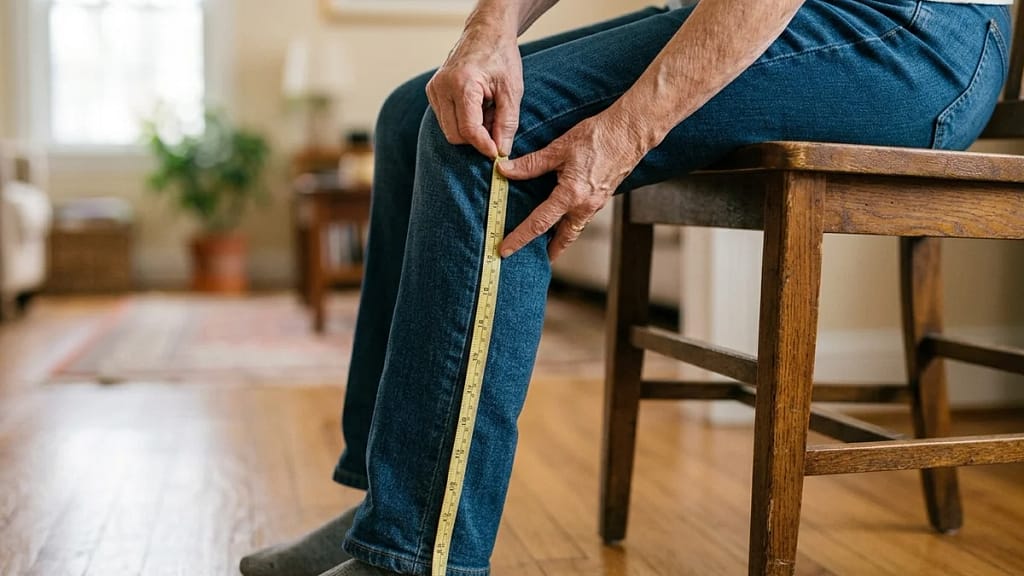
Start with the body the chair needs to support, since that number does not change depending on which bathroom it goes in.
- Measure your hip width while seated on a firm chair, then add one to two inches on each side for the seat itself.
- Measure from the back of your knee to the floor while seated with your feet flat, since this sets the seat height that lets your knees bend near a right angle.
- Note your actual body weight, then look for a listed capacity with meaningful margin above it, not one that only just clears it.
A tape measure alone cannot judge how a fit feels during the actual sit-to-stand transfer, which is where a professional fit check adds real value.
One occupational therapist and rehabilitation supervisor has pointed to making sure a shower chair sits fully flat on the shower floor, alongside a full walkthrough of the bathroom before recommending any equipment.
A seat that sits even an inch too high or low changes how controlled the sit-to-stand motion feels, which is why the shower chair height guide breaks the target range down further by leg length.
Having the right range only matters once the chair is actually set to it; how to adjust shower chair height covers making that change once the chair arrives.
Once those three numbers are set, the next step is checking them against the bathroom itself.
Then Measure Your Shower or Tub Space
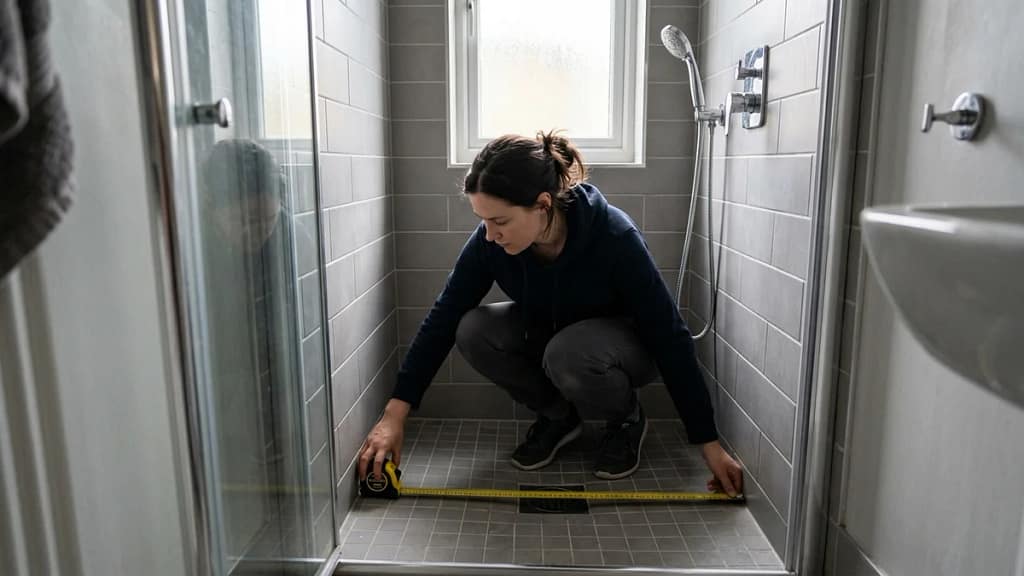
The body-side numbers only matter if the bathroom can actually accommodate them.
- Floor width and depth inside your shower or tub, measured at the narrowest point, not just the widest
- Door swing or curtain clearance, so the chair does not block entry or exit
- Drain location and floor slope, since a leg sitting directly over a sloped drain area can rock
- Arm and back clearance if the model has either, measured against your walls and any fixtures
For a step-by-step walkthrough of both sets of measurements, see how to measure for a shower chair.
Important notes:
Measure the actual shower or tub floor with a tape measure before ordering, rather than relying on a product listing’s stated dimensions alone. Bath and shower seating is bulky enough that returns are often a hassle, and a chair that looks right in photos can still be too wide for a specific stall.
If a listing only states seat width and leaves out the legs’ spread once assembled, check customer photos, reviews, or the seller’s own product questions for that detail before ordering.
Accessible design standards from the U.S. Department of Justice set ADA shower seat standards within a fairly narrow band for public facilities, useful context even though most home shower chairs are not built to that exact commercial specification.
With both sets of numbers in hand, the next question is what happens when the bathroom itself is already tight on space.
How to Avoid a Chair That’s Too Big for Your Bathroom
A shower chair can fail by being too big just as easily as too small, and a compact bathroom makes that mistake more likely to happen unnoticed until it is already assembled.
- In a narrow walk-in shower, a compact footprint usually matters more than a wider, more heavily padded seat
- When measurements fall between two available sizes, sizing down typically causes less crowding than sizing up, as long as hip clearance still holds
- In a shared bathroom, measure for the largest regular user first, then confirm the chair still works for anyone smaller who uses it too
- When sizing down for a tight space, double-check the smaller model’s weight capacity too, since some compact chairs also carry a lower capacity rating
Real-life example:
A caregiver shopping for a parent with a narrow walk-in shower measured the stall at 30 inches wide, then ordered a chair listed with a 28 inch seat width, assuming that number was the only one that mattered. Once assembled, the legs splayed out to a 34 inch total footprint, wider than the stall itself, and the chair had to be returned.
Size is only one piece of the decision. Arms, backrest, and bathtub versus walk-in fit round out the rest of the how to choose a shower chair for elderly decision guide.
Fit and weight capacity work together too, and that pairing matters most for larger-bodied users.
Matching Size to Weight Capacity and Body Type
The ranges below are a starting point. Use them to shortlist a size before double-checking against the hip and height measurements from earlier.
| Body Type | Typical Seat Width | Weight Capacity to Look For |
|---|---|---|
| Petite or narrow frame | 15 to 17 inches | At least 250 lb |
| Average build | 17 to 19 inches | At least 300 to 350 lb |
| Larger or bariatric build | 19 to 23+ inches | 400 lb or higher, purpose built bariatric frame |
These are starting ranges to check against your own hip measurement, not fixed rules.
Treat a listed shower chair weight limit as a ceiling to stay well under, not a target to reach. A chair rated at exactly a user’s body weight has little margin left for shifting, reaching, or an off-center sit, all of which add real force beyond a static number on a label.
What I Recommend
I recommend measuring the body first, then the bathroom, and letting the bathroom’s limit win whenever the two numbers conflict, since a shower chair that does not physically fit is not a safer option no matter how supportive its seat is.
A practical way to check size before buying is:
- Measure hip width and add one to two inches per side
- Measure seated knee-to-floor height for the target seat height
- Measure the shower or tub floor at its narrowest point, including any door or curtain swing
- Confirm the chair’s full footprint, legs included, fits inside that measurement with room to spare
- Choose a weight capacity meaningfully above actual body weight, not just at or near it
Once those numbers agree, the features covered in the full shower chair buyer’s guide become much easier to compare, since they only matter once a chair already fits.
Once the chair is set up, using it safely is its own separate step, covered in how to use a shower chair safely.
FAQ
How do I know which size shower chair to buy?
Measure hip width for seat width, seated knee-to-floor height for seat height, and the shower or tub floor’s narrowest point for footprint, then choose a model whose full dimensions, including any leg splay, fit inside all three numbers.
What is the weight limit of most shower chairs?
Standard shower chairs are typically listed between 250 and 350 pounds, while bariatric models start around 400 pounds and go higher. Treat the listed number as a ceiling to stay under, not a target to meet exactly.
How do I make sure the bath chair will fit my bathtub?
Measure the tub floor’s width at its narrowest point, not just at the widest part of the basin, since many tubs taper toward the drain end where a chair’s back legs often sit.
What are the best seat dimensions for a shower or bath chair?
There is no single best dimension. The right seat width is typically one to two inches wider than hip width on each side, and the right seat height lets the knees bend close to a right angle with feet flat on the floor.
Can a shower chair be used outside of the shower?
Some models are stable enough for general bathroom use, such as at a sink or vanity, but a shower chair’s non-slip feet and drainage-friendly design are built for wet flooring specifically, so check the manufacturer’s guidance before using it elsewhere.
Are there any accessories I should consider for my shower chair?
A handheld showerhead with an extension hose is worth adding alongside a shower chair, since it lets you reach a seated user at any distance rather than needing a larger chair positioned directly under a fixed showerhead.
How do I clean my shower chair?
Most shower chairs can be wiped down with a mild cleaner and rinsed, with regular attention to the leg tips and any padded surfaces, where soap residue and mildew tend to build up fastest.
Final Thoughts
The right shower chair size is less about finding one ideal number and more about making sure two separate measurements, the body and the bathroom, actually agree with each other. A chair that matches the numbers on the box but not the bathroom on the wall solves nothing.
