
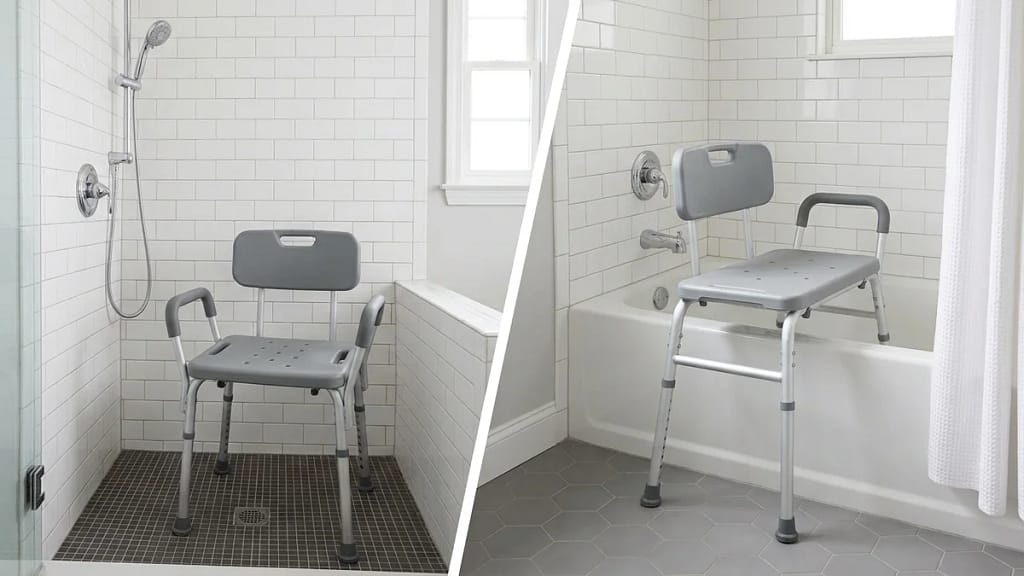
Choosing between a shower chair and a transfer bench often comes down to one question: can the person step over the edge of the tub or into the shower safely, or not? The two products solve different problems, and picking the wrong one can leave someone less stable than using no equipment at all.
According to the CDC, older adults report more than 14 million falls each year, and about 1 in 5 of those falls causes a serious injury such as a broken bone. Bathrooms are one of the more demanding rooms in the house for balance and coordination.
This guide compares a shower chair vs transfer bench across bathroom layout, stability, and caregiver involvement, so the choice matches the actual movement problem instead of just the product name.
Disclosure: As an Amazon Associate, I earn from qualifying purchases. This post may contain affiliate links. If you purchase through these links, I may earn a small commission at no extra cost to you. I only recommend products I would feel comfortable using in my own home. Learn more.
On This Page
- Shower Chair vs Transfer Bench: Key Differences at a Glance
- What Is a Shower Chair? (and When It’s Usually Enough)
- What Is a Transfer Bench? (and When You Need the Extra Support)
- Bathtub or Walk-In Shower? Why Your Setup Decides a Lot
- Stability, Balance, and Fall Risk: The Bigger Factors Than Comfort
- How Much Help You’ll Need From a Caregiver
- Recovering From Surgery? What Changes After a Hip or Knee Replacement
- What I Recommend
- FAQ
- Final Thoughts
Quick Answer
A shower chair sits entirely inside the shower or tub for someone who can step in and out safely but needs to sit while washing, while a transfer bench extends across the tub wall so a person can sit down outside first and then slide in, which is usually safer when stepping over the edge is the real risk.
- Ability to step over the tub wall: if that’s uncertain, a transfer bench removes the step entirely.
- Bathroom layout: a bathtub lets a transfer bench straddle the wall; many walk-in showers don’t have a ledge for one to rest on.
- How much a caregiver needs to help: a transfer bench usually needs less lifting from a caregiver during the transfer itself.
- Balance versus fatigue: fatigue alone often points to a shower chair; balance and fall risk point toward a transfer bench.
- Available floor space: a transfer bench needs clear floor outside the tub; a shower chair does not.
Both products reduce the risk of a fall during bathing, but they solve different parts of the problem. A shower chair adds a place to sit; a transfer bench changes how someone enters and exits the tub in the first place.
The sections below walk through each factor in more detail, including what changes after a hip or knee replacement and when a caregiver’s help matters most.
Shower Chair vs Transfer Bench: Key Differences at a Glance
The table below lines up the two products side by side. The sections after it explain the reasoning behind each row.
← Swipe to see more →
| Factor | Shower Chair | Transfer Bench |
|---|---|---|
| Where it sits | Fully inside the shower or tub | Straddles the tub wall, with part inside and part on the floor outside |
| Best for | Someone who can step in and out safely but tires while standing | Someone who struggles to step over the tub wall |
| Bathroom fit | Works in walk-in showers and bathtubs | Needs a bathtub plus clear floor space outside it |
| Caregiver involvement | Usually lower (mainly supervision) | Often higher during the transfer itself, less lifting overall |
| Typical use case | Fatigue or general stability support | Higher fall risk, recent surgery, limited weight-bearing |
The table above covers the more common case: choosing one. Some households end up using both instead, a transfer bench for daily bathing and a shower chair in a second bathroom or for travel. When the table doesn’t point clearly to one option, the safer default is usually whichever one handles the harder part of the movement: getting over the tub wall.
What Is a Shower Chair? (and When It’s Usually Enough)
A shower chair is a seat placed entirely inside the shower stall or bathtub. It gives someone a stable place to sit while washing, without changing how they get in or out.
- Fits in both walk-in showers and bathtubs, as long as there’s room for the chair’s footprint.
- Works well when the main problem is fatigue or brief dizziness, not difficulty stepping over an edge.
- Non-slip rubber feet and a stable frame matter more than extra features like armrests.
- Height-adjustable legs help match the seat to the person’s knee height for an easier sit-to-stand.
How to choose a shower chair for elderly breaks down arm, backrest, seat width, and weight capacity choices in more detail.
Real-life example:
A person recovering from a minor illness may be steady enough to walk into a walk-in shower alone but still tire quickly standing through a full shower. A shower chair solves that specific problem without adding equipment the bathroom doesn’t need.
What Is a Transfer Bench? (and When You Need the Extra Support)
A transfer bench is a longer seat with two legs inside the tub and two legs on the bathroom floor outside it. Instead of stepping over the tub wall, the person sits down on the outside portion first, then slides across into the tub.
- Removes the need to lift a leg over the tub wall, which is often the highest-risk moment during bathing.
- Requires a bathtub, since most transfer benches aren’t designed for a curbless walk-in shower.
- Needs clear floor space outside the tub for the two outer legs and for someone to sit down safely.
- Sliding and swivel-seat versions reduce how much scooting or twisting the transfer takes.
Taken together, these features make a transfer bench most useful when the entry itself, not just the sitting, is the hard part of bathing.
Bathtub or Walk-In Shower? Why Your Setup Decides a Lot

The type of bathing space limits which option even fits. A transfer bench needs a bathtub with enough floor clearance outside it; a shower chair can go in either a bathtub or a walk-in shower.
- A curbless walk-in shower usually rules out a transfer bench, since there’s no tub wall for it to rest against.
- A narrow bathroom may not have enough floor space outside the tub for a transfer bench’s outer legs.
- Curved or sloped tub floors can affect how stable either product feels, so check for a flat, even surface before choosing.
- A walk-in shower with even a small curb or step should be treated the same way as a bathtub wall for this decision, not automatically grouped with fully curbless showers.
If a bathtub is part of the setup, can you use a shower chair in a bathtub covers footprint and non-slip fit in more detail.
Stability, Balance, and Fall Risk: The Bigger Factors Than Comfort
Comfort matters less than whether the product matches the person’s actual balance and fall risk. A shower chair that’s simply more comfortable isn’t a substitute for the support a transfer bench provides during tub entry.
Balance and stability aren’t quite the same thing. Balance is about the person, how steady they are on their feet. Stability is about the product itself, whether it rocks, slides, or shifts once someone sits down or leans on it. Both are worth checking separately before relying on either seat.
- A history of losing balance while standing is a stronger signal for a transfer bench than general tiredness.
- A previous fall in the bathroom, even a minor one, is worth treating as a reason to reassess the setup rather than repeat it.
- Weakness on one side of the body, common after a stroke, may call for a bench or chair positioned so the stronger side leads the transfer.
- Weak grip or reduced arm strength can make the sliding motion on a transfer bench harder, so check the seat surface and any handle before buying.
Important note:
A product that rocks or shifts on the tub floor adds fall risk on its own, separate from the person’s balance. Testing the chair or bench’s footing before the first real use matters as much as choosing the right type.
Grab bars near the tub or shower entry support either product and are worth considering alongside the seating decision. Best grab bars for shower safety covers placement options in more detail.
How Much Help You’ll Need From a Caregiver

For a spouse or family caregiver, the more important question is often how much lifting or steadying the transfer itself requires, not just where the person sits afterward.
- A transfer bench usually needs less lifting during entry and exit, since the person slides rather than steps.
- A shower chair still requires the person to walk in and out unassisted, so it doesn’t reduce a caregiver’s role during that part of the routine.
- Testing the full sit-down, slide, and stand-up sequence with the caregiver present, before relying on it daily, catches problems early.
A caregiver who has watched that full sequence once, start to finish, usually knows within a few minutes whether daily help will mean full physical support or just standing by in case something goes wrong.
Recovering From Surgery? What Changes After a Hip or Knee Replacement
Hip and knee replacement recovery often comes with specific movement restrictions, sometimes called hip precautions, that affect which bathing setup is safer for a period of time.
- Seat height often needs to keep the knee below the hip, following the surgeon’s or physical therapist’s guidance.
- A seat without armrests may be preferred temporarily, since twisting to grip an armrest can conflict with hip precautions.
- A transfer bench is commonly recommended over a shower chair right after hip surgery, since it avoids stepping over the tub wall entirely.
Patient education materials from hospitals such as Northwestern Medicine recommend a seated transfer using a transfer bench or bathtub seat rather than stepping over the tub wall after a hip replacement.
Important note:
Recovery guidelines vary by surgeon, surgery type, and individual healing progress. Confirm the exact seat height and any hip precautions with a surgeon or physical therapist before choosing equipment for the recovery period.
What I Recommend
My starting point is the tub wall. If stepping over it safely is even slightly in question, a transfer bench is usually the more dependable choice, especially right after surgery or after a fall.
A practical way to work through the decision is:
- confirm whether the bathing space is a bathtub or a walk-in shower
- ask whether stepping over the tub wall is safe today, not just in general
- measure the floor space outside the tub if a transfer bench is being considered
- check with a surgeon or physical therapist if recovering from hip or knee surgery
- test the full sit-down-to-stand-up sequence before relying on either option daily
If a shower chair turns out to be the better fit, best shower chairs for seniors covers specific models worth considering. The right choice is the one that matches today’s actual movement, not the option that looks the most capable on paper.
FAQ
Is a shower chair or a transfer bench better for seniors?
Neither is universally better. A shower chair usually works when someone can step in and out of the shower or tub safely but needs to sit while washing, while a transfer bench is usually the safer choice when stepping over the tub wall is difficult or risky.
What’s the difference between a shower chair and a shower bench?
The terms are often used inconsistently, but a shower bench typically refers to a seat that sits fully inside the shower, similar to a shower chair, while a transfer bench specifically extends across the tub wall to help with entry and exit.
Does Medicare cover a shower chair or transfer bench?
Original Medicare generally treats shower chairs and transfer benches as convenience items rather than durable medical equipment, so they usually aren’t covered. CMS’s durable medical equipment reference list confirms this, denying bathtub seats specifically as a comfort or convenience item. Some Medicare Advantage plans, Medicaid programs, or VA benefits may help with the cost instead.
Can I use a shower chair in a walk-in shower instead of a transfer bench?
Yes. A shower chair is generally the better fit for a walk-in shower, since a transfer bench is designed to rest against a bathtub wall that a curbless shower doesn’t have.
How much bathroom floor space does a transfer bench need?
A transfer bench needs enough clear floor outside the tub for its two outer legs and for the person to sit down safely before sliding in, so measuring that space before buying is worth doing in a smaller bathroom.
Is a transfer bench safer than a shower chair after hip or knee surgery?
A transfer bench is commonly recommended after hip replacement surgery specifically because it avoids stepping over the tub wall, though the exact recommendation should come from a surgeon or physical therapist based on individual precautions.
What’s the difference between a shower stool, a shower chair, and a transfer bench?
A shower stool is typically a compact, backless seat for someone who’s fairly stable. A shower chair adds a back and sometimes arms for more support while sitting. A transfer bench is the longest of the three and is built specifically to help with getting over a tub wall.
Final Thoughts
A shower chair and a transfer bench are built for different moments in the bathing routine, not different quality tiers of the same product. Matching the choice to how someone actually moves through the tub or shower, rather than to the more familiar name, is what keeps the equipment doing its job over time.
