
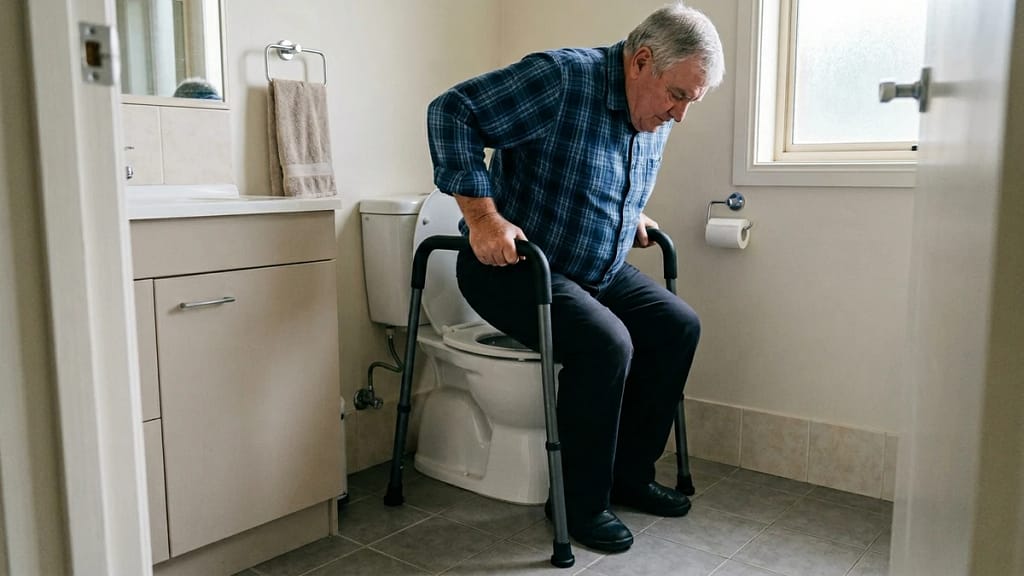
A toilet safety frame needs to do more than fit around the toilet. It also needs to feel strong enough during one of the most demanding bathroom movements: pushing down on the handles while sitting or standing.
If the question is how much weight can a toilet safety frame hold, the answer depends on more than the number listed by the manufacturer. The frame design, how the force is applied, and how stable the setup feels in daily use all matter.
This guide explains typical weight-capacity ranges, what affects real-world support, and how to tell when a toilet safety frame is strong enough for regular use.
Disclosure: As an Amazon Associate, I earn from qualifying purchases. This post may contain affiliate links. If you purchase through these links, I may earn a small commission at no extra cost to you. I only recommend products I would feel comfortable using in my own home. Learn more.
On This Page
- Typical Weight Capacity for Toilet Safety Frames
- What Affects How Much Weight a Toilet Safety Frame Can Hold?
- Listed Capacity vs Real-World Support
- How to Tell If a Toilet Safety Frame Feels Safe Under Weight
- Folding vs Fixed Toilet Safety Frames
- When a Higher-Capacity Toilet Safety Frame Makes More Sense
- How to Choose a Toilet Safety Frame Based on Weight Support
- Toilet Safety Frame vs Grab Bars for Weight Support
- Common Mistakes When Judging Toilet Safety Frame Capacity
- What I Recommend
- FAQ
- Final Thoughts
Quick Answer
Many toilet safety frames are rated for around 250 to 300 pounds, while higher-capacity and heavy-duty models may support 400 to 500 pounds or more. The real safe limit still depends on frame design, stability, and how force is applied during sitting and standing.
- Many standard toilet safety frames are built for moderate support needs
- Heavier-duty models are designed for stronger push-off force and higher-capacity use
- Pushing down on the handles creates force that can feel different from static body weight
- Stability depends on frame design, setup, and daily use
- A frame should feel secure during transfers, not just look strong on paper
The key point is that listed capacity matters, but daily performance matters just as much. A toilet safety frame should feel steady when weight shifts, when one side is used more heavily, and when the user pushes up to stand.
A listed weight capacity does not simply mean the frame is only suitable for users under that exact body weight. It reflects how the frame is designed to handle support force under expected conditions, which is why transfer pressure and stability matter just as much as the number itself.
Typical Weight Capacity for Toilet Safety Frames
Most toilet safety frames fall into a practical range that works for many seniors and adults with moderate mobility needs. Many standard models are rated around the 250 to 300 pound range, while stronger and heavier-duty designs may support 400 to 500 pounds or more.
In general, toilet safety frames usually fall into these categories:
- Standard-capacity frames
Often designed for moderate support needs and everyday sit-to-stand help. - Higher-capacity frames
Better suited for stronger push-off force, heavier users, or repeated daily transfers. - Heavy-duty designs
Built for users who need more reassurance, more stability, or a frame that feels less borderline in regular use.
Those numbers are useful as a starting point, but they do not tell the whole story. A frame can have a reasonable listed capacity and still feel less stable if the handles flex, the frame rocks, or the setup does not match the bathroom well.
For example, a person may be well within the listed weight limit but still feel the frame shift slightly when pushing up from one side. In that situation, the concern is not only the capacity number. It is how the frame handles real transfer pressure.
Those broad categories are a useful starting point, but real support depends on what makes one frame feel stronger or weaker in actual use.
What Affects How Much Weight a Toilet Safety Frame Can Hold?
Weight support depends on several practical factors, not just the published number.
The most important ones are:
- Frame material
Stronger materials and sturdier construction usually handle repeated pressure better. - Handle design
Wider, more stable handles often feel more secure when force is applied during standing. - Base stability
A frame that sits evenly and securely is more likely to feel reliable under load. - Mounting or contact style
Some frames rely more on floor contact, while others depend more on toilet attachment or overall frame structure. - How force is applied
Pushing up unevenly, leaning to one side, or transferring slowly can change how the frame feels under weight.
For example, a toilet safety frame may seem solid when both hands press evenly downward, but feel less secure when the user leans harder on one side during standing. That is why daily movement patterns matter as much as the listed specification.
A strong frame is not just one that can technically hold weight. It is one that still feels steady when force is applied the way it actually is during everyday transfers.
Listed Capacity vs Real-World Support
A listed weight rating tells part of the story, but it does not describe how the frame will feel in every real bathroom setup.
The published number reflects what the frame is designed to support under expected conditions. Real-world use adds other variables such as side pressure, repeated transfers, uneven weight shifting, and how securely the frame sits in place.
Example:
A frame may technically support the user’s body weight and still feel less secure if the person pushes much harder on one handle while turning or standing. That kind of uneven transfer pressure matters more than the number alone.
That is why support devices should be judged by both listed capacity and transfer stability. A toilet safety frame should not only meet a number on paper. It should also feel secure during the full sit-to-stand movement.
How to Tell If a Toilet Safety Frame Feels Safe Under Weight
The safest way to judge a toilet safety frame is to check how it behaves during real use.
Look for signs such as:
- rocking when pressure is applied
- handles that flex too much
- one side feeling less stable than the other
- uneven contact with the floor or toilet area
- movement that becomes noticeable while standing up
How to test whether the frame feels safe under weight:
Apply light pressure from different angles, then notice whether the frame stays steady when both sides are used evenly and when one side takes more load.
If the frame shifts, rocks, or feels less secure when one side is used more heavily during standing, that matters more than how strong it looks at a glance.
Setup also plays a big part here, so this guide on how to install a toilet safety frame is useful if the frame does not feel as secure as expected.
A safe frame should feel predictable during the full transfer, not just when it is lightly tested.
Folding vs Fixed Toilet Safety Frames
The design style can change how confident a frame feels under weight. Both folding and fixed toilet safety frames can work well, but they do not always feel the same in regular use.
A simple way to compare them is:
- Fixed toilet safety frames
Usually feel more rigid and more predictable because the structure is focused on stability first. - Folding toilet safety frames
More useful when space is limited or shared access matters, but some users prefer a frame that feels less adjustable and more solid during repeated transfers.
That does not mean folding frames are automatically weak. It means their convenience needs to be considered alongside how stable they feel in practice.
For example, a folding frame may make more sense in a shared bathroom where space needs to stay flexible, while a fixed frame may feel better for someone who wants the most predictable support every time they stand up.
If folding designs are part of the decision, this guide on folding toilet safety frames explains where they work well and what trade-offs to expect.
The best choice depends on whether the priority is maximum rigidity, easier storage, or a balance between the two.
When a Higher-Capacity Toilet Safety Frame Makes More Sense
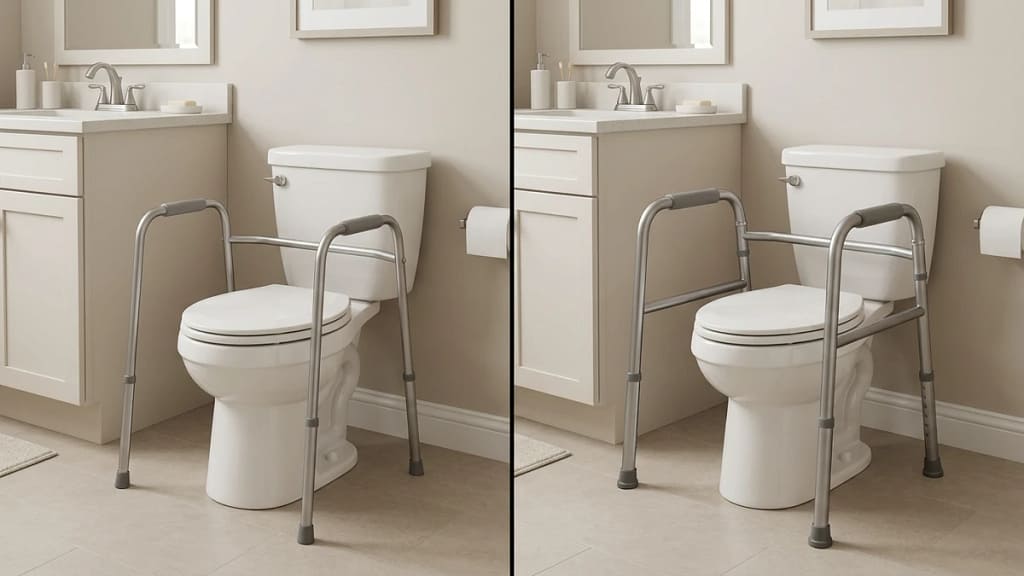
A higher-capacity frame often makes more sense when the setup already feels borderline or when daily use puts more force through the handles.
This is more likely when:
- body weight is higher
- the user pushes down hard while standing
- transfers happen many times a day
- lighter frames already feel less reassuring
For example, a frame may technically work for basic use but still feel less stable when the user depends on it heavily during every transfer. In that situation, moving to a stronger design is often a better solution than continuing with a frame that only feels “good enough.”
A higher-capacity frame is usually the better choice when the user needs consistent support, not just occasional assistance.
How to Choose a Toilet Safety Frame Based on Weight Support
Choosing based on weight support means looking beyond one number and thinking about how the frame will be used every day.
Focus on:
- the user’s actual support needs
- how forcefully the handles are used during standing
- how stable the frame feels under uneven pressure
- whether the bathroom layout supports a secure setup
- whether the frame is for short-term or long-term use
For example, a frame that looks acceptable for occasional help may not be the right choice for a user who relies on it during every transfer.
The best decision usually comes from matching the frame to real use, not just to the minimum listed requirement. This guide on how to choose a toilet safety frame explains how support level, fit, and daily use patterns should be weighed together.
A stronger setup is usually the better choice when the current one already feels close to its limit.
Toilet Safety Frame vs Grab Bars for Weight Support
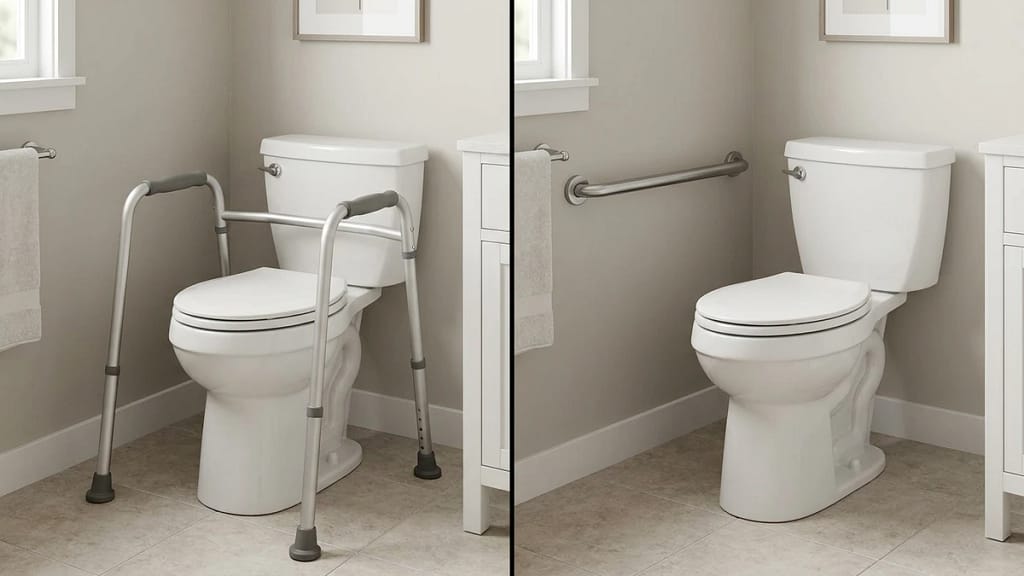
A toilet safety frame and grab bars both provide support, but they do it in different ways. The better option depends on where support is needed most and how the user transfers on and off the toilet.
The main difference is:
- Toilet safety frames
Usually work best when the user needs side support positioned close to the toilet and close to the body during transfers. - Grab bars
Often feel more secure when fixed wall support is the main need and the bathroom layout allows proper placement.
In real use, a toilet safety frame is often helpful when someone wants both hands close to the toilet while pushing up. Grab bars can make more sense when the user needs stable support from the wall rather than a frame around the toilet base.
For example, someone who pushes down heavily while standing may prefer the close hand placement of a toilet safety frame, while another person may feel more secure with firmly installed grab bars that stay fixed to the wall.
If the goal is to compare these support styles more directly, this guide on toilet grab bars vs toilet safety frames explains how the two differ in real bathroom use.
The better option depends on where the support is needed most and how the user transfers on and off the toilet.
Common Mistakes When Judging Toilet Safety Frame Capacity
A toilet safety frame can be misjudged in a few common ways.
These are the biggest ones:
- Assuming the listed weight tells the whole story
A strong number does not guarantee the frame will feel secure in every bathroom setup. - Ignoring setup quality
A good frame can still feel less stable if it is not adjusted or positioned well. - Overlooking side pressure
Many users place more force on one handle than the other during standing. - Choosing by size alone
A larger or bulkier frame is not always the most stable option.
The safest choice comes from looking at both the capacity rating and how the frame behaves during actual transfers.
What I Recommend
The most practical approach is to choose a toilet safety frame that comfortably exceeds the user’s real support needs rather than one that only barely meets them.
That usually means:
- prioritize secure feel over minimum specs
- pay attention to how the frame handles uneven pressure
- do not keep using a frame that already feels borderline
- choose a sturdier design when the user depends on the frame heavily
If the next step is comparing stronger options directly, this roundup of the best toilet safety frames for seniors helps narrow down which designs make the most sense for higher support needs and daily use.
The best toilet safety frame is the one that feels reliably steady during real movement, not just one that lists a high number.
FAQ
What is the average weight limit for a toilet safety frame?
Many standard toilet safety frames are rated around 250 to 300 pounds, while higher-capacity models may support 400 to 500 pounds or more depending on the design.
Can a toilet safety frame hold full body weight?
Some can handle substantial downward pressure, but they should still be judged by real-world stability and not by the number alone.
Are folding toilet safety frames weaker?
Not always, but some users find fixed frames feel more rigid and more predictable during daily use.
How do I know if a toilet safety frame feels secure?
Check for rocking, handle flex, uneven pressure points, and movement during the full sit-to-stand transfer.
When should a heavier-duty toilet safety frame be used?
A heavier-duty frame makes more sense when body weight is higher, push-off force is stronger, or the current setup already feels borderline.
Final Thoughts
A toilet safety frame can often support a significant amount of weight, but the listed capacity is only part of the decision.
In practice, the answer to how much weight can a toilet safety frame hold depends on both the listed rating and how secure the frame feels during real sit-to-stand use.
Real-world support depends on how the frame is built, how force is applied during sitting and standing, and how secure the setup feels in daily use. A frame that looks strong on paper still needs to feel stable in practice.
The safest choice is usually the frame that combines appropriate capacity with solid setup, predictable support, and the right level of stability for the user’s daily routine.
