
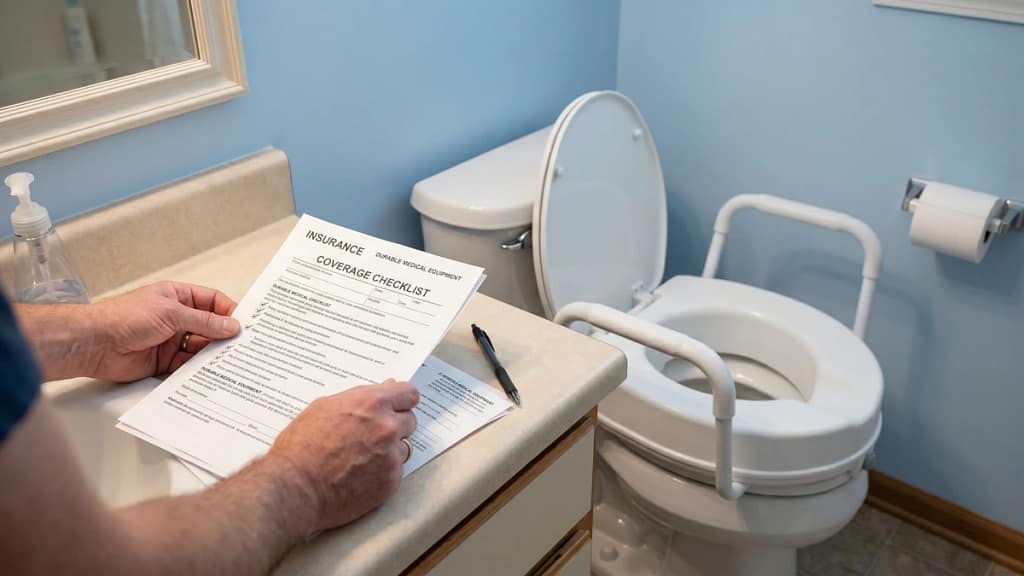
Raised toilet seats can be useful when a low toilet makes sitting down or standing up more difficult. They are often considered after surgery, with arthritis, or when bathroom transfers start feeling less controlled.
A common question is: does Medicare cover raised toilet seats? In most cases, Original Medicare generally does not cover standard raised toilet seats, even when they are helpful for daily bathroom use.
The details can still be confusing because related bathroom equipment may be treated differently. Medicare Advantage plans and other insurance may also have different rules or extra benefits. This guide explains the main coverage issue, the difference between raised toilet seats and commode chairs, and what to check before buying.
Disclosure: As an Amazon Associate, I earn from qualifying purchases. This post may contain affiliate links. If you purchase through these links, I may earn a small commission at no extra cost to you. I only recommend products I would feel comfortable using in my own home. Learn more.
On This Page
- Why Original Medicare Usually Does Not Cover Raised Toilet Seats
- Raised Toilet Seat vs Bedside Commode Coverage
- Does a Doctor’s Prescription Change the Answer?
- What About Medicare Advantage Plans?
- When a Raised Toilet Seat May Still Be Worth Considering
- When Disability or Mobility Needs Are Broader Than Toilet Height
- What to Ask Before Trying to Get Coverage
- When You May Need to Compare Out-of-Pocket Options
- Common Mistakes to Avoid
- What I Recommend
- FAQ
- Final Thoughts
Quick Answer
Original Medicare generally does not cover standard raised toilet seats. They are usually treated differently from covered durable medical equipment. Some related items, such as certain commode chairs, may be covered when Medicare rules are met, and Medicare Advantage benefits may vary by plan.
- Standard raised toilet seats are usually not covered by Original Medicare
- A doctor’s recommendation does not automatically make every bathroom item covered
- Commode chairs are a separate coverage category
- A commode chair used mainly over the toilet as a raised seat may not be covered the same way as a medically necessary bedside commode
- Medicare Advantage plans may offer extra benefits, but coverage depends on the plan
- Many families may still need to compare out-of-pocket options
The safest approach is to check the person’s exact Medicare coverage before assuming payment. That means confirming whether the item is considered covered DME, whether a doctor’s order is needed, and whether the supplier or plan requirements are met.
A raised toilet seat may still be useful even when it is not covered. The coverage decision and the practical bathroom-safety decision are related, but they are not the same thing.
Why Original Medicare Usually Does Not Cover Raised Toilet Seats
Original Medicare Part B can cover certain durable medical equipment when the item is medically necessary, ordered by a qualified provider, and meets Medicare rules. However, not every helpful home safety item qualifies as covered DME.
Raised toilet seats are generally treated as a non-covered item under Original Medicare. The usual reason is that they are classified more like a convenience or hygienic bathroom item than a covered medical device.
This does not mean a raised toilet seat has no practical value. It only means Medicare coverage rules may not treat it the same way as items such as walkers, wheelchairs, hospital beds, or certain commode chairs.
This distinction matters because families sometimes assume that a product is covered if it helps with mobility or bathroom safety. Medicare coverage depends on the item category, medical necessity rules, documentation, and supplier requirements.
The safest wording is: Original Medicare generally does not cover standard raised toilet seats, but related equipment and Medicare Advantage benefits should be checked separately.
Raised Toilet Seat vs Bedside Commode Coverage
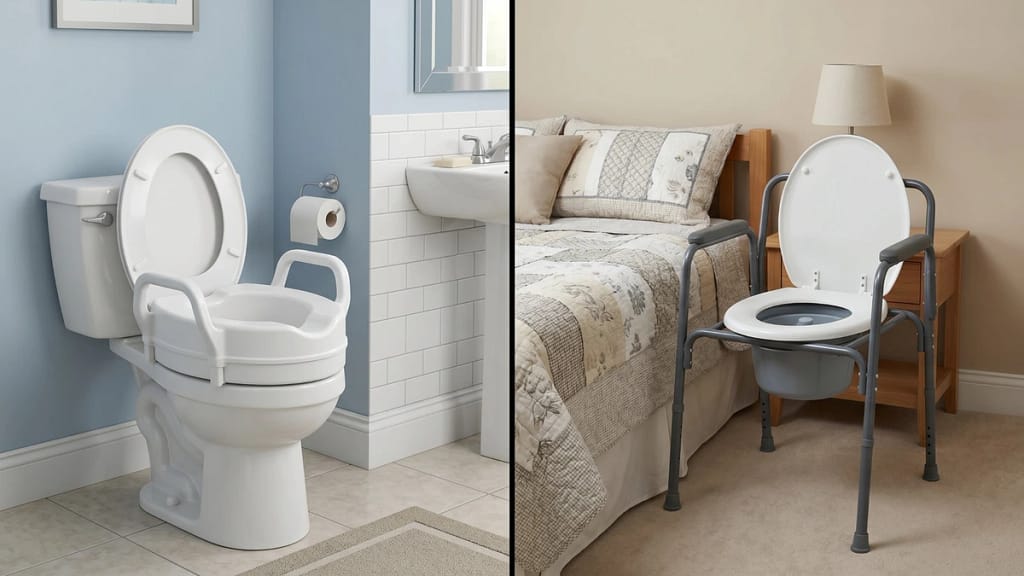
A raised toilet seat and a bedside commode are not the same item for coverage purposes. This distinction matters because one bathroom product may look similar to another but be treated differently under Medicare rules.
A raised toilet seat usually:
- attaches to or sits on an existing toilet
- adds height to the toilet
- may or may not include handles
- depends on the bathroom toilet already being used
- is generally treated as noncovered by Original Medicare
A bedside commode usually:
- is a separate toilet-style chair
- may be used beside the bed or in another room when bathroom access is difficult
- is treated as a different equipment category
- may be covered when Medicare criteria are met
The important nuance is how the item is being used. A commode chair may be covered when it meets Medicare’s commode-chair criteria, but a commode chair used mainly as a raised toilet seat over the toilet may not be covered the same way.
The practical difference also matters in daily use. A raised toilet seat can be simpler when the main issue is low toilet height. A bedside commode may be considered when getting to the bathroom is difficult or when a separate toilet-style chair is needed. This guide on raised toilet seat vs bedside commode explains the everyday-use differences more clearly.
Before assuming coverage, confirm exactly what item is being recommended and how it will be billed: a raised toilet seat, a bedside commode, a commode chair used over the toilet, or another bathroom support device.
Does a Doctor’s Prescription Change the Answer?
A doctor’s order can be important for covered DME, but it does not automatically make every bathroom item covered by Medicare. The item itself still needs to fit Medicare’s coverage rules.
For example, a doctor may recommend a raised toilet seat because it could make bathroom transfers easier. That recommendation may be helpful for care planning, but it does not necessarily change how Original Medicare classifies the item.
This is where confusion often happens. Families may hear “medically recommended” and assume that means “covered.” Medicare coverage usually depends on more than the recommendation alone.
Before buying, it may help to ask:
- Is this item covered under Original Medicare?
- Is the item considered DME?
- Is a doctor’s order required?
- Does the supplier accept Medicare assignment?
- Would a commode chair or another item be treated differently?
- Is there a Medicare Advantage benefit that may apply?
The safest step is to ask the doctor, supplier, or plan to clarify what Medicare is likely to cover before relying on reimbursement.
What About Medicare Advantage Plans?

Medicare Advantage plans can be different from Original Medicare. These plans must cover medically necessary services that Original Medicare covers, but some plans may also offer extra benefits that Original Medicare does not.
That means a raised toilet seat might not be covered by Original Medicare, but a Medicare Advantage plan may have supplemental benefits, over-the-counter allowances, or other plan-specific benefits that could help with certain bathroom safety items.
However, this is not guaranteed. Medicare Advantage coverage depends on the specific plan, the benefit year, the plan documents, and sometimes prior authorization or approved supplier rules.
For this reason, the safest advice is to check the plan directly. Useful places to check include:
- Evidence of Coverage documents
- OTC benefit catalog
- member services
- plan website
- care manager or case manager, if available
- prior authorization rules
A plan representative can explain whether the item is covered, whether an allowance can be used, and whether the item must be purchased through a specific supplier or catalog.
When a Raised Toilet Seat May Still Be Worth Considering
A lack of Medicare coverage does not mean a raised toilet seat is never useful. It only means the person may need to pay out of pocket or look for another benefit source.
A raised toilet seat may still be worth considering when:
- the toilet feels too low
- standing up from the toilet takes extra effort
- knee or hip bending feels difficult
- recovery makes lower seating harder
- bathroom transfers feel slower or less controlled
The key question is whether toilet height is part of the problem. If the person mainly struggles because the toilet is too low, added height may help make the movement easier. This guide on when seniors should use a raised toilet seat explains the movement signs that may point toward added height.
Arthritis is another common reason families consider raised toilet seats. When knee, hip, hand, or grip discomfort affects toilet transfers, height and support features may both matter. This guide on raised toilet seats for seniors with arthritis explains how joint pain can affect the choice.
The practical decision should still be based on fit, height, stability, and support needs, even when insurance coverage is limited.
When Disability or Mobility Needs Are Broader Than Toilet Height
Some people need more than a raised toilet seat. The problem may not be only that the toilet is too low. It may also involve balance, transfer control, hand support, bathroom space, or the ability to reach the toilet safely.
A broader support plan may be needed when:
- standing balance is uncertain
- the person needs help turning or positioning
- hand support is needed during transfers
- the bathroom layout is tight or awkward
- the person cannot safely get to the toilet every time
In these situations, a raised toilet seat may solve only one part of the problem. A toilet safety frame, commode chair, grab bars, or another setup may need to be discussed with a clinician, therapist, or equipment supplier.
This is especially important for disabled adults whose bathroom-use needs may involve more than seat height. This guide on raised toilet seats for disabled adults explains how height, support, and transfer needs can overlap.
The safest choice is usually based on the full bathroom routine, not only the product category.
What to Ask Before Trying to Get Coverage
Before trying to get Medicare or another plan to pay for bathroom equipment, it helps to ask specific questions. This can prevent confusion between raised toilet seats, commode chairs, and other support devices.
Useful questions include:
- Is the item classified as covered DME?
- Is the item a raised toilet seat, commode chair, or another device?
- Is a doctor’s order required?
- Does the supplier participate in Medicare?
- Does the person have Original Medicare or Medicare Advantage?
- Does the Medicare Advantage plan have OTC or supplemental benefits?
- Is prior authorization required?
- What out-of-pocket cost should be expected?
It is also helpful to ask the supplier how the item will be billed. A product that looks similar to another bathroom aid may still fall under a different coverage category.
How to check before buying:
Ask the doctor, supplier, or plan for the exact item name, billing category, required documentation, supplier rules, and expected out-of-pocket cost before purchasing. Do not rely only on a product name such as “toilet riser,” “commode,” or “raised seat,” because similar products may be billed differently.
The safest approach is to confirm coverage before purchase whenever reimbursement is expected.
When You May Need to Compare Out-of-Pocket Options
If Medicare does not cover a raised toilet seat, many families compare out-of-pocket options. In that case, the decision should still be practical, not rushed.
Important factors include:
- toilet shape
- amount of added height
- stability
- handle support
- ease of cleaning
- bathroom clearance
- short-term vs long-term use
The least expensive option is not always the best fit. A seat that rocks, shifts, or does not match the toilet can create a new problem even if it costs less.
For readers who need to compare options after confirming coverage limits, this guide to the best raised toilet seats for seniors compares different raised toilet seat styles based on fit, support, and everyday usability.
Out-of-pocket buying should still start with the user’s real bathroom need: height, support, stability, or a different equipment type altogether.
Common Mistakes to Avoid
A few common mistakes can make Medicare coverage and equipment decisions more confusing.
The biggest ones are:
- Assuming Medicare covers all bathroom safety equipment
Some bathroom items may be helpful but still not covered by Original Medicare. - Assuming a prescription guarantees coverage
A doctor’s recommendation may matter, but the item must still meet coverage rules. - Confusing raised toilet seats with commode chairs
These are different equipment categories and may be treated differently. - Buying before checking fit
Even if paying out of pocket, the seat still needs to match the toilet and bathroom. - Ignoring whether height alone solves the problem
Some people need side support, transfer support, or a different device.
The safest process is to separate two questions: whether the item is covered and whether the item is actually the right bathroom support choice.
What I Recommend
The most practical approach is to confirm coverage before assuming Medicare will pay for a raised toilet seat.
A careful process is:
- ask whether the item is covered under the person’s exact plan
- separate raised toilet seats from commode chairs
- ask the doctor, supplier, or plan what documentation is needed
- check Medicare Advantage supplemental benefits if applicable
- compare out-of-pocket options only after the coverage question is clear
If paying out of pocket, choose based on fit, height, stability, and support needs. A raised toilet seat should not be chosen only because it is inexpensive or easy to buy.
The right decision should match both the coverage situation and the person’s real bathroom-use needs.
FAQ
Does Medicare cover raised toilet seats?
Original Medicare generally does not cover standard raised toilet seats. Medicare Advantage benefits may vary by plan, so it is worth checking the person’s specific coverage.
Does Medicare cover raised toilet seats with handles?
Original Medicare generally treats raised toilet seats as non-covered, and handles alone do not usually change that classification. A specific plan or supplier should be asked before assuming coverage.
Will a doctor’s prescription make a raised toilet seat covered?
Not necessarily. A doctor’s recommendation can be important for covered DME, but it does not automatically make every bathroom item covered.
Does Medicare cover bedside commodes instead?
Medicare may cover certain commode chairs when coverage rules are met. A bedside commode is different from a standard raised toilet seat.
Can Medicare Advantage pay for a raised toilet seat?
Some Medicare Advantage plans may offer extra benefits or allowances that Original Medicare does not. Coverage depends on the specific plan, so member services or the plan documents should be checked.
Final Thoughts
Original Medicare generally does not cover standard raised toilet seats. Some related equipment, such as certain commode chairs, may be treated differently when Medicare rules are met, but the exact item and how it is used still matter. Medicare Advantage plans may also vary, especially when extra benefits or OTC allowances are involved.
Because coverage can depend on plan type, item classification, documentation, and supplier rules, it is safest to check before buying.
A raised toilet seat may still be useful even if it is not covered. The best next step is to confirm coverage first, then choose any bathroom equipment based on the person’s height, stability, support, and transfer needs.
