

When an aging parent starts gripping the wall on the way into the shower, or quietly begins skipping washes because standing feels unsteady, a shower chair is usually the first thing families look into. It is an affordable, widely available way to make bathing safer. But are shower chairs safe for seniors in every case? Not automatically. Safety depends on how the chair is chosen and used, not on the chair alone.
Falls are the leading cause of injury for adults 65 and older, and the bathtub and shower area is the single most hazardous spot in the home for fall injuries. The data on senior bathroom falls provides more context on that risk.
A shower chair can lower that risk during the moments it matters most. It can also give a false sense of security when the wrong type is used. This guide covers both sides so the decision is a confident one.
Disclosure: As an Amazon Associate, I earn from qualifying purchases. This post may contain affiliate links. If you purchase through these links, I may earn a small commission at no extra cost to you. I only recommend products I would feel comfortable using in my own home. Learn more.
On This Page
Quick Answer
Yes, shower chairs are generally safe for seniors and can meaningfully reduce the risk of falls during bathing, as long as the chair fits the user and the space, sits stably on non-slip feet, and is used alongside grab bars rather than as a replacement for them.
A shower chair is most likely to be safe when:
- It is rated for the user’s weight, with the listed capacity comfortably above their body weight.
- Its height lets the user sit with feet flat on the floor and knees near a right angle.
- All four feet make firm, non-slip contact with the shower or tub floor.
- Grab bars are within easy reach for sitting down and standing up.
- The user still has enough balance and awareness to use it safely, or has someone nearby if they do not.
The chair reduces risk mainly by removing the need to stand on a wet surface for the length of a shower. Standing, turning, and reaching are the movements where balance is most likely to fail. Sitting through most of the shower takes those high-risk moments out of the routine. The remaining risk sits in the transfer, getting in and out, which is why fit and grab bars matter as much as the chair itself.
When a Shower Chair Actually Helps a Senior
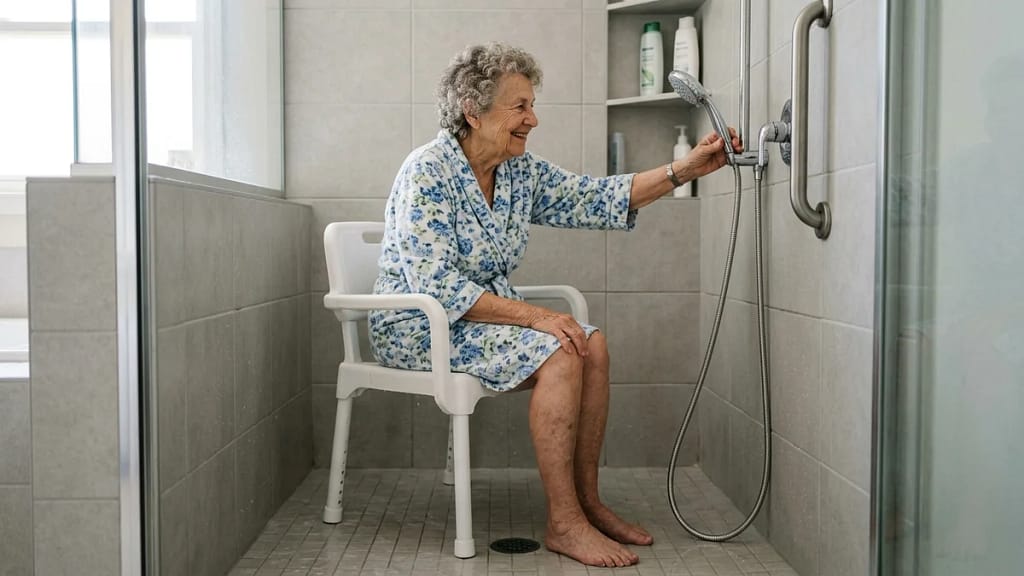
A shower chair earns its place when standing has become the hard part of bathing. Seated bathing directly addresses fatigue and balance by letting the user sit for the parts of the shower that take the longest, washing, rinsing, and reaching, instead of holding a standing position on a slick surface.
The clearest signs a shower chair would help include:
- Legs that tire or feel shaky partway through a shower.
- Dizziness or lightheadedness when standing in warm water.
- Difficulty with the one-legged balance needed to step over a tub wall.
- A recent fall, or a growing habit of leaning on the wall or shower door.
- Recovery from surgery or an illness that has temporarily reduced strength.
The benefit is strongest during transitions. Getting in and out of the tub or shower is one of the most dangerous parts of the whole routine, and CDC injury data attributes close to 10 percent of bathroom injuries specifically to getting out of the tub or shower. A chair gives the user a stable place to lower onto and rise from, which shortens the moment spent unsupported.
Real-life example:
Someone recovering from hip surgery is often advised to sit while bathing during the weeks when standing strength and balance are still returning. A well-fitted shower chair lets them keep washing daily without the standing risk, and it usually comes out of the bathroom once mobility improves.
For readers who have decided a chair makes sense and want to compare options, the best shower chairs for seniors guide walks through the common types and who each one suits.
When a Shower Chair Can Be Unsafe
A shower chair is not automatically safe. A few common situations turn it into a hazard rather than a help:
- Wrong type for the space. A chair that doesn’t actually fit your tub can rock or shift under the user’s weight — width and a curved floor are the usual culprits.
- A chair that slides. Worn or poorly gripping feet on a wet, smooth surface let the chair move at the worst possible moment.
- Too little support for the user. A lightweight backless stool suits a steady user in a walk-in shower, but it offers no back or side support for someone whose balance is already uncertain.
- Improvised handholds. Leaning on a towel bar, soap shelf, or the chair arm during the transfer invites a fall, because none of those are built to hold body weight.
- Overreliance. A chair helps with standing and fatigue. It does not manage confusion, severe balance loss, or the judgment needed to move safely.
Important note:
Never use a towel bar or shelving unit as a grab bar. Occupational therapists at the Shirley Ryan AbilityLab warn that these are not built to hold body weight and can pull loose during a transfer. If balance support is needed, install a real grab bar.
None of these situations are reasons to avoid a shower chair. Each one points back to the same fix: match the chair to the user and the space, keep its feet in firm contact with the floor, and pair it with grab bars for the transfer a chair cannot support on its own.
For the specific steps that keep that transfer safe, see how to use a shower chair safely.
How to Check a Shower Chair Fits and Stays Stable
Fit should come before features. A chair with adjustable arms and a padded seat still is not safe if it wobbles or sits at the wrong height. Before the chair becomes part of a daily routine, run this short stability and fit check:
- Press down on each corner. All four feet should stay flat with no rock or shift. If it rocks, the height settings are uneven or the floor is too curved for that model.
- Check the seat height. With the user seated, feet should rest flat on the floor and knees should sit near a right angle. A seat that is too high leaves feet dangling; too low makes standing harder.
- Confirm the width suits the user. The seat should support the hips comfortably without the user perching on the edge.
- Confirm the leg locks are engaged. Height-adjustable legs should click firmly into place, with the same setting on all four.
- Check the weight rating. The listed capacity should sit comfortably above the user’s body weight, not right at it.
Each of these checks ties back to the broader buying decision covered in how to choose a shower chair for elderly.
Weight is worth its own attention, because exceeding the rating is a leading cause of a chair tipping or a frame giving way. Always check the shower chair’s weight limit against the user’s weight before the first use, and treat the listed capacity as one part of the decision rather than a guarantee. If the user is near the upper end of a standard rating, a heavy-duty model is usually the safer choice.
These checks are easier to act on before buying than after. Measuring the space first, then matching the seat height, width, and weight rating to the user, is usually what prevents the common outcome: a chair that fits the person but not the shower, or the shower but not the person.
Non-Slip Feet and Floor Surface
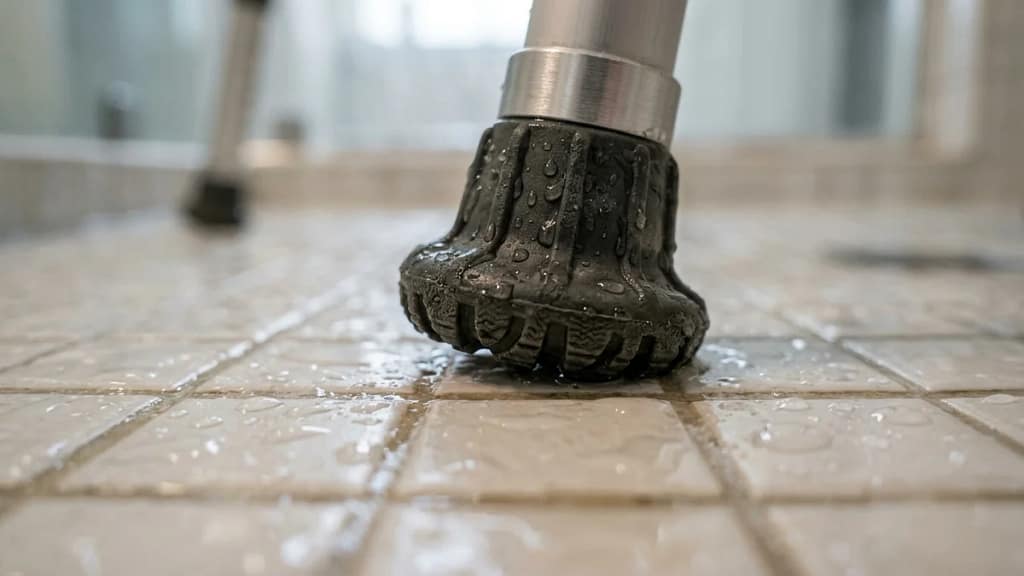
The point where the chair meets the floor is where stability is won or lost. Most shower chairs come with rubber tips or suction-style feet designed to grip a wet surface, and they work well when they are in good condition and making full contact. They tend to fail in a few predictable ways:
- Worn rubber tips. Months of use wear the tips smooth, and smooth rubber loses its grip on a wet floor.
- Soap and conditioner film. A slick residue on the shower floor reduces friction even for feet that look fine.
- Suction feet on the wrong surface. Suction only holds on a smooth, flat base, so it may not seal on textured or tiled floors.
- A smooth tub floor. Acrylic or fiberglass bases are far more slippery when wet than a textured floor that gives the feet something to bite into.
A non-slip bath mat under the chair adds grip on a smooth floor, as long as the mat itself is secured and the chair feet sit fully on it rather than half on, half off. A short maintenance habit helps too: check the feet every few weeks, rinse away soap buildup, and replace the rubber tips once they wear smooth. Feet in good condition are what keep the chair steady as it ages, and they are the cheapest part of the setup to replace.
Do You Still Need Grab Bars With a Shower Chair?
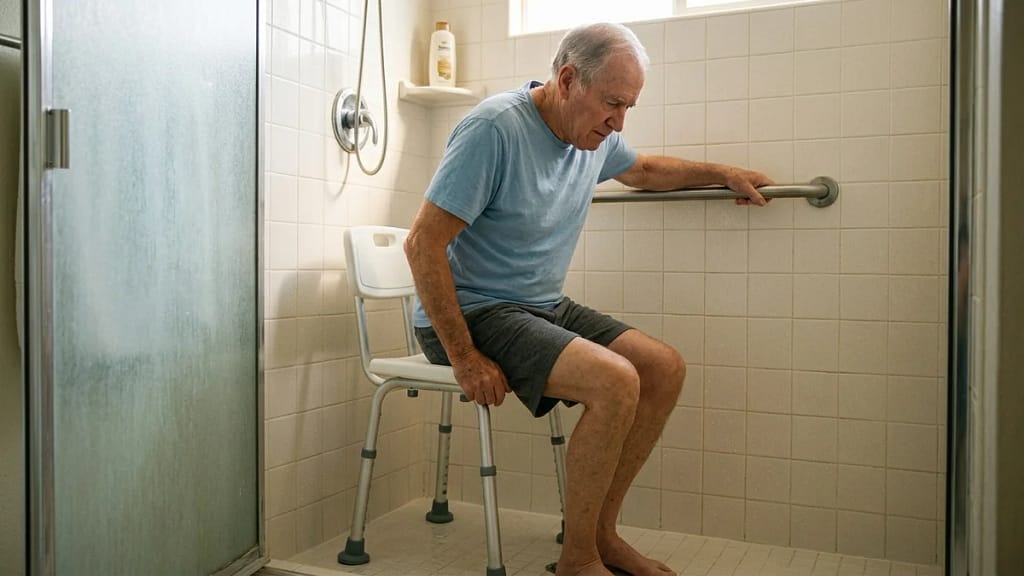
Yes. A shower chair and grab bars solve different problems, and the safest bathrooms use both:
- The chair supports the user while seated, through the washing and rinsing that take up most of the shower.
- Grab bars support the transfer, the moment of lowering onto the seat and rising back up, when balance is most likely to shift.
Occupational therapists generally treat properly installed grab bars as the baseline recommendation for bathroom safety, not an optional add-on. A bar mounted into wall studs gives the user a fixed, weight-bearing handhold that a chair cannot provide during the stand-up movement. Reaching for a chair arm while rising is far less stable than pulling up on a securely mounted bar. If there is any doubt about whether they earn their place, it helps to understand whether grab bars are safe for seniors and how they reduce risk.
Placement matters as much as having them. A bar should sit where the hand naturally reaches during the transfer, close enough to grip before balance begins to shift. A grab bar placement diagram shows where bars generally work best around a shower and tub.
When a Senior Shouldn’t Shower Alone, Even With a Chair
A shower chair supports the body. It does not supply judgment, awareness, or the ability to react to a problem, and that limit is where supervision comes in. Some situations call for someone nearby regardless of the equipment:
- Dementia or significant memory loss, which can make the user forget how to use the chair or become disoriented by the water and surroundings.
- Severe or worsening balance problems, where even a seated transfer is unreliable.
- Frequent dizziness, including blood-pressure drops on standing.
- A recent fall, which signals that current supports may not be enough on their own.
Supervision does not have to mean hovering. For many users it means a helper staying within earshot, checking in, and being ready to assist with the transfer rather than watching the entire shower. The goal is to have help available at the two riskiest moments, getting in and getting out. When the level of support needed is unclear, an occupational therapist can assess the specific person and bathroom and recommend the right setup. If the user consistently needs a hand to move safely even with a chair and grab bars in place, that is a signal the situation has moved beyond what a chair alone can cover.
What I Recommend
For most seniors, I recommend treating the shower chair as one layer of a safer bathroom rather than a complete fix. A stable chair sized to the user, sitting on non-slip feet you have actually tested, paired with grab bars mounted into the wall, covers both the seated part of the shower and the riskier transfer.
Before settling on a setup, it helps to work through this:
- measure the shower or tub floor so the chair actually fits the space
- match the seat height and width to the user, not just to the average
- confirm the listed weight rating sits well above the user’s weight
- test all four feet for grip on the wet floor before the first real shower
- add grab bars positioned for the sit-down and stand-up movement
- take an honest look at balance and memory to decide whether supervision is needed
The right choice is not the chair with the most features or the highest price. It is the setup that matches the user’s real movement, the bathroom layout, and how much support they genuinely need. If balance is truly unreliable, a transfer bench across a tub wall may be safer than a chair inside it.
FAQ
Is a shower chair safer than standing in the shower?
For a senior with balance or fatigue concerns, sitting is usually safer than standing, because it removes the need to hold balance on a wet surface for the length of a shower. The transfer in and out still carries risk, which is why grab bars remain important alongside the chair.
Do you still need grab bars if you use a shower chair?
Yes. A chair supports the user while seated, but grab bars support the stand-up and sit-down transfer, which is the riskiest part of the movement. The two work together, and using a chair is not a reason to skip grab bars.
Can a shower chair help after surgery?
Yes. Sitting to bathe is commonly used during recovery from hip or knee surgery, when standing strength and balance are reduced. In these cases the chair is often a temporary support until mobility returns, and a therapist may advise on the safest setup.
Are shower chairs safe for someone with dementia?
A chair can help physically, but memory loss or confusion may prevent safe use, so supervision is usually needed. Someone with dementia may not remember how to use the chair or may become disoriented, which makes a caregiver’s presence more important than the equipment itself.
Is a shower stool stable enough for a senior?
A backless stool can suit a steady user in a walk-in shower, but it offers no back or side support. For a senior with uncertain balance, a chair with a backrest and armrests is usually the more dependable choice.
Do shower chairs actually prevent falls?
Shower chairs can reduce the risk of falls by removing the need to stand throughout a shower, but they should not be treated as a guarantee. Their effect is strongest when combined with grab bars, non-slip feet, and a bathroom setup matched to the user’s actual mobility.
Final Thoughts
A shower chair is one of the more effective, lower-cost changes a family can make to reduce bathing risk, and for a steady user it often restores the confidence to shower independently again. Its value comes from how it fits into the whole setup: the right size and height, non-slip contact with the floor, grab bars for the transfer, and a realistic read on whether supervision is needed. Chosen and used with those pieces in mind, it does exactly what families hope it will, making a daily routine safer without making the bathroom feel like a hospital.
