
Grab bars are often added after a fall, but the more useful time to plan them is before a person begins relying on towel bars, shower doors, walls, or furniture for balance.
If you’re asking whether grab bars are safe for seniors, the answer is generally yes—provided the bar, mounting method, wall structure, and placement match the support needed. A poorly mounted or badly positioned bar can create false confidence instead of dependable support.
For adult children or caregivers setting up a bathroom for someone else, the same principles apply — but the evaluation should be based on the user’s specific movements, reach, and strength rather than the caregiver’s own.
Disclosure: As an Amazon Associate, I earn from qualifying purchases. This post may contain affiliate links. If you purchase through these links, I may earn a small commission at no extra cost to you. I only recommend products I would feel comfortable using in my own home. Learn more.
On This Page
Quick Answer
Yes—grab bars are generally safe for seniors when the product, mounting method, wall structure, and placement match the support needed. They can provide a stable handhold during bathroom movements, but they should not be treated as a guarantee against falls.
- For daily support: Use a permanently mounted bar secured with the manufacturer’s approved hardware.
- For useful placement: The bar should be reachable before the user needs to lean, step, or change direction.
- For a usable grip: Choose a diameter, surface, and length that the user can hold comfortably.
- For temporary balance assistance: A suction bar may help only when the surface and intended use match the manufacturer’s instructions.
- Before relying on the bar: Check for movement, loose fittings, wall damage, or any change in stability.
Installation method is central to the decision. This guide explains when grab bars need to be screwed in and when an approved alternative mounting system may be appropriate.
Why Grab Bars Can Help During Bathroom Movements
Grab bars do not prevent every fall, but they can provide a stable handhold during movements that often challenge balance. The main benefit is having support available before the person reaches for a towel bar, shower door, wall, or another fixture that was not designed for support.
Common moments when a correctly placed bar may help include:
- stepping into or out of a shower or bathtub
- turning or changing direction on a wet surface
- standing up from or lowering onto a toilet
- moving between separate support points in the bathroom
Grab bars work best as one part of a broader safety plan rather than as a stand-alone guarantee. This guide on whether grab bars prevent falls explains both their value and their limits.
What Makes Grab Bars Safe for Seniors?

A dependable grab-bar setup depends on six connected factors. Each one affects whether the bar provides reliable support or creates a false sense of security.
1. Condition over time: The bar should remain free from movement, loose fittings, wall damage, corrosion, or rotating components.
2. Mounting and wall structure: The bar, fasteners, mounting device, and supporting wall must work together. A product’s listed capacity does not apply independently of the installation. This guide explains how much weight grab bars can hold and why mounting conditions matter.
3. Product type: Fixed, fold-down, clamp-on, and suction products serve different purposes. Choose a product designed for the amount and direction of support the user needs.
- Fixed bars are the most common and provide consistent support in a single position.
- Fold-down bars mount flush to the wall and swing out when needed — useful in smaller bathrooms.
- Clamp-on bars attach to the toilet without wall mounting, making them useful where drilling is not possible.
- Suction bars are temporary aids and are not equivalent to structurally mounted options.
4. Placement and orientation: The bar should be reachable during the actual movement without forcing the user to lean, twist, or step farther into a wet area. Use these grab bar placement height guidelines as a planning reference, then account for the user’s reach and bathroom layout.
5. Grip and length: Textured surfaces may add wet-hand traction, while smooth bars may feel more comfortable for sensitive hands. Length should provide useful hand positions without placing the bar beyond natural reach.
For seniors with arthritis or reduced hand strength, grip diameter matters more than surface texture alone. A bar between 1.25 and 1.5 inches in diameter is generally easier to hold without requiring a tight squeeze. Textured or non-slip finishes help in wet conditions, but a bar that is too thick or too smooth may be harder to grip securely regardless of the surface.
6. Ongoing inspection: Even a correctly installed bar can loosen over time. Periodic checks for movement, loose hardware, or wall deterioration around the flanges keep the installation reliable.
Where Should Grab Bars Be Installed to Be Safe?
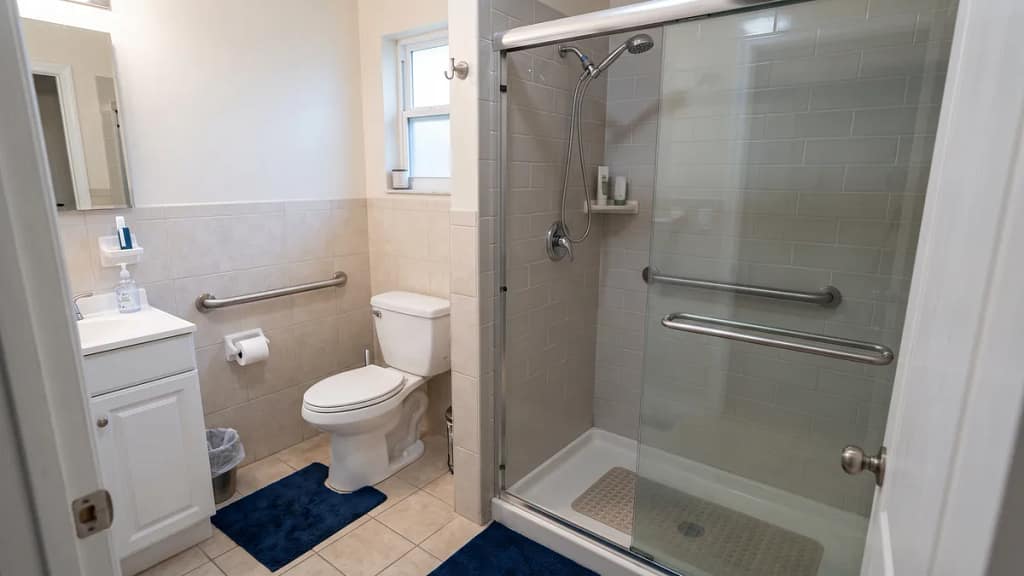
Placement determines whether a grab bar is actually usable during a balance-loss moment. A bar positioned out of natural reach — one that requires leaning, twisting, or stepping into a wet area before gripping it — does not provide support when it matters most.
A good setup often includes:
- a bar near the shower or tub entry
- a bar inside the shower for balance while standing/turning
- a support point near the toilet for sitting/standing transitions
A full placement guide with specific positioning guidance for each bathroom area is available here: where to install grab bars in a bathroom.
When Grab Bars Can Become Unsafe

A grab bar can create false confidence when the product, wall, fasteners, placement, or intended use do not match. Reliability depends on the complete installation—not only on how solid the bar feels during a light check.
Common problems include:
- Unapproved mounting hardware: Ordinary lightweight drywall anchors should not be treated as grab-bar mounting systems.
- Weak or damaged wall material: Loose tile, flexible panels, water damage, or missing structural support can undermine the installation.
- Poor placement: A bar that requires leaning, twisting, or stepping into the wet area before reaching it may not support the intended movement.
- Using the wrong product type: Different grab bar types — fixed, fold-down, clamp-on, and suction — are rated for different levels and directions of force. Using a product outside its intended use case, such as relying on a suction bar for standing transfers or a decorative bar for full body-weight support, removes the safety margin the product was designed to provide.
- Ignoring movement or looseness: A bar that shifts, rotates, flexes, or pulls away from the wall should not remain in use.
- Relying on a towel bar: Bathroom accessories that resemble grab bars are not automatically designed as transfer support.
The bar’s length or surface should also match the user and movement. A short or smooth bar is not automatically unsafe, but it may be unsuitable if the user cannot reach or hold it securely.
Are Suction Grab Bars Safe for Seniors?

Suction grab bars may be useful as temporary light-balance aids when the surface, installation, and intended use match the manufacturer’s instructions. They should not be treated as equivalent to structurally mounted support.
Before using a suction bar:
- confirm that the surface is smooth, flat, clean, dry, and nonporous
- keep each suction cup fully inside the compatible surface rather than crossing grout lines
- close all locking mechanisms completely
- inspect and test the attachment with light hand pressure before each use
- reattach the bar immediately if there is movement or loss of suction
- do not use it for pulling upward, standing transfers, or body-weight support unless the manufacturer explicitly permits that use
Suction bars also carry lower force ratings than permanently mounted bars. They are designed for light balance assistance during low-load movements — not for pulling to standing or supporting full body weight during a transfer. Checking the manufacturer’s stated weight or force limit before use is advisable, particularly for heavier users.
This comparison of suction and permanent grab bars explains when temporary support may be reasonable and when structural mounting is the better choice.
Whether using a permanent or temporary bar, the installation process determines whether the support is reliable in practice.
How to Plan and Check a Grab Bar Installation
Plan the installation around the movement being supported rather than choosing a convenient empty space on the wall.
- Identify the movement. Shower entry, standing from the toilet, and balancing inside the bathing area may require different support points.
- Check natural reach. Mark a possible position and simulate the movement carefully — do not use the uninstalled bar for actual support during this step. The goal is to confirm the bar will be within natural reach before any drilling begins.
- Inspect the wall. Confirm the wall material, stud or backing location, possible plumbing or wiring, and the mounting methods approved for the specific product.
- Follow the manufacturer’s instructions. Use the specified fasteners, hole pattern, sealant, mounting system, and torque requirements. This guide on installing grab bars into studs explains the structural-mounting process in more detail.
- Inspect the finished installation. The bar should not rotate, flex at the flange, pull away from the wall, or show movement in the surrounding surface.
- Recheck it over time. Stop using the bar and inspect the installation if movement, loose hardware, damaged grout, cracked tile, corrosion, or wall deterioration appears.
When professional installation is worth considering:
- Wall structure or stud location cannot be confirmed with a standard stud finder
- The surface is tile or fiberglass that may crack during drilling
- The required mounting position does not align with available studs or backing
- The user depends heavily on the bar for standing transfers rather than light balance support
What I Recommend
The practical answer to whether grab bars are safe for seniors depends on matching the support to the movement and installing it with approved hardware.
- For regular daily support: Start with a permanently mounted bar and a wall structure or mounting system approved for that product.
- For showers and bathtubs: Identify whether support is needed at the entrance, inside the wet area, or at both movement points.
- For toilet transfers: Place support where the hand naturally reaches while sitting down and standing up.
- For temporary situations: Limit suction products to the light-balance use and compatible surfaces specified by the manufacturer.
Grab bars address only one part of bathroom safety. A complete bathroom safety checklist can also help identify lighting, flooring, clutter, access, and equipment concerns.
FAQ
Can a grab bar be installed when no stud is available?
Sometimes. Use only a manufacturer-approved grab-bar mounting system that is compatible with the wall material and installation instructions. Ordinary lightweight wall anchors are not an equivalent substitute.
Should a grab bar move when pushed or pulled?
No. Stop using the bar if it shifts, rotates, flexes at the flange, or pulls away from the wall. Inspect the mounting hardware and surrounding wall before relying on it again.
How often should grab bars be checked?
Check them during routine bathroom cleaning and whenever the user notices movement, new wall damage, corrosion, loose hardware, or a change in how the bar feels.
Are grab bars enough to make a bathroom safe?
Not by themselves. Lighting, nonslip surfaces, clear walking paths, suitable toilet and bathing equipment, and the user’s mobility needs should also be considered.
Final Thoughts
Are grab bars safe for seniors? Generally, yes—when the product is suitable for the intended movement and the complete installation is secure.
Reliability depends on more than the bar itself. Wall structure, approved hardware, placement, grip, length, and ongoing inspection all affect whether the support remains useful.
A grab bar that is properly matched to the movement, correctly mounted, and regularly checked remains one of the most reliable fall-prevention tools available in a standard bathroom. For help selecting the right type, this guide to the best grab bars for seniors covers permanent, fold-down, textured, compact, and temporary options side by side.