
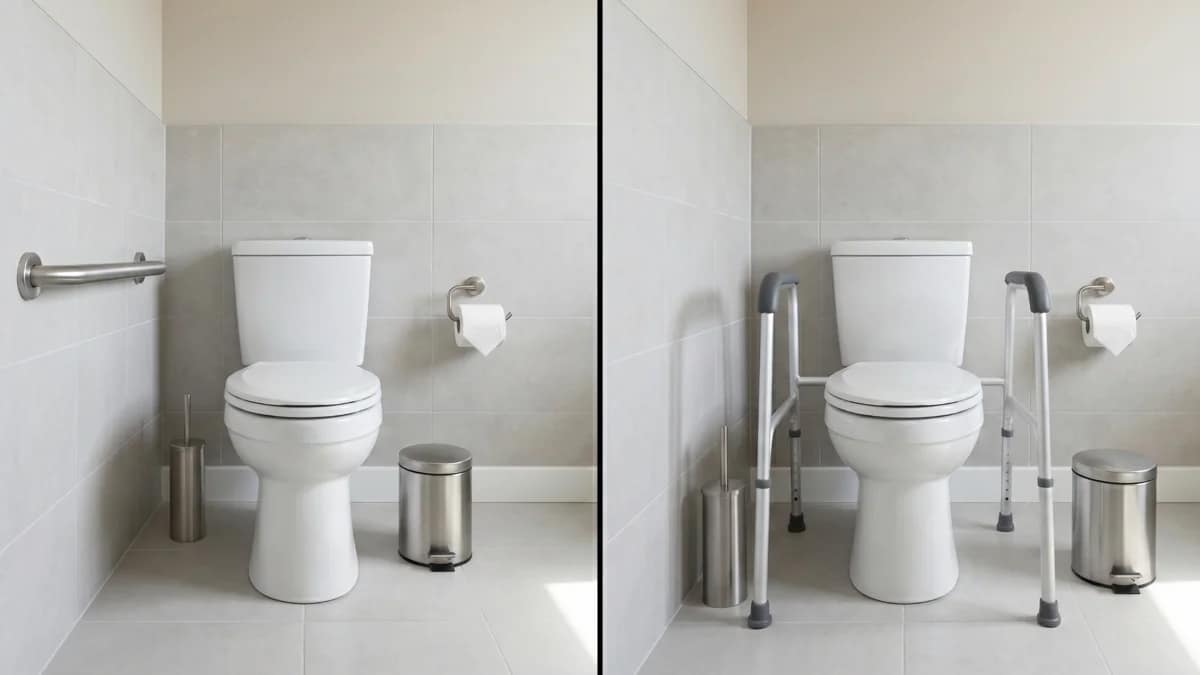
Choosing between toilet grab bars and toilet safety frames can make a big difference in how safe and supported a bathroom feels for a senior.
Both are designed to help with sitting and standing, but they work in very different ways. One provides fixed wall-mounted support, while the other offers freestanding assistance on both sides of the toilet.
The better choice depends on how much support is needed, how the person actually stands up, and what the bathroom layout allows.
This guide compares toilet grab bars vs toilet safety frames based on stability, setup, space, and real-life use so the decision is easier to make.
Disclosure: As an Amazon Associate, I earn from qualifying purchases. This post may contain affiliate links. If you purchase through these links, I may earn a small commission at no extra cost to you. I only recommend products I would feel comfortable using in my own home. Learn more.
On This Page
- What Are Toilet Grab Bars?
- What Are Toilet Safety Frames?
- Toilet Grab Bars vs Toilet Safety Frames: Practical Comparison
- Which Option Is Safer for Seniors?
- When Grab Bars Are the Better Choice
- When Safety Frames Are the Better Choice
- Can You Use Grab Bars and Safety Frames Together?
- Common Mistakes When Choosing
- What I Recommend
- FAQ
- Final Thoughts
Quick Answer
Toilet grab bars are usually better when you want a permanent, space-saving support point, while toilet safety frames are usually better when two-sided support and easier setup matter more.
- Choose grab bars when wall installation is possible and support is mainly needed from one side
- Choose safety frames when the user needs balanced support from both sides during sitting and standing
- Grab bars usually work better in tighter bathrooms
- Safety frames are often better for temporary setups, renters, or changing mobility needs
In practice, the safer option is the one that matches the person’s real movement pattern, balance needs, and bathroom layout.
What Are Toilet Grab Bars?
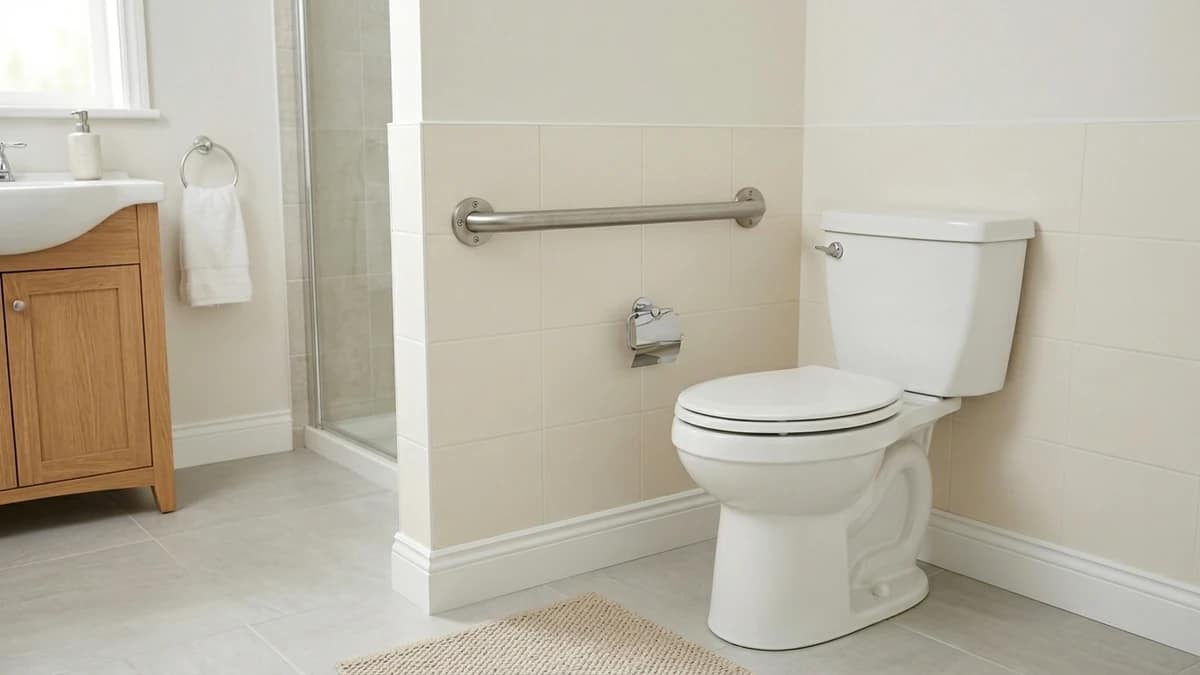
Toilet grab bars are fixed support bars installed near the toilet to help with sitting down, standing up, and maintaining balance during movement. They are usually mounted to the wall and designed to provide a stable handhold in a specific position.
Unlike freestanding support equipment, grab bars do not surround the toilet. Instead, they create a fixed support point that the user can hold when lowering down or pushing up.
Toilet grab bars are often best suited to situations where:
- the bathroom has enough wall access for proper installation
- the user mainly pushes from one side
- floor space around the toilet is limited
- a permanent, low-profile support solution is preferred
If a grab bar will be used for daily weight-bearing support, it also helps to understand grab bar weight limits and why proper mounting matters so much.
When installed correctly, grab bars can feel very stable and integrated into the bathroom layout. They are often the better option when the goal is long-term support without adding floor bulk around the toilet.
What Are Toilet Safety Frames?
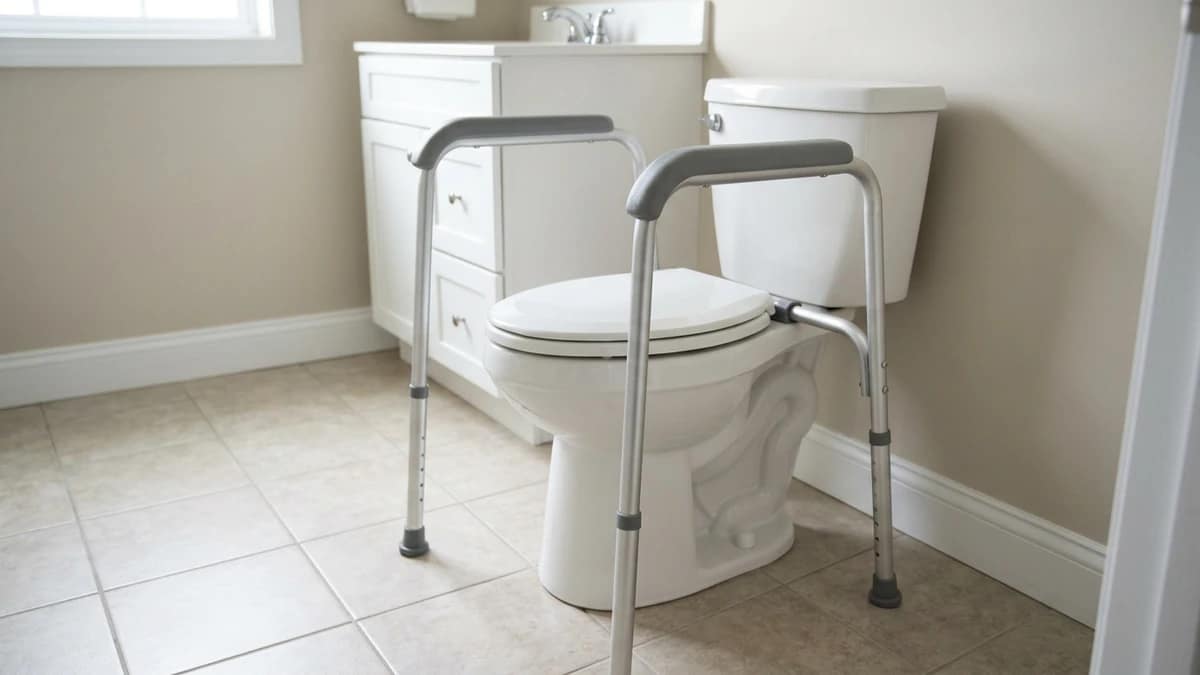
Toilet safety frames are freestanding or toilet-mounted support structures placed around the toilet to provide assistance during sitting and standing. Unlike wall-mounted grab bars, they usually offer support on both sides, which can make movement feel more balanced and controlled.
Because they sit around the toilet rather than attaching to the wall, safety frames are often easier to set up and do not usually require drilling. This makes them a practical option when bathroom modifications are not possible or when support needs may change over time.
Toilet safety frames are often best suited to situations where:
- the user relies on both arms during the stand-up motion
- balanced two-sided support feels safer than one fixed handhold
- drilling into walls is not allowed or not preferred
- the setup may need to be temporary, adjustable, or removable
If a frame sounds like the better direction, this guide on choosing a toilet safety frame explains which frame style, support level, and bathroom fit matter most.
For many seniors, safety frames feel more supportive because they provide a wider and more balanced base of assistance. They are often the better choice when stability during the full sit-to-stand movement matters more than saving floor space.
Toilet Grab Bars vs Toilet Safety Frames: Practical Comparison
Once the basic difference is clear, the better option usually comes down to how each one performs in real bathroom use. Stability, setup, space, cost, and long-term practicality all affect which solution feels safer and more appropriate.
Stability and Support Style
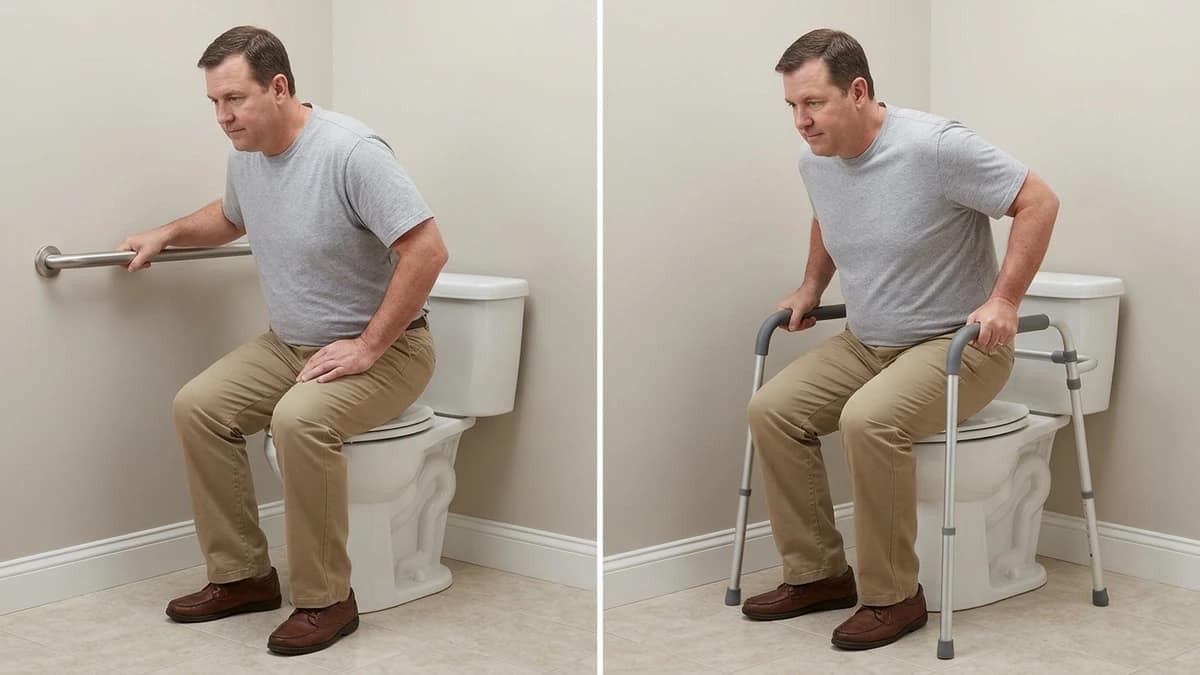
Toilet grab bars provide fixed support from a mounted position near the toilet. When installed correctly into wall studs or other proper structural support, they can feel extremely solid and reliable.
- best for users who mainly push from one side
- work well when a fixed handhold is enough
- do not move once properly installed
Toilet safety frames provide support on both sides of the toilet. This often feels more balanced for users who rely on both arms during sitting and standing.
- best for users who need two-sided push-off support
- often feel more natural during the full stand-up motion
- can feel very stable when assembled correctly and fitted well
In practice, grab bars usually offer stronger fixed support from one direction, while safety frames often provide more balanced assistance during the full movement.
Installation and Setup
Grab bars require more planning because safe installation depends on correct placement and proper anchoring.
- usually require drilling and mounting hardware
- must be positioned accurately for effective use
- are better suited to permanent bathroom modification
Safety frames are usually easier to set up because they do not depend on wall installation.
- typically require only assembly and adjustment
- do not usually need drilling
- can often be moved or removed later if needs change
If a frame is the better match, this guide on installing a toilet safety frame explains how to assemble it correctly and what to check before first use.
If permanent installation is acceptable, grab bars can be a strong long-term solution. If setup needs to stay simple or non-permanent, safety frames are usually more practical.
Bathroom Space and Layout
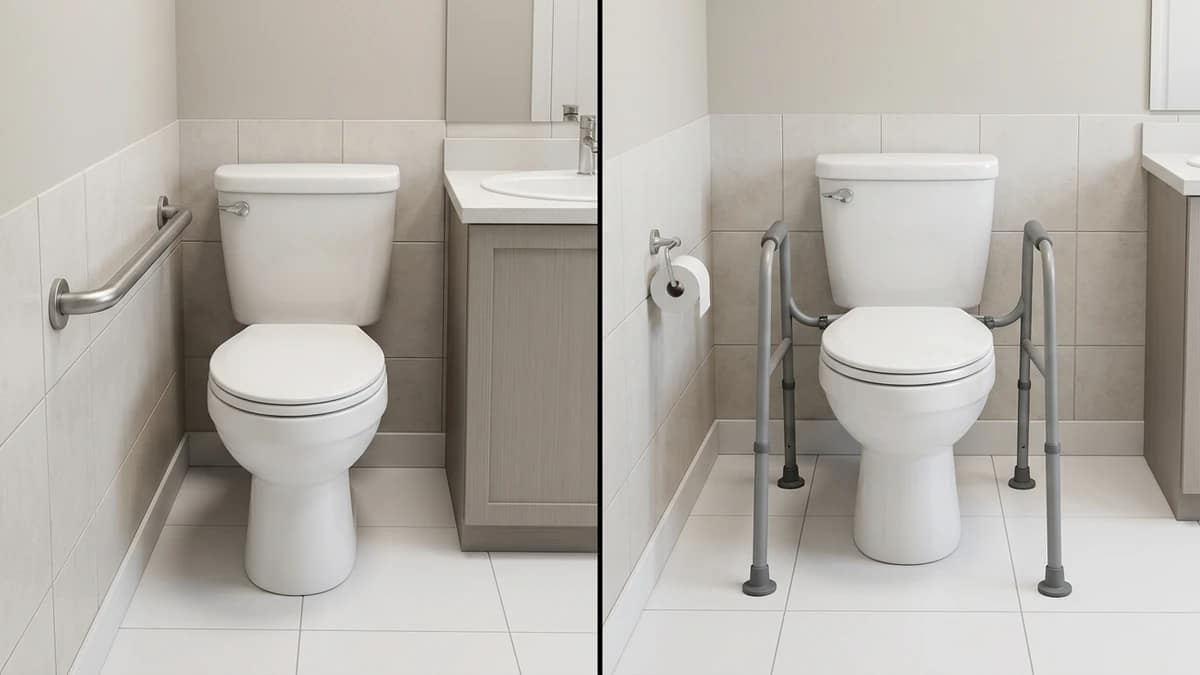
Bathroom size can make a major difference in this comparison.
Grab bars usually take up less space because they attach to the wall and do not add floor bulk around the toilet.
Safety frames sit around the toilet base, so they need enough side and front clearance to feel usable rather than cramped.
- grab bars are usually better in tighter bathrooms
- safety frames work better when there is enough room for two-sided access
- a crowded layout can make even a good frame feel less practical
If floor space is limited, grab bars often have the advantage. If the layout still allows enough clearance, a safety frame may still feel more supportive overall.
If space is especially tight around the toilet, this guide on toilet safety frames for small bathrooms explains which frame styles tend to fit narrow layouts more effectively.
Cost and Practical Value
Cost should be judged as total setup cost, not just product price.
Grab bars often cost less per unit, but installation may add time, tools, or labor costs.
Safety frames often cost a bit more upfront, but they usually avoid drilling and professional installation.
- grab bars may be more budget-friendly when installation is simple
- safety frames may be comparable in total cost when installation help would otherwise be needed
- the better value depends on whether the setup is temporary or permanent
For some households, the cheaper product is not automatically the cheaper overall solution.
Long-Term Use vs Temporary Use
Grab bars are usually the better fit when support needs are expected to remain in place long term.
- good for aging-in-place planning
- well suited to permanent bathroom safety upgrades
- integrate better into remodeled or fixed layouts
When the setup is meant to stay in place for years, material choice matters as much as installation. This guide on grab bar materials for long-term bathroom use explains which options tend to hold up best over time.
Safety frames are often the better fit when needs may change or when the setup should remain flexible.
- useful during recovery or temporary mobility issues
- good for rental properties or no-drill situations
- easier to remove, replace, or reposition later
In general, grab bars are usually better for permanent support planning, while safety frames are often better for flexibility and short-term use.
Simple takeaway:
Choose grab bars when fixed support, compact layout, and long-term installation matter most. Choose safety frames when balanced two-sided support, easier setup, and flexibility matter more.
Which Option Is Safer for Seniors?
When comparing toilet grab bars vs toilet safety frames, neither option is automatically safer in every situation. Safety depends on how well the support matches the user’s balance, strength, movement pattern, and bathroom setup.
Toilet grab bars are often safer when:
- they are installed correctly into wall studs or other proper structural support
- the user mainly pushes from one side
- bathroom space is limited and floor clearance matters
- a fixed, permanent support point is preferred
Toilet safety frames are often safer when:
- the user relies on both arms during sitting and standing
- balanced two-sided support feels more secure
- drilling into the wall is not possible or not preferred
- the setup may need to be temporary, adjustable, or removable
In real use, grab bars usually provide stronger fixed support from one direction, while safety frames often provide more balanced assistance through the full sit-to-stand movement.
For users who place significant force through both arms while standing, it also helps to understand toilet safety frame weight limits before choosing a lighter model.
Real-Life Example:
A senior with mild balance issues and a small bathroom may feel safer with a properly installed grab bar.
A senior who pushes evenly with both arms and needs more controlled support may feel safer with a toilet safety frame instead.
For example, a senior with mild balance issues and a small bathroom may feel safer with a properly installed grab bar. A senior who pushes evenly with both arms and needs more controlled support may feel safer with a toilet safety frame instead.
Whichever option is chosen, it should be judged during real movement rather than by appearance alone. The user should be able to sit down, push up, shift weight, and steady themselves without looseness, awkward reach, or hesitation.
For some users, the more important question is not whether a grab bar or frame is safer, but whether added side support is needed at all. This comparison of toilet safety frames vs raised toilet seats explains when extra height may solve the problem more effectively than side rails.
The safest option is the one that feels stable, predictable, and well-matched to the person’s actual movement during everyday use.
When Grab Bars Are the Better Choice
Toilet grab bars are usually the better choice when the goal is to create a fixed, space-efficient support point that stays in place long term.
They often make more sense when:
- wall studs or other proper mounting support are accessible
- bathroom space is limited and floor clearance matters
- the user mainly pushes or stabilizes from one side
- a permanent support solution is preferred
Grab bars are especially practical in bathrooms where adding floor equipment would make the area feel crowded. Because they mount directly to the wall, they provide support without reducing the open space around the toilet.
For example, a senior with mild balance difficulty in a smaller bathroom may do very well with a properly placed grab bar if the main need is a stable handhold during standing or lowering down.
If a grab bar is clearly the better fit, reviewing the best toilet grab bars for seniors can help narrow down which designs provide the most reliable support near the toilet.
In general, grab bars are the better choice when one-sided fixed support is enough and the bathroom setup is meant to stay in place long term.
When Safety Frames Are the Better Choice
Toilet safety frames are usually the better choice when the user needs more balanced assistance during the full sit-to-stand movement.
They often make more sense when:
- the user relies on both arms during sitting and standing
- two-sided support feels more stable than a single handhold
- drilling into the wall is not possible or not preferred
- the setup may need to be temporary, adjustable, or removable
Safety frames often feel more supportive because they sit around the toilet and provide help from both sides. For seniors with reduced balance, weaker leg strength, or more hesitation during standing, that balanced support can feel more controlled and reassuring.
For example, a senior recovering from surgery or someone who pushes evenly with both arms may feel much safer with a toilet safety frame than with a single wall-mounted grab bar.
If a safety frame is clearly the better fit, it also helps to compare the top toilet safety frames for seniors based on stability, bathroom fit, and ease of setup.
In general, safety frames are the better choice when balanced two-sided support matters more than saving floor space or creating a permanent setup.
Can You Use Grab Bars and Safety Frames Together?
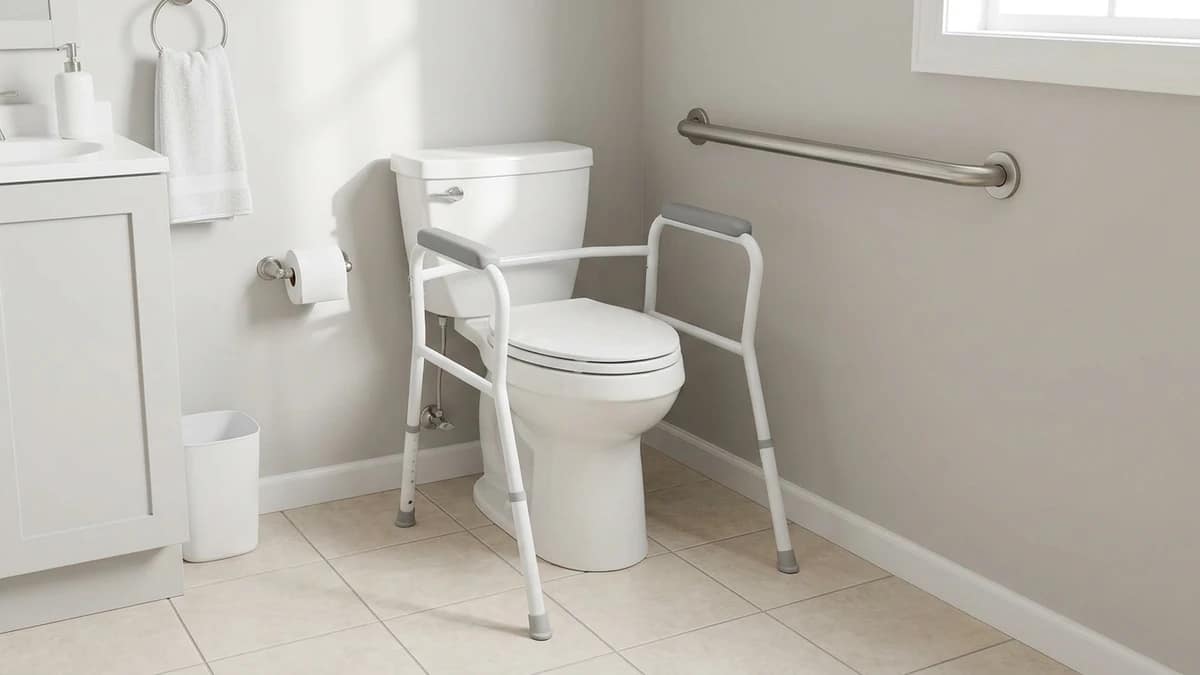
Yes, in some bathrooms it makes sense to use both toilet grab bars and a toilet safety frame together, but only when each one serves a clear purpose and the setup does not feel crowded.
This can make sense when:
- the user needs balanced support near the toilet but also benefits from a fixed handhold nearby
- support is needed during more than one part of the movement
- the bathroom layout allows both without creating obstacles
For example, a toilet safety frame may provide the main two-sided support during sitting and standing, while a nearby grab bar adds an extra fixed support point during repositioning or transfers.
In practice, using both together only works well when the setup stays clear, stable, and easy to use. If the area starts to feel crowded or confusing, one well-matched support option is usually better than too many overlapping aids.
Common Mistakes When Choosing
Problems with toilet support often come from choosing based on appearance, price, or convenience instead of how the person actually moves in daily use. These are some of the most common mistakes that lead to the wrong choice.
Choosing based only on price
A lower-cost option may look appealing at first, but if it does not provide the right kind of support, it may feel less stable and less practical over time.
Ignoring bathroom space
Safety frames need enough clearance around the toilet to feel usable and secure. In tighter bathrooms, lack of space can make even a supportive frame feel awkward or crowded.
Underestimating balance and movement needs
Some people need more than a simple handhold. If standing up requires balanced push-off from both arms, a single grab bar may not feel supportive enough.
Assuming installation is a minor detail
Grab bars are only as safe as their installation. If they are mounted incorrectly or placed in the wrong position, they may not provide reliable support when it matters most.
Focusing on the product instead of the movement
The better choice usually becomes clear when you look at how the person actually sits down, stands up, and shifts weight in real use.
In practice, the safest setup is usually the one that matches the user’s real movement pattern rather than the one that seems simpler or cheaper on paper.
What I Recommend
The decision usually becomes clearer when you focus on how the person actually stands up from the toilet.
If support mainly comes from one side and bathroom space is limited, toilet grab bars are often the better choice because they provide fixed support without adding floor bulk.
If the person relies on both arms and needs balanced assistance during sitting and standing, a toilet safety frame often feels more natural and supportive.
In general, grab bars are usually better for permanent, space-saving support, while safety frames are usually better when two-sided assistance and easier setup matter more.
When in doubt, prioritize the option that feels more stable and controlled during a real stand-up test rather than the one that seems simpler on paper.
FAQ
Can you use both grab bars and safety frames together?
Yes. Some setups combine a wall-mounted grab bar with a safety frame for added stability, especially when the user needs both a fixed support point and balanced assistance near the toilet.
Are toilet safety frames bulky?
They take up more floor space than grab bars, so measuring the bathroom layout first is important. In smaller bathrooms, they can feel crowded if there is not enough clearance around the toilet.
Do grab bars require professional installation?
Not always, but they must be securely anchored into wall studs or other proper structural support to be safe. If installation is uncertain, professional help may be the better option.
Which option is better for renters?
Toilet safety frames are usually better for renters because they do not typically require drilling into the wall and can be removed later if needed.
Which option is better for long-term use?
Grab bars are often better for long-term bathroom safety planning because they are fixed, permanent, and integrate more easily into the bathroom layout.
Which option is better for seniors with poor balance?
Safety frames are often better when poor balance makes two-sided support feel more secure. Grab bars may still work well if the user mainly relies on one side and the bar is placed correctly.
Final Thoughts
Toilet grab bars vs toilet safety frames is not just a product comparison, but a decision about which type of support fits the user’s real movement needs more safely and practically.
Grab bars usually work better when support needs are more one-sided, bathroom space is limited, and a permanent setup is preferred. Safety frames usually work better when the user needs balanced two-sided assistance and a setup that does not require wall modification.
The better choice is the one that matches how the person actually sits down, stands up, and uses the bathroom every day.
When the support type matches the real movement pattern, the bathroom usually feels safer, more practical, and easier to use with confidence.
