
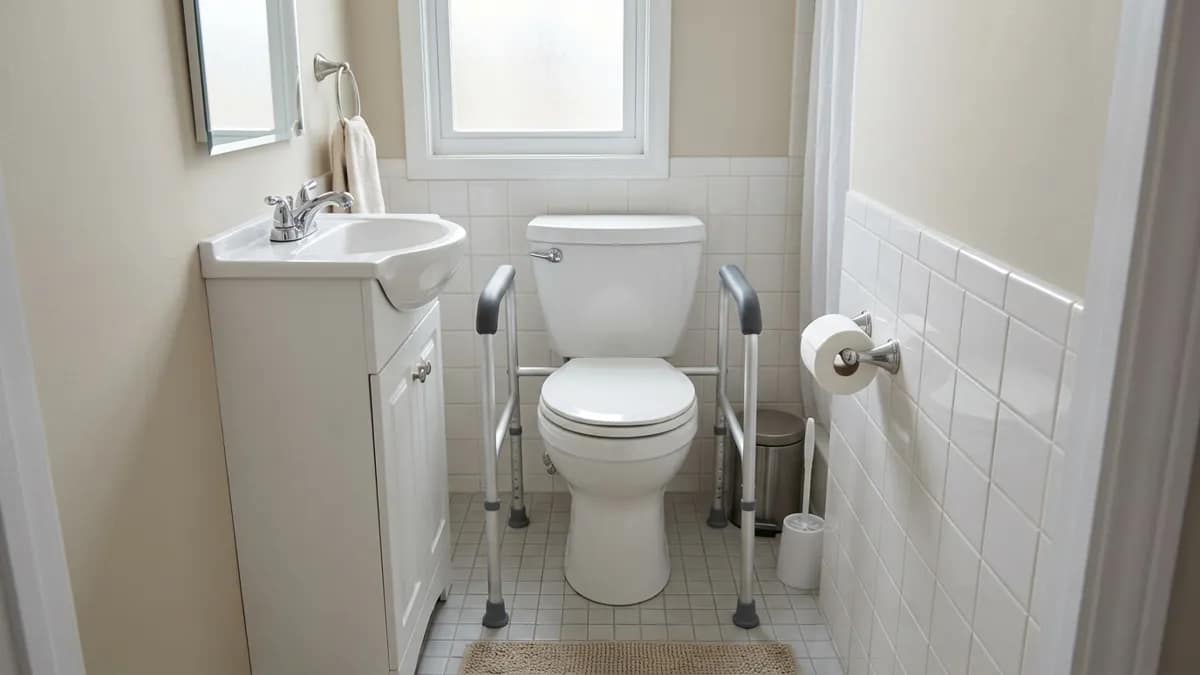
Finding toilet safety frames for small bathrooms can be difficult because tight layouts often leave very little room around the toilet for safe support equipment.
Most product photos show spacious layouts with plenty of clearance, but in many homes, bathroom layouts provide very limited space around the toilet.
If space is tight, choosing the wrong frame can restrict movement and reduce safe usability.
Even small bathrooms can often accommodate the right type of frame, but only when the layout is measured carefully and the correct design is chosen.
In tight layouts, it can also help to compare toilet grab bars vs toilet safety frames to determine which option fits more effectively.
The sections below explain how to measure the space, compare frame types, and identify when alternatives may be the better option.
Disclosure: As an Amazon Associate, I earn from qualifying purchases. This post may contain affiliate links. If you purchase through these links, I may earn a small commission at no extra cost to you. I only recommend products I would feel comfortable using in my own home. Learn more.
On This Page
- How Much Space Do You Need for a Toilet Safety Frame?
- What to Measure Before Buying
- Freestanding vs Toilet-Mounted Frames in Small Bathrooms
- Layout Scenarios: What Works in Real Life
- Compact Frame Features to Look For
- Common Problems in Small Bathrooms
- Alternative Solutions for Small Bathrooms
- What I Recommend
- FAQ
- Final Thoughts
Quick Answer
Yes, toilet safety frames can work in small bathrooms, but only if the layout provides enough side clearance, front space, and room for the frame style you choose.
- Toilet-mounted frames usually fit better in tighter spaces
- Freestanding frames need more side and front clearance
- Bathrooms with one side blocked may need a grab bar instead
- Measuring width, depth, and door swing is essential before buying
In most cases, the best option depends less on the frame itself and more on whether the bathroom layout can support it safely.
How Much Space Do You Need for a Toilet Safety Frame?
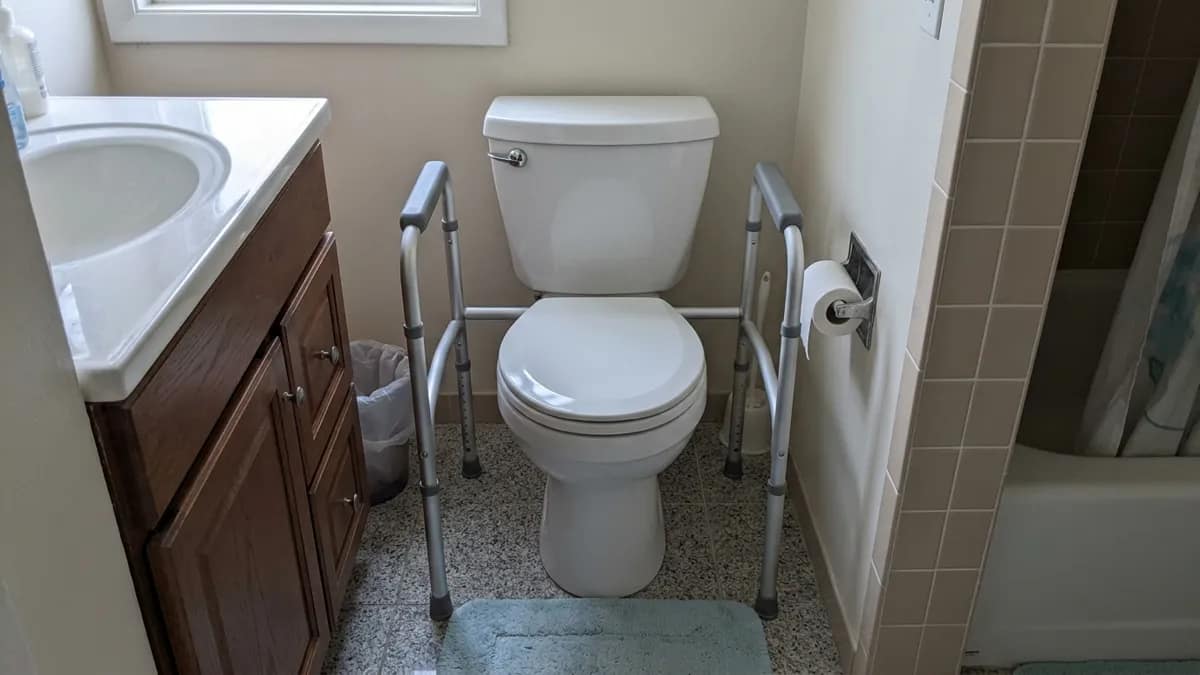
The amount of space required depends mainly on the frame style.
Most freestanding toilet safety frames require:
- 18–24 inches of usable width around the toilet
- Clearance on both sides for arm movement
- Enough depth in front for standing motion
In practical terms, that usually means:
- At least 3–4 inches of clearance from the toilet base on each side
- No tight obstructions from vanities or walls
If your toilet is positioned directly against a side wall, a full freestanding frame may not work.
This is why measuring first is essential.
What to Measure Before Buying
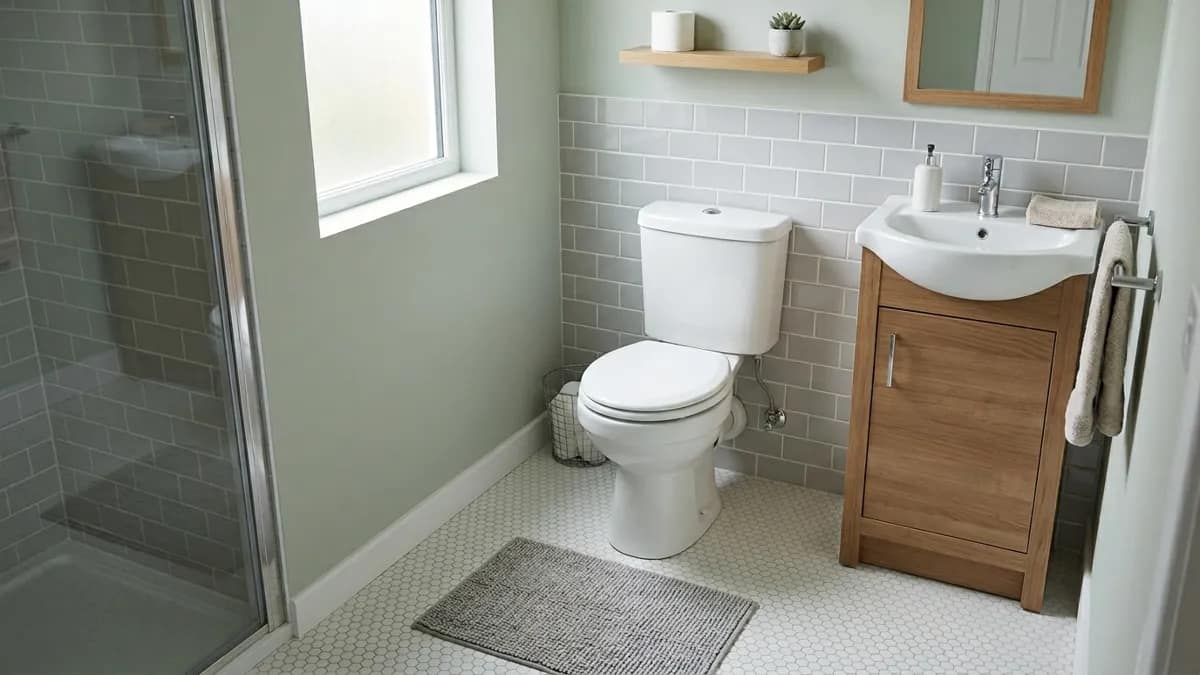
Before choosing toilet safety frames for small bathrooms, measure carefully.
Accurate measurement is essential. Use a tape measure rather than estimating dimensions.
Width Between Obstacles
Measure the total horizontal space around the toilet.
Check:
- Distance from toilet centerline to side wall
- Distance between toilet and vanity
- Total open width available for armrests
Many adjustable frames have a minimum width setting. Compare your measurement to the manufacturer’s minimum width.
If your clearance is under 20 inches total usable width, your options will likely be limited to compact or toilet-mounted models.
Depth in Front of the Toilet
Freestanding frames extend slightly forward.
Make sure:
- There is at least 18–24 inches of open space in front of the toilet
- The bathroom door still opens fully
- The person can step forward comfortably after standing
In very tight bathrooms, door swing becomes the biggest issue.
If the door opens inward and hits the frame, the layout may need reconsideration.
Distance From Rear Wall
Some frames sit slightly forward from the tank.
If the toilet is installed very close to the back wall, check that the frame doesn’t press awkwardly against it.
Rear clearance problems are less common but still worth checking.
Toilet Height
Standard toilets are typically 15–17 inches high.
Comfort-height toilets are around 17–19 inches.
Most frames adjust vertically, but small bathrooms often contain older standard-height toilets.
Confirm that:
- The frame’s minimum height adjustment works with your toilet
- Armrests align naturally with elbow height when seated
Improper height can make standing harder — even if the frame technically fits.
Once those measurements are clear, the next step is choosing the frame type that fits the available space most effectively.
If you want a broader step-by-step framework beyond small-bathroom fit alone, a guide on how to choose a toilet safety frame can help compare support level, installation style, and bathroom layout before narrowing down models.
Freestanding vs Toilet-Mounted Frames in Small Bathrooms
When comparing toilet safety frames for small bathrooms, the type of frame often matters more than the brand or styling.
Freestanding Frames
Freestanding models:
- Sit directly on the floor
- Provide wide two-sided support
- Provide stable support when weight is applied
However, they require clear floor space.
In narrow bathrooms, they may:
- Block movement
- Interfere with door swing
- Appear visually bulky in tight spaces
They work best when there’s at least moderate clearance on both sides.
Toilet-Mounted Frames
Toilet-mounted models attach directly to the toilet bolts.
They:
- Have a smaller footprint
- Stay aligned with the toilet
- Don’t require wide floor bases
In very tight bathrooms, this style often fits better.
The trade-off is slightly reduced stability compared to larger freestanding bases — though many remain stable when properly installed.
If space is extremely limited, toilet-mounted options are often the more practical choice.
Understanding how installation affects fit and stability can also help prevent layout issues. This guide on how to install a toilet safety frame explains how to set it up correctly.
Layout Scenarios: What Works in Real Life
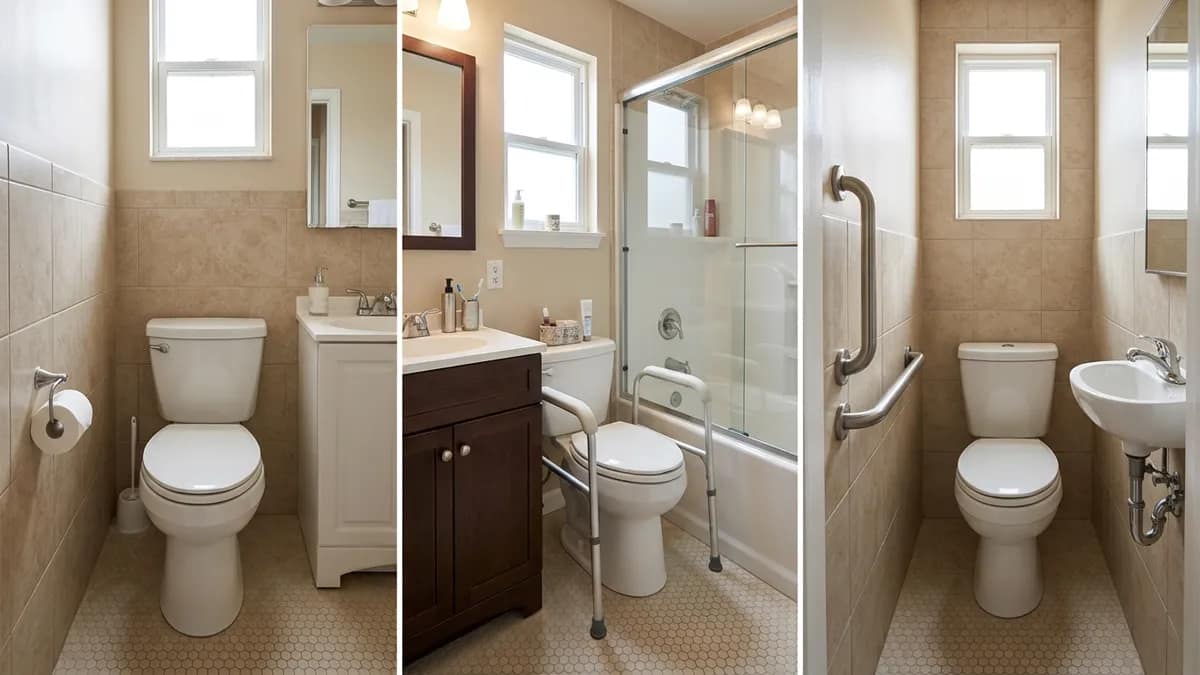
These are common small bathroom layouts and the solutions that typically work in each case:
Scenario 1: Toilet Against One Side Wall
If one side of the toilet is flush against a wall:
- A full freestanding frame likely won’t fit
- A single grab bar on the open side may be better
- Or a compact toilet-mounted frame with offset support
Scenario 2: Toilet Between Vanity and Tub
If space is narrow on both sides:
- Measure carefully
- Look for adjustable-width frames
- Avoid oversized hospital-style frames
Compact models are essential here.
In especially tight layouts, folding toilet safety frames may also be worth considering when the goal is to reduce bulk between uses without giving up basic support near the toilet.
Scenario 3: Extremely Narrow Powder Room
In very tight half-baths:
- A wall-mounted grab bar may be more realistic
- Freestanding frames may restrict movement
If floor space is limited, grab bars often become the safer choice.
In some cases, the decision depends on whether height assistance or side support is more important. This comparison of toilet safety frames vs raised toilet seats explains how each option fits different situations.
Quick fit guide:
- Open space on both sides: a compact freestanding frame may work
- Tight side clearance: a toilet-mounted frame is usually the better fit
- One side blocked or severe tightness: a grab bar may be more practical than a frame
Compact Frame Features to Look For
If you’re shopping specifically for toilet safety frames for small bathrooms, prioritize:
- Adjustable width
- Slim profile tubing
- Minimal floor footprint
- Narrow arm spacing options
- Non-slip rubber feet
Avoid:
- Oversized “medical” frames
- Extra-wide reinforced hospital-style models
- Models without width adjustment
Compact designs can still provide stable support when properly constructed and installed.
If you want to compare broader models before narrowing down to compact layouts, this guide to the best toilet safety frames for seniors can help show which frame styles offer the most stable support overall.
Common Problems in Small Bathrooms
These are the most common problems in small bathroom layouts:
1. Frame Blocks the Door
Always test door clearance after measuring.
Even small increases in width can interfere with door clearance.
2. Frame Feels Cramped
If armrests are too close together, sitting may feel restrictive.
Balance compactness with comfort.
3. Instability on Tile Floors
In tight bathrooms with smooth tile:
- Make sure feet have rubber grips
- Check that the floor is level
- Test weight-bearing before full use
Stability matters more than size.
Alternative Solutions for Small Bathrooms
In some layouts, a toilet safety frame may not be the most practical solution. When space is limited, the goal is to improve support without adding bulk that interferes with movement.
Two common alternatives are grab bars and raised toilet seats, each designed to address different challenges in small bathrooms.
Grab bars
Provide support without taking up floor space. Because they mount directly to the wall, they are often the most effective option when side clearance is limited or when a frame would block movement. This guide on grab bars for small bathrooms explains how to position them effectively in tight layouts.
Raised toilet seats
Take a different approach by increasing seat height instead of adding side support. In compact bathrooms where a frame feels too bulky, they can reduce strain without changing the surrounding layout. This guide on raised toilet seats for small bathrooms explains when this lower-profile solution works best.
In some cases, combining solutions may also be effective. For example, a raised toilet seat can reduce bending effort while a single grab bar provides additional balance support.
The right choice depends on the available space and the type of support needed, not just the product category.
What I Recommend
Once you understand which solutions fit your space, the next step is applying that information to your specific layout.
If you’re working with a small bathroom:
- Measure width and depth carefully.
- Compare those numbers to product specifications.
- Prioritize adjustable or toilet-mounted models.
- Avoid oversized designs unless measurements clearly allow them.
If clearance is tight on one side, consider combining:
- A compact frame
- Or a single grab bar for one-sided support
Safety should allow comfortable movement without restricting space.
In tight layouts, the goal is to maximize support without blocking movement.
If you want to compare compact models that are better suited to narrow spaces, this guide to the best toilet safety frames for small bathrooms highlights designs that balance support with a smaller footprint.
FAQ
Toilet Safety Frames for Small Bathrooms: What Actually Fits?
Most compact models require roughly 18–24 inches of usable width, but checking manufacturer specifications is essential.
Are there narrow toilet safety frames available?
Yes. Some adjustable or toilet-mounted models are designed specifically for tighter bathroom layouts.
Can a toilet safety frame fit next to a vanity?
It depends on clearance. Measure the available width carefully before purchasing.
Is a grab bar better in very small bathrooms?
In extremely tight spaces, wall-mounted grab bars may be more practical because they don’t add floor bulk.
Final Thoughts
A toilet safety frame for small bathrooms can absolutely work — but only if the layout supports it.
Tight spaces require more careful planning, but the right measurements and frame type can still create a safe and usable setup.
Measure carefully. Choose the right style. And prioritize stability over appearance.
The right setup should make movement feel easier — not more restricted.
