
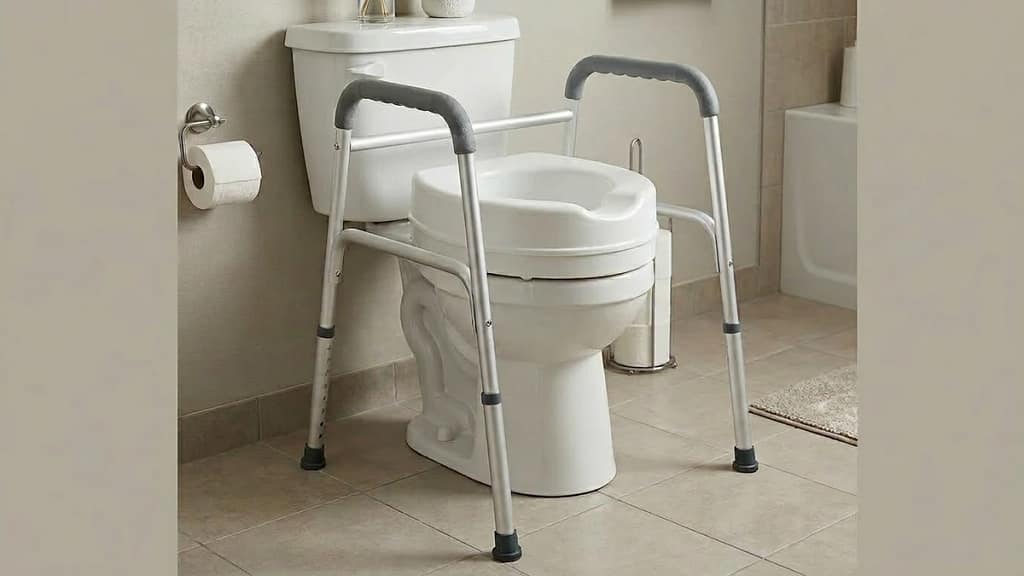
Some bathroom setups need more than one type of support. A raised toilet seat can help when the toilet feels too low, while a toilet safety frame can help when extra hand support is needed during sitting and standing.
That is why people often ask, can you use a raised toilet seat with a toilet safety frame? In some cases, the answer is yes. The two can work together, but only if the seat, frame, toilet, and surrounding space all fit together in a way that still feels stable.
The important question is not only whether both pieces physically fit. The more important question is whether the full setup feels secure, practical, and easy to use during real transfers.
Disclosure: As an Amazon Associate, I earn from qualifying purchases. This post may contain affiliate links. If you purchase through these links, I may earn a small commission at no extra cost to you. I only recommend products I would feel comfortable using in my own home. Learn more.
On This Page
- Why Someone Might Need Both a Raised Toilet Seat and a Toilet Safety Frame
- Raised Toilet Seat vs Toilet Safety Frame vs Using Both
- When This Combination Helps Most
- When a Raised Toilet Seat and Toilet Safety Frame May Not Work Well Together
- How to Check Compatibility and Stability
- How to Choose a Raised Toilet Seat and Safety Frame That Work Together
- Common Mistakes to Avoid
- What I Recommend
- FAQ
- Final Thoughts
Quick Answer
Yes, in some cases a raised toilet seat can be used with a toilet safety frame, but the setup only works well when the seat and frame are compatible, the toilet area has enough space, and the combination still feels stable during sitting and standing.
- Some people benefit from both extra height and side support
- Physical fit alone is not enough if the setup feels crowded or unstable
- Seat shape, frame width, and handle position all matter
- Some combinations work well for slower or more supported transfers
- Not every raised seat works well with every toilet safety frame
In practical terms, this setup makes the most sense when one product solves part of the problem but not the whole transfer. A raised toilet seat may help with low height, while the frame may help with hand support and control.
The best combination is the one that feels steady, leaves enough room to move, and makes sitting and standing easier rather than more complicated.
Why Someone Might Need Both a Raised Toilet Seat and a Toilet Safety Frame
A raised toilet seat and a toilet safety frame do two different jobs. One helps with height. The other helps with support.
A raised toilet seat is usually meant to:
- reduce how far the body has to lower down
- reduce how much effort it takes to stand back up
- make a low toilet feel easier to manage
A toilet safety frame is usually meant to:
- give the user stable hand support
- improve control during transfers
- make sit-to-stand movement feel less uncertain
For example, a person may feel that the toilet is too low and also notice that pushing up from that lower position feels unsteady. In that situation, extra height alone may help part of the movement, but not the part that needs hand support.
This also connects to the bigger timing question. A raised toilet seat usually becomes useful when toilet height is clearly adding difficulty to daily use. This guide on when seniors should use a raised toilet seat explains the kinds of movement changes that often signal a need for added height.
When both problems exist at the same time, using both products together can make sense.
Raised Toilet Seat vs Toilet Safety Frame vs Using Both
Once the main transfer problem is clear, it becomes easier to decide whether the person needs added height, side support, or both together. These options are not interchangeable because each one solves a different part of the movement.
A raised toilet seat usually makes the most sense when:
- low toilet height is the main issue
- sitting down feels too deep
- standing up takes more effort because of the low position
A toilet safety frame usually makes the most sense when:
- side support is the main issue
- the user needs stable hand placement during transfers
- height is less important than control
Using both usually makes the most sense when:
- the toilet feels too low
- the user also needs side support
- the transfer is slower and needs both elevation and control
For example, a person may not need a taller toilet if the main challenge is hand support. Another person may not need a frame if the only problem is toilet height. The combined setup helps when both of those problems are present at the same time.
If the main question is how these options compare more broadly, this guide on toilet safety frames vs raised toilet seats explains when height alone, support alone, or both together make the most sense.
The best option depends on which part of the transfer feels hardest in real use.
When This Combination Helps Most
This kind of setup usually helps most when both height and transfer support are clearly part of the problem.
That is more likely when:
- the toilet feels too low
- standing up requires stronger push-off
- leg strength is reduced
- the user moves more slowly and needs more control
- the transfer feels easier with both hands supported
Example:
A person may be able to use the toilet independently but still struggle with the final push to stand because the toilet feels low and there is nothing stable to hold. In that situation, the raised seat helps with elevation while the frame helps with controlled hand support.
This can also come up during recovery. After hip surgery, some people need both a higher toilet position and more support during transfers because bending and pushing up both feel harder than usual. This guide on raised toilet seats after hip surgery explains why that combination can become relevant during recovery.
The combination usually helps most when one product solves only part of the transfer difficulty.
When a Raised Toilet Seat and Toilet Safety Frame May Not Work Well Together
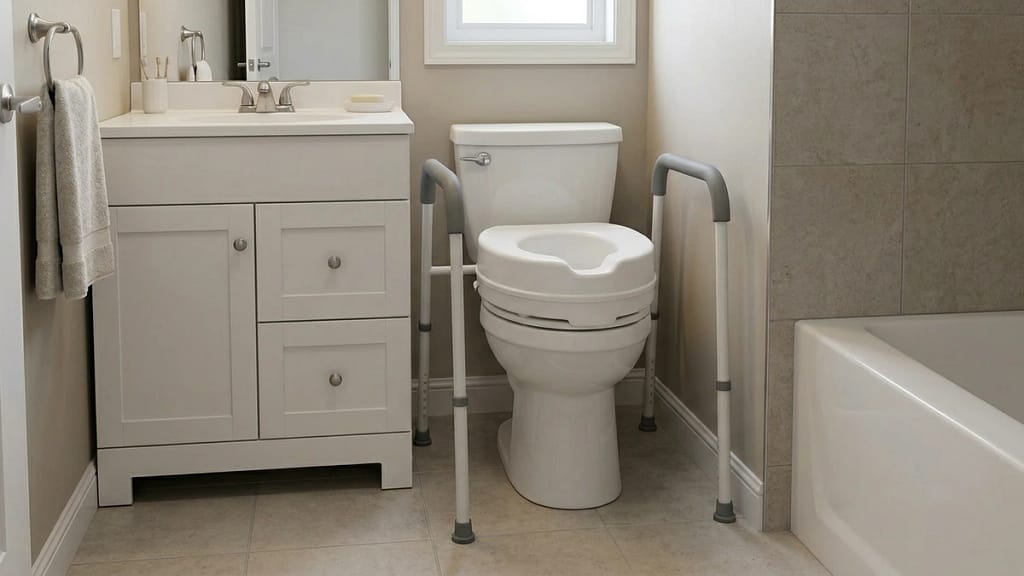
This setup does not always work well. In some bathrooms, the combination feels too crowded, awkward, or unstable even if both pieces technically fit around the toilet.
Problems are more likely when:
- the bathroom is very tight
- the frame arms sit too close to the raised seat
- the raised seat makes handle access awkward
- the setup rocks or shifts during transfers
- the user has less room to sit down or stand up naturally
Example:
A raised toilet seat may lift the sitting position enough to change how the hands meet the frame handles. If that changes the push-off angle in an awkward way, the setup may feel less helpful than expected.
The goal is not to force two useful tools into one space. The goal is to create one setup that still feels stable and practical when the person actually uses it.
How to Check Compatibility and Stability
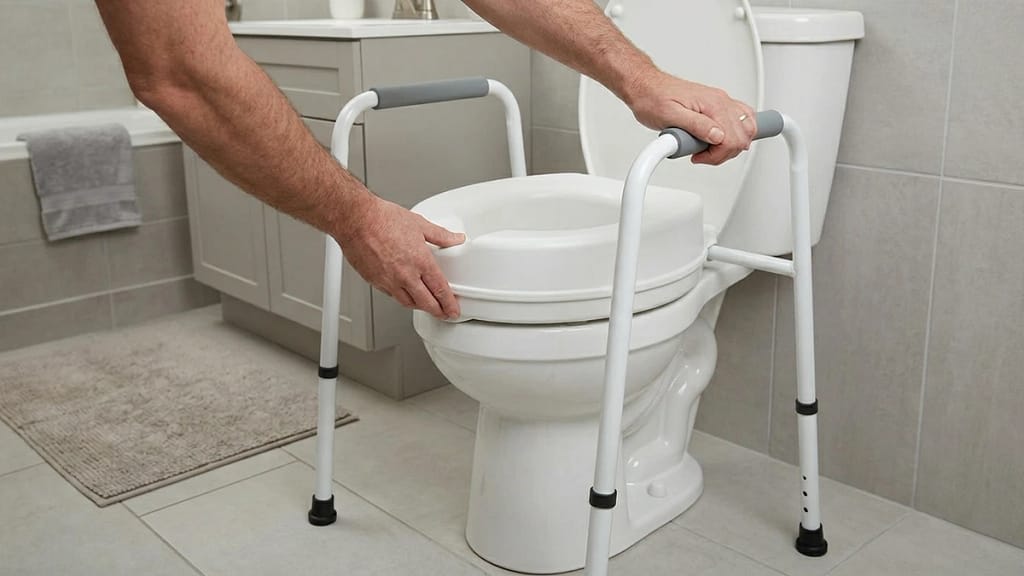
A combined setup should be checked in a practical way before it becomes part of the daily routine.
Look for:
- rocking or shifting when pressure is applied
- enough space between the seat and the frame handles
- clear hand access during sitting and standing
- enough room to position the body comfortably
- no interference between the raised seat and frame structure
How to check the setup:
Sit down slowly, stand back up, and notice whether the raised seat stays steady, whether both hands reach the frame naturally, and whether one side feels more loaded than the other. The setup should feel stable during the full transfer, not just when it is sitting in place.
This matters because real pressure during transfers can feel different from a simple visual fit check. When both a raised seat and a frame are involved, weight support and force direction matter more than they may seem at first. This guide on how much weight a toilet safety frame can hold gives useful context on how capacity and real-world stability work together.
A setup should not only fit in the bathroom. It should also feel stable, predictable, and easy to use during the full transfer.
How to Choose a Raised Toilet Seat and Safety Frame That Work Together
The best combined setup comes from choosing both pieces with the full transfer in mind, not choosing them separately and hoping they work well together.
For the raised toilet seat, pay attention to:
- how much extra height is actually needed
- whether the seat attachment style leaves enough room for the frame
- whether the raised seat uses clamps, bolts, or over-the-bowl placement that could interfere with the frame
- whether the seat fits the toilet securely
- whether the final sitting position still feels stable
For the toilet safety frame, pay attention to:
- frame width
- handle position
- how rigid the frame feels
- how well it fits around the toilet and raised seat
- whether the frame stands independently or attaches near the same area used by the raised seat
- whether it leaves enough room for comfortable transfers
It helps to start with the raised seat side of the decision first, especially if toilet height is what made the setup necessary in the first place. This guide on how to choose a raised toilet seat explains how to weigh height, fit, support, and daily use together.
Then the frame needs to be chosen in a way that supports that seat instead of interfering with it. Width, handle placement, and overall stability matter more once both products share the same toilet space. This guide on how to choose a toilet safety frame helps clarify what to look for on the frame side of the setup.
The right combination should feel like one workable system, not two separate products competing for the same space.
Common Mistakes to Avoid
Most problems with this combination happen when the seat and frame are chosen as separate products instead of one shared transfer setup. The goal is not just to make both pieces fit around the toilet, but to make sure they work together during sitting and standing.
The biggest ones are:
- Assuming physical fit means safe use
Two products may fit around the toilet and still feel awkward or unstable during transfers. - Ignoring bathroom space
A workable setup on paper may feel too crowded in a smaller bathroom. - Choosing two products that interfere with each other
Handle placement, seat height, and frame width can change how the setup feels in practice. - Ignoring how each product attaches
Some raised seats and frames may compete for the same space around the toilet, especially if both rely on the seat area, bowl shape, or nearby floor space for stability. - Overlooking real transfer movement
A setup should be judged while sitting and standing, not only while looking at it in place.
Most problems with this combination come from treating it like a simple parts-matching exercise. It works best when the seat, the frame, the toilet, and the person’s transfer pattern all work together.
What I Recommend
This combination makes the most sense when both extra height and extra side support are clearly needed. If one product already solves the problem well, adding the second one may only make the setup more crowded.
A practical approach is:
- use both only when height and hand support are both necessary
- test stability carefully during real transfers
- avoid forcing the combination if the toilet area already feels tight
- keep the setup as simple as possible when one solution is enough
If the support side of the setup matters more than the height side, then the frame becomes the more important part of the decision.
In that situation, it can help to compare support-focused frame options more directly. This guide to best toilet safety frames for seniors is useful when the frame is doing most of the work in the overall setup.
The best result is usually the simplest stable setup that solves the actual transfer problem without creating a new one.
FAQ
Can any raised toilet seat be used with a toilet safety frame?
No. Some combinations work better than others, and compatibility depends on the seat design, frame shape, and toilet area.
Is it safe to use both together?
It can be safe when the setup feels stable and leaves enough room for natural transfers.
Who benefits most from using both?
People who need both extra toilet height and extra hand support during sitting and standing often benefit most.
How do you know if the setup is too crowded?
If the handles are hard to reach, the seat feels awkward to use, or the transfer path feels restricted, the setup may be too crowded.
Is a toilet safety frame sometimes enough on its own?
Yes. If height is not the main problem and the real issue is transfer support, a frame alone may be enough.
Final Thoughts
So, can you use a raised toilet seat with a toilet safety frame? Yes, this combination can work well when the user needs both a higher toilet position and more hand support during transfers.
The important part is not whether both products can physically fit in the same space. The important part is whether the full setup feels stable, leaves enough room to move, and makes the transfer easier instead of more awkward.
When the seat, frame, toilet, and bathroom space all work together, this combination can be a practical solution.
