
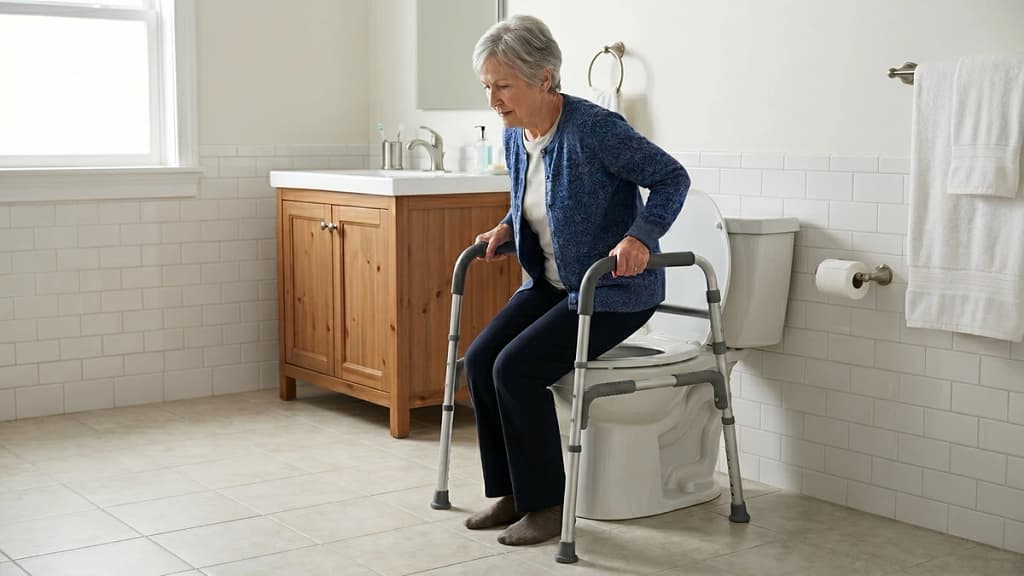
A toilet safety frame can make bathroom use easier when sitting down, standing up, or staying balanced near the toilet has become more difficult. The right frame gives stable hand support close to the toilet, but the wrong one can feel awkward, crowded, or less secure than expected.
Learning how to choose a toilet safety frame means looking beyond the product shape. The best choice depends on the user’s transfer style, bathroom space, toilet fit, support needs, and whether other bathroom safety equipment is already being used.
This guide explains what matters most before choosing a toilet safety frame, including frame type, fit, weight support, folding designs, installation, and when a different support option may work better.
Disclosure: As an Amazon Associate, I earn from qualifying purchases. This post may contain affiliate links. If you purchase through these links, I may earn a small commission at no extra cost to you. I only recommend products I would feel comfortable using in my own home. Learn more.
On This Page
- Start with the Real Support Problem
- When a Toilet Safety Frame Is the Right Choice
- Check Bathroom Space, Width, and Toilet Fit
- Folding vs Non-Folding Toilet Safety Frames
- How Weight Capacity and Stability Affect the Choice
- Can the Frame Work with a Raised Toilet Seat?
- How Installation and Setup Change the Decision
- How to Narrow Down the Right Toilet Safety Frame
- Common Mistakes to Avoid
- What I Recommend
- FAQ
- Final Thoughts
Quick Answer
To choose a toilet safety frame, start by identifying the user’s main support problem, then check whether the frame fits the toilet, bathroom space, and transfer pattern.
The best option should feel stable during sitting and standing, provide comfortable hand placement, and match the user’s support needs without making the toilet area crowded.
- Choose based on support needs, not appearance alone
- Check toilet fit, frame width, and bathroom clearance
- Make sure the handles are easy to reach during transfers
- Consider weight capacity and real-world stability
- Decide whether a fixed or folding design makes more sense
A good toilet safety frame should make the full sit-to-stand movement feel more controlled. It should not only fit around the toilet; it should also feel steady when pressure is applied through the handles.
The best choice is usually the simplest frame that solves the actual support problem without adding unnecessary bulk or making the bathroom harder to use.
Quick check:
- If the main problem is standing up with control, focus on handle stability and reach.
- If the main problem is low toilet height, compare raised toilet seats first.
- If the bathroom is narrow, check frame width and clearance before choosing a larger model.
Start with the Real Support Problem
The first step is identifying what the toilet safety frame needs to solve. Some people need help because the toilet feels low, but others mainly need stable hand support while lowering down or standing back up.
A toilet safety frame is most useful when the main issue involves:
- needing hand support close to the toilet
- feeling uncertain during sit-to-stand movement
- pushing heavily on nearby counters, walls, or the toilet seat
- moving more slowly and needing more control
- wanting support on both sides of the body
Example:
A person may be able to walk to the bathroom independently but still feel unsteady during the final movement of sitting down or standing up. In that situation, the frame is not just a convenience. It gives a predictable place for the hands during the part of the movement that feels least controlled.
This support problem should guide every other decision. A compact frame, a folding frame, and a heavier-duty frame may all look similar at first, but they solve different real-use problems.
When a Toilet Safety Frame Is the Right Choice
A toilet safety frame is usually the right choice when the user needs steady hand support close to the toilet during sitting and standing. It is most helpful when the difficult part of the movement is not only the toilet height, but the need for controlled support during the transfer.
This often applies when:
- standing up feels uncertain without hand support
- the user needs support on both sides of the toilet
- nearby counters, walls, or towel bars are being used for leverage
- the transfer feels slower, weaker, or less controlled than before
To decide whether a toilet safety frame is the right choice, it helps to compare it with the two most common alternatives.
Toilet Safety Frames vs Raised Toilet Seats
The first decision is whether the main problem is low toilet height or lack of support. A raised toilet seat mainly helps by reducing how far the body has to lower. A toilet safety frame mainly helps by giving the hands a stable place to push from during the transfer.
For example, if the toilet feels too low and the user can still stand safely once the height is improved, a raised toilet seat may be enough. But if the toilet height is manageable and the harder part is pushing up with control, a toilet safety frame may be the better fit.
This distinction matters because choosing the wrong support type can leave the main problem unsolved. This guide on toilet safety frames vs raised toilet seats explains how to compare height-based support with side-support options more clearly.
Toilet Safety Frames vs Toilet Grab Bars
The second decision is where the support should come from. A toilet safety frame keeps the handles close to the toilet and close to the user’s body. Grab bars provide fixed wall support, which can be better when the bathroom layout allows proper placement and the user needs a stable point on the wall.
For example, a toilet safety frame may work better when both hands need to stay near the toilet during standing. Grab bars may work better when the user needs fixed support beside or behind the toilet, especially when the wall position lines up well with the transfer.
The better option depends on the bathroom layout and how the user moves during the transfer. This guide on toilet grab bars vs toilet safety frames explains when close toilet-mounted support and fixed wall support each make more sense.
A toilet safety frame is usually the best fit when the user needs close, reachable, two-sided support during the toilet transfer itself. If the main issue is only low toilet height, a raised toilet seat may be enough. If the user has a suitable wall and needs fixed support instead of frame handles, toilet grab bars may be the better option.
Check Bathroom Space, Width, and Toilet Fit
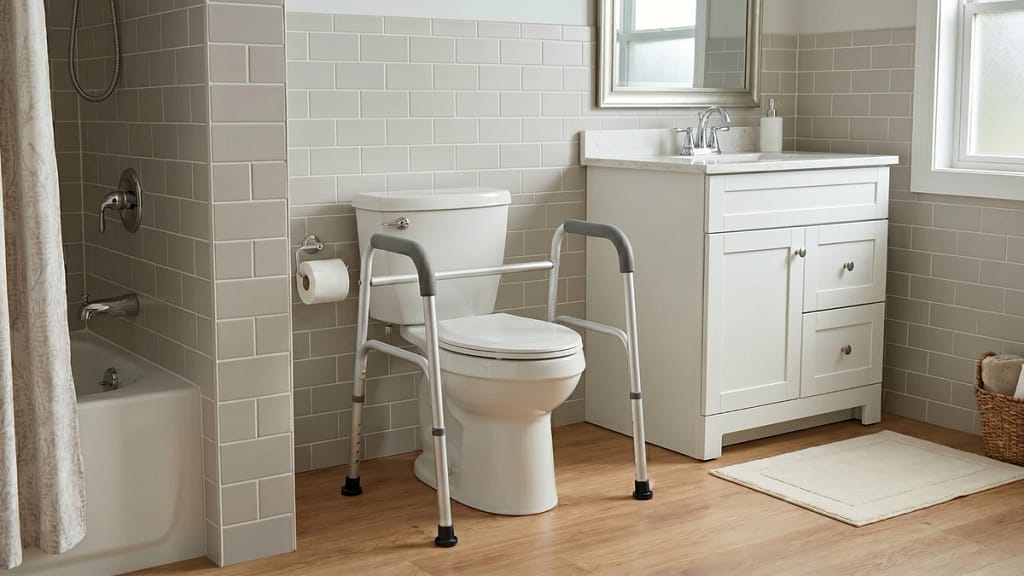
Bathroom fit matters because even a supportive frame can feel wrong if it crowds the toilet area. The frame needs enough space to sit properly around the toilet while still leaving room for the user’s knees, feet, and movement path.
Key fit factors include:
- frame width
- handle spacing
- distance from nearby walls or vanities
- toilet shape and surrounding clearance
- how much space is available in front of the toilet
A wider frame may feel more stable for some users, but it can become awkward in a narrow bathroom. A compact frame may fit better in tight spaces, but it still needs to provide enough hand support to be useful.
Example:
A frame may technically fit around the toilet but still make transfers harder if one side sits too close to a vanity. In that case, the issue is not the frame’s support level. It is the available working space around the toilet.
Small bathrooms need extra attention because the best frame is often the one that balances support with a manageable footprint. This guide on toilet safety frames for small bathrooms explains what to consider when space is limited.
The right frame should support the user without making the toilet area feel blocked or difficult to enter.
Folding vs Non-Folding Toilet Safety Frames
Folding and non-folding toilet safety frames can both be useful, but they serve slightly different needs. The decision often depends on whether the bathroom needs to stay flexible.
A non-folding frame often works better when:
- the frame will stay in place every day
- maximum rigidity is more important than storage
- the user depends on the frame for regular transfers
- the bathroom does not need frequent rearranging
A folding frame may work better when:
- the bathroom is shared
- space needs to be opened up between uses
- the frame may need to be moved or stored
- temporary support is needed
Folding designs are not automatically weaker, but the convenience of folding should be weighed against how solid the frame feels during actual use. For someone who depends heavily on the handles, a more rigid design may feel more reassuring.
If folding options are part of the decision, this guide on folding toilet safety frames explains where they work well and what trade-offs to consider.
The better choice depends on whether daily stability or flexible storage matters more in the bathroom.
How Weight Capacity and Stability Affect the Choice
Weight capacity is important, but it should not be judged as a number alone. A toilet safety frame also needs to feel stable when pressure is applied during real transfers.
This matters because users often do not push straight down evenly. They may:
- press harder on one handle
- shift weight while turning
- lean forward before standing
- use the frame many times per day
- apply more force when tired or stiff
For example, a frame may have a suitable listed capacity but still feel less secure if it rocks or flexes when one side takes more pressure. That is why stability, construction, and setup all matter alongside the rating.
A stronger frame may be worth considering when the user relies heavily on the handles every day, has a higher support need, or already makes lighter frames feel borderline. This guide on how much weight a toilet safety frame can hold explains how listed capacity and real-world support can differ.
A good frame should feel predictable under the kind of pressure the user actually applies, not just meet a number on paper.
Can the Frame Work with a Raised Toilet Seat?
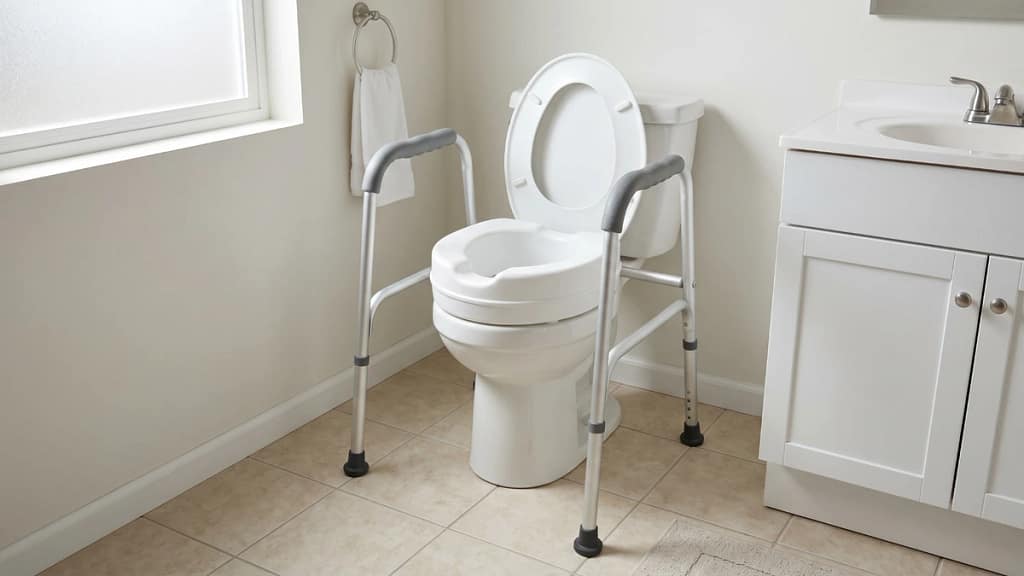
Some people need both side support and added height. In that case, a toilet safety frame may need to work alongside a raised toilet seat.
This combination can make sense when:
- the toilet feels too low
- standing up still requires side support
- the user needs both elevation and hand placement
- the transfer feels difficult for more than one reason
Compatibility matters. A raised toilet seat can change the final sitting height, the hand position, and the amount of room available around the toilet. If the frame arms do not line up well after the seat is added, the setup may feel awkward even if both products technically fit.
For example, a raised seat may reduce bending, but the user may still need handles to control the standing movement.
In that case, the frame and seat need to work together as one setup, not as two separate pieces competing for space. This guide on using a raised toilet seat with a toilet safety frame explains when the combination works and what to check first.
The combined setup is useful only when it improves the transfer without making the toilet area crowded or unstable.
How Installation and Setup Change the Decision

A toilet safety frame can only work well if it is set up correctly. Even a good frame may feel less stable if it is poorly adjusted, unevenly positioned, or not matched to the toilet area.
Before regular use, check:
- whether the frame sits evenly
- whether the handles are at a useful height
- whether the frame shifts when pressure is applied
- whether the user can reach both handles naturally
- whether the frame interferes with the toilet seat, lid, or nearby fixtures
Setup should be tested during the actual sit-to-stand movement, not only by looking at the frame in place. The frame may look centered but still feel awkward if the user has to reach too far forward or push at an uncomfortable angle.
Installation and adjustment are also important because many stability problems start with small setup errors. This guide on how to install a toilet safety frame explains what to check when placing and securing the frame.
Even a properly chosen frame should be tested carefully, because stability depends on both the product and the setup.
How to Narrow Down the Right Toilet Safety Frame
Once the main support problem is clear, the choice becomes easier. The goal is to match the frame to the user, the toilet, and the bathroom space.
A simple decision process looks like this:
- If transfer support is the main issue: choose a stable frame with comfortable handles.
- If the bathroom is tight: prioritize compact width and clearance.
- If the frame will be moved often: consider a folding or easier-to-store design.
- If the user relies heavily on the frame: prioritize rigidity and weight support.
- If a raised toilet seat is also used: check compatibility before assuming the setup will work.
This is also the point where comparing actual frame types becomes more useful.
After the support need, bathroom fit, and stability requirements are clear, it is easier to evaluate which models match the situation. This guide to best toilet safety frames for seniors can help narrow the decision once the basic requirements are understood.
The best choice should feel specific to the user’s transfer pattern rather than based only on general product features.
Common Mistakes to Avoid
Several common mistakes can lead to a toilet safety frame that looks suitable but does not work well in daily use.
The biggest mistakes are:
- Choosing by appearance alone
A frame that looks sturdy still needs to fit the user’s support needs and bathroom layout. - Ignoring bathroom width
A wider frame may not work well near walls, vanities, or narrow toilet spaces. - Overlooking compatibility with a raised toilet seat
Added height can change handle position and available space. - Focusing only on folding convenience
Folding can be useful, but it should not come at the cost of stability for someone who relies heavily on the frame. - Assuming any frame will feel stable enough
Real transfers involve shifting weight, uneven pressure, and repeated use.
Most poor choices happen when the frame is judged as a standalone product instead of part of the full bathroom setup. The best frame should fit the user, the toilet, and the space together.
What I Recommend
The most practical way to think about how to choose a toilet safety frame is to start with the transfer problem, then check the bathroom space and frame stability. The frame should solve the support problem without making the bathroom more crowded or the movement more awkward.
A good decision usually follows these priorities:
- start with the user’s support needs
- check bathroom space before choosing a wider frame
- prioritize stability over extra features
- consider folding designs only when storage or shared access matters
- test how the frame feels during actual sitting and standing
If one support method already solves the problem, the setup should stay simple. More equipment is only helpful when it clearly improves the transfer.
A toilet safety frame works best when it provides steady, reachable support during the exact movement that feels difficult.
FAQ
What is the most important thing to look for in a toilet safety frame?
The most important factor is stable, reachable support during sitting and standing. The frame should match the user’s transfer needs and bathroom space.
Are folding toilet safety frames less stable?
Not always, but fixed frames may feel more rigid for users who depend heavily on daily support. Folding designs are often better when storage or shared bathroom access matters.
Can a toilet safety frame work in a small bathroom?
Yes, but width, handle placement, and side clearance need to be checked carefully before choosing one.
Can a toilet safety frame be used with a raised toilet seat?
Sometimes. The two can work together when the seat and frame are compatible and the setup still leaves enough room for safe transfers.
When is a toilet safety frame better than grab bars or a raised toilet seat?
A toilet safety frame is often better when the user needs close, two-sided support around the toilet during transfers.
Final Thoughts
Learning how to choose a toilet safety frame starts with the real bathroom-use problem, not the product category. The right frame depends on support needs, bathroom space, stability, toilet fit, and whether other equipment is part of the setup.
A frame that works well for one bathroom may feel too wide, too light, or poorly positioned in another. That is why fit and real transfer testing matter as much as product features.
The best toilet safety frame is the one that makes sitting down and standing up feel more controlled without creating new space, comfort, or stability problems.
