
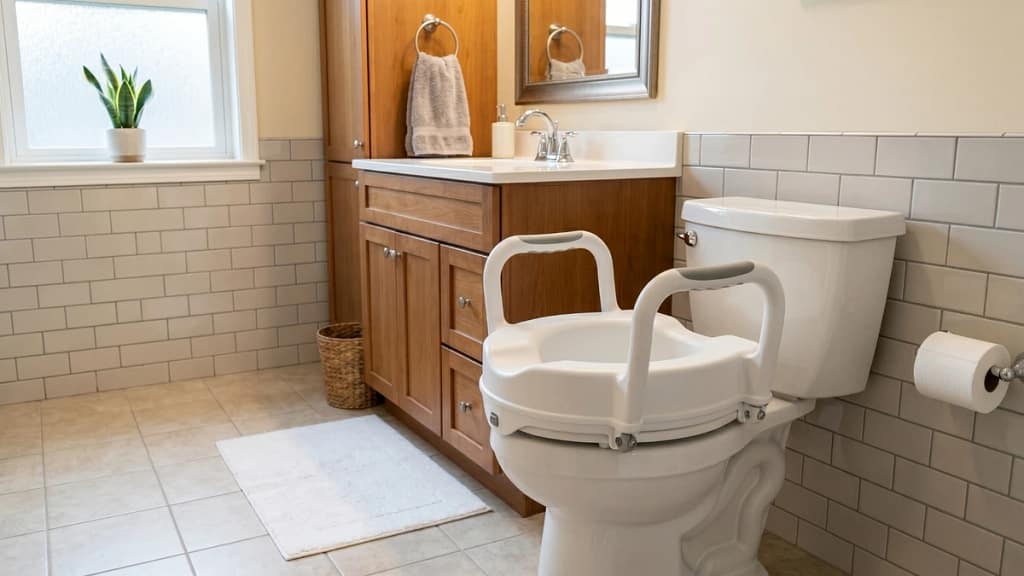
A raised toilet seat can make the toilet easier to use by reducing how far the body needs to lower. But for many seniors, height alone is not the full issue. Sitting down and standing back up may also require stable hand support.
That is where the best raised toilet seats with handles can help. These seats combine added height with built-in hand support, making them useful when the user needs both elevation and a place to hold during transfers.
The right choice depends on more than the handles. Toilet fit, seat height, handle width, stability, bathroom clearance, and support needs all affect whether the setup works well in daily use.
Disclosure: As an Amazon Associate, I earn from qualifying purchases. This post may contain affiliate links. If you purchase through these links, I may earn a small commission at no extra cost to you. I only recommend products I would feel comfortable using in my own home. Learn more.
On This Page
- Quick Answer: Best Raised Toilet Seats with Handles
- Which Raised Toilet Seat with Handles Makes the Most Sense?
- Best Raised Toilet Seats with Handles: Top Picks
- Why Handles Matter on a Raised Toilet Seat
- Are Raised Toilet Seats with Handles Safe?
- Who Benefits Most from Raised Toilet Seats with Handles?
- How to Choose the Best Raised Toilet Seats with Handles
- When Handles May Not Be Enough
- When It Makes Sense to Compare Broader Raised Toilet Seat Options
- Common Mistakes When Choosing Raised Toilet Seats with Handles
- What I Recommend
- Final Thoughts
- FAQ
Quick Answer: Best Raised Toilet Seats with Handles
The best raised toilet seats with handles are stable, easy to fit securely, and supportive enough to help with sitting and standing without making the bathroom feel crowded. The right option should match the toilet shape, provide comfortable hand placement, and feel steady during real transfers.
- Handles can help during sitting and standing
- Stability matters more than handles alone
- Removable handles may help in shared or narrow bathrooms
- Toilet fit and seat height still need to be checked
- Some users may need a toilet safety frame instead of seat-mounted handles when stronger side support is needed
A raised toilet seat with handles works best when the user needs added height and light-to-moderate hand support. It may not be enough when the person leans heavily, has major balance concerns, or needs stronger side support.
The safest choice is the seat that fits the toilet securely and gives the user reachable support without rocking, shifting, or crowding the transfer space.
Which Raised Toilet Seat with Handles Makes the Most Sense?
This table compares the top options based on support level, ideal use case, and the trade-offs that matter most in real use.
| Product | Best Use Case | Support Level | Why It Stands Out | Watch-Out | Action |
|---|---|---|---|---|---|
| Lunderg Raised Toilet Seat with Handles | Best overall for most seniors | 300 lb listed | 3-inch raise with removable handles | Higher price than basic options | Check on Amazon |
| Bemis Assurance 3" Raised Toilet Seat with Handles | Best for stronger support | 1,000 lb listed | Secure hinge-style setup | Less flexible than removable-handle seats | Check on Amazon |
| Vive Raised Toilet Seat Riser with Handles | Best value with removable handles | 300 lb listed | Affordable removable-handle design | 3.5-inch raise may feel tall for some users | Check on Amazon |
| HOMLAND Raised Toilet Seat with Handles | Best adjustable frame-style option | 400 lb listed | Adjustable height and width | Bulkier than standard raised seats | Check on Amazon |
| Drive Medical 2-in-1 Raised Toilet Seat with Removable Padded Arms | Best budget option | 300 lb listed | Low price with locking attachment | Standard toilets only; 5-inch height | Check on Amazon |
Best Raised Toilet Seats with Handles: Top Picks
These raised toilet seats were selected for different support needs, handle styles, toilet-fit situations, and daily-use priorities.
BEST OVERALL
Lunderg Raised Toilet Seat with Handles
The Lunderg Raised Toilet Seat with Handles is the best overall pick for seniors who need added height plus moderate hand support. Its 3-inch raise, removable handles, and cleaner toilet-seat style design make it a balanced daily-use option compared with bulkier medical-style risers.
Best for: Seniors who want a raised toilet seat with handles that feels more like a normal toilet seat while still adding practical support.
Watch-outs: It is higher priced than many basic options, and the correct toilet-shape version should still be selected before buying.
Why it stands out:
- 3-inch raise is broadly useful without being as tall as many 5-inch risers
- Removable handles add flexibility when support is not needed all the time
- Cleaner design feels less medical-looking than many alternatives
- 300 lb listed support fits a general-use raised toilet seat with handles
Always confirm toilet shape, side clearance, and handle stability before regular use.
BEST FOR STRONGER SUPPORT
Bemis Assurance 3″ Raised Toilet Seat with Handles
The Bemis Assurance 3″ Raised Toilet Seat with Handles is the stronger support-focused pick in this group. Its hinge-style setup and built-in handles make it a better fit when stability and secure attachment matter more than removable-handle flexibility.
Best for: Users who want a more secure, support-focused raised seat with steady built-in handles.
Watch-outs: It is less flexible than removable-handle designs and requires choosing the correct round or elongated version.
Why it stands out:
- Secure hinge-style setup feels more stability-oriented than many removable risers
- 3-inch raise helps reduce bending without creating an overly tall seat
- Built-in handles provide consistent hand placement during transfers
- 1,000 lb listed support gives it the strongest capacity angle among the selected options
Listed capacity should not be treated as a safety guarantee; fit, attachment, and real transfer stability still matter.
BEST VALUE WITH REMOVABLE HANDLES
Vive Raised Toilet Seat Riser with Handles
The Vive Raised Toilet Seat Riser with Handles is the best value pick for users who want removable handles without moving into a premium price range. It offers a practical 3.5-inch raise, 300 lb listed support, and standard or elongated size options.
Best for: Users who want handle flexibility and noticeable height support at a more affordable price.
Watch-outs: The 3.5-inch raise may feel slightly tall for some users, and the correct toilet shape must still be selected.
Why it stands out:
- Removable handles provide flexibility for users who may not need handles all the time
- Good value compared with higher-priced raised toilet seats with handles
- Available for both standard and elongated toilets based on the listing options
- Strong review volume and bestseller signal support its value positioning
Check handle stability after installation or removal before relying on it for regular transfers.
BEST ADJUSTABLE FRAME-STYLE OPTION
HOMLAND Raised Toilet Seat with Handles
The HOMLAND Raised Toilet Seat with Handles is the best adjustable frame-style option for users who need more height and width flexibility than a standard seat-mounted riser provides. Its frame-like build, padded seat, padded armrests, and 400 lb listed capacity give it a stronger support angle.
Best for: Users who want a more adjustable, chair-like support setup around the toilet.
Watch-outs: It is bulkier and more frame-like than standard raised toilet seats with handles, so it is not the best choice for users who want a normal toilet-seat feel.
Why it stands out:
- Adjustable height helps match different users and toilet setups
- Adjustable width provides more fit flexibility than fixed-width seat-mounted models
- Frame-style build may feel more supportive for users who need extra stability
- Padded seat and armrests add comfort for more supported bathroom use
This is closer to an over-toilet frame-style setup than a simple riser, so bathroom space should be checked carefully.
BEST BUDGET OPTION
Drive Medical 2-in-1 Raised Toilet Seat with Removable Padded Arms
The Drive Medical 2-in-1 Raised Toilet Seat with Removable Padded Arms is the best budget option for users who need basic height and handle support at a lower price. Its locking attachment and removable padded arms make it more practical than very simple non-locking risers, especially for light-to-moderate support needs.
Best for: Budget-conscious users who need basic raised toilet support with removable padded arms.
Watch-outs: It appears to be for standard toilets, and the 5-inch height may feel too tall for some users.
Why it stands out:
- Affordable option for basic height and handle support
- Removable padded arms add comfort and flexibility
- Locking attachment helps separate it from simpler non-locking risers
- Strong review volume compared with many budget alternatives
Confirm toilet compatibility and test the locking attachment before regular use.
After comparing the products, the next step is checking whether handle support actually matches the user’s transfer needs. A raised seat with handles should make sitting and standing easier without creating new fit, height, or stability problems.
Why Handles Matter on a Raised Toilet Seat
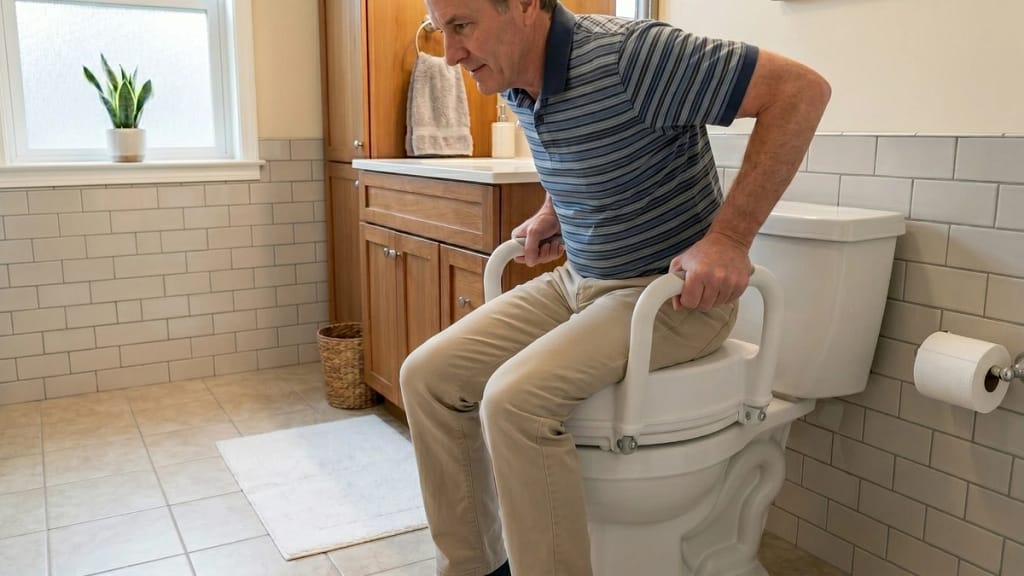
Handles matter because many toilet transfers involve more than sitting on a higher surface. The user may also need a stable place to hold while lowering down, shifting weight, or pushing back up.
Handles can help with:
- controlled lowering
- push-off during standing
- balance during transfers
- hand placement close to the body
- reducing reliance on nearby counters or walls
Example:
A senior with knee or hip discomfort may benefit from the added height, but still need support during the upward part of the movement. Handles can make that movement feel more controlled when they are positioned well and the seat is secure.
This can be especially relevant when arthritis affects knees, hips, hands, or grip strength. This guide on raised toilet seats for seniors with arthritis explains how joint pain and hand comfort can affect raised toilet seat choice.
Handles are most useful when they support the actual transfer movement, not just when they look helpful on the product listing.
Are Raised Toilet Seats with Handles Safe?
Raised toilet seats with handles can be safe when the seat fits properly, attaches securely, and matches the user’s support needs. The handles should not be treated as a safety feature on their own if the seat itself is unstable.
Safety depends on:
- secure toilet fit
- correct seat height
- stable attachment
- handle strength and position
- enough bathroom clearance
- no rocking or shifting during use
For example, handles may help a user stand more confidently, but only if the seat remains steady when pressure is applied. If the seat moves when the handles are used, the setup may create more uncertainty instead of improving support.
The broader safety question is about the full setup: the toilet, the raised seat, the handles, and how the person transfers in real use. This guide on whether raised toilet seats are safe for seniors explains what usually makes the difference between a helpful setup and one that should be reconsidered.
A raised toilet seat with handles should feel stable before it becomes part of a daily bathroom routine.
Who Benefits Most from Raised Toilet Seats with Handles?
Raised toilet seats with handles are usually most helpful for seniors who need both extra height and nearby hand support. They are not only for people with severe mobility issues. They can also help when the toilet has become just difficult enough to make transfers slower or less controlled.
They may help users who:
- struggle to stand from a low toilet
- need light-to-moderate hand support
- have knee, hip, or hand discomfort
- move more slowly during transfers
- need a more controlled way to sit and stand
They can also be useful for disabled adults when the main challenge is manageable with added height and built-in handles.
If the person needs broader transfer support, a more support-focused setup may be needed. This guide on raised toilet seats for disabled adults explains when height, handles, and other support features need to be considered together.
A raised toilet seat with handles is usually a good fit when the user needs more than height alone, but does not necessarily need a full toilet safety frame.
How to Choose the Best Raised Toilet Seats with Handles
Choosing the best raised toilet seat with handles requires more than comparing handle style. The seat needs to match the toilet, the bathroom, and the user’s real transfer needs.
Start with the Type of Support Needed
Handles are not all used the same way. Some users only need light balance support, while others use the handles more actively during standing.
A raised toilet seat with handles may work well when:
- the user needs help with balance during transfers
- the handles are used for light-to-moderate push-off support
- the seat remains stable when the handles are used
- the user does not need a wider freestanding frame
If the person leans heavily or needs very firm side support, seat-mounted handles may not be enough. In that case, a different support setup may be safer and more practical.
Choose the Right Height
More height is not always better. The goal is to reduce strain without making the seated position feel awkward.
Too little height may not help enough. Too much height may make the feet feel less grounded or make balance harder while seated.
A good height should:
- reduce bending at the knees and hips
- make standing easier
- allow the feet to stay comfortably positioned
- avoid making the toilet feel too high
The right height should make the movement easier without creating a new stability problem.
Check Toilet Fit Before Comparing Features
A raised toilet seat with handles still needs to fit the toilet securely. Handles do not make up for poor fit.
Check:
- round vs elongated toilet shape
- attachment style
- toilet rim compatibility
- whether the seat sits evenly
- whether the handles interfere with nearby fixtures
A seat may look supportive but still be the wrong choice if it does not attach securely to the toilet. Fit should always come before extra features.
Fixed Handles vs Removable Handles
Fixed handles can feel more consistent for daily use because they stay in place. Removable handles can be useful when the bathroom is shared, narrow, or needs more flexible access.
Fixed handles may work better when:
- the user needs support every day
- consistent hand placement matters
- the bathroom has enough side clearance
Removable handles may work better when:
- the bathroom is shared
- one side is close to a wall or vanity
- handles are only needed sometimes
- cleaning or access is a concern
Removable handles are only useful if they still feel secure when installed. Flexibility should not come at the cost of stability.
Look at Handle Width and Bathroom Clearance
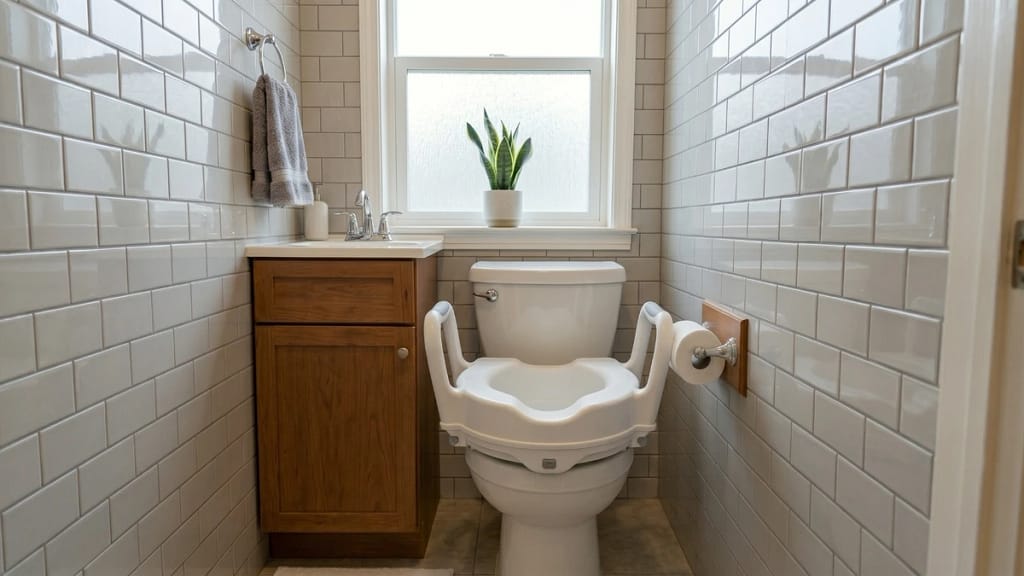
Handles can make the seat wider. In a small bathroom, that can become a real issue.
Check whether:
- both handles can be reached naturally
- one handle sits too close to a wall or vanity
- the user has enough room for knees and feet
- the handles block cleaning or shared access
- the seat still allows a natural transfer path
A handle-supported seat can become awkward if one side is too close to a fixed object. The handles should support the movement rather than force the user into an uncomfortable position.
Before choosing a handled model, picture the full transfer path:
Feet in front of the toilet, hands reaching both handles, and enough side clearance so one handle does not press against a wall, vanity, cabinet, or toilet paper holder.
Prioritize Stability Over Extra Features
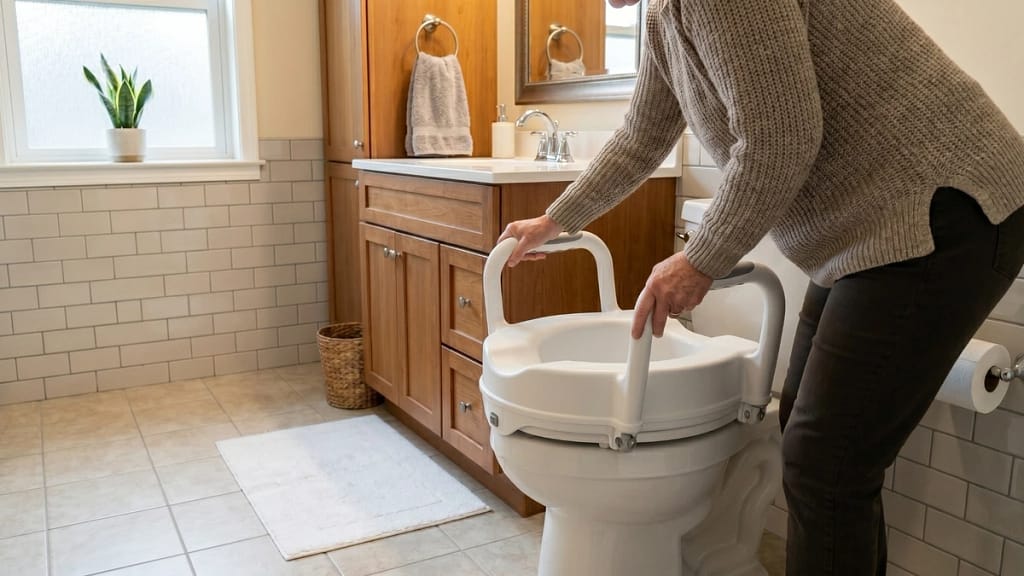
Handles only help if the base stays secure. A raised toilet seat that rocks or shifts should not be treated as acceptable just because it has support arms.
Look for:
- secure attachment
- stable base contact
- handles that do not flex excessively
- enough support for the user’s real movement
- no side-to-side shifting during transfers
How to check handle stability:
After the seat is installed, press gently on each handle from the seated position and again while standing up. The seat should not rock, shift, tilt, or loosen when the handles are used. If the handles feel secure but the seat moves, the setup should not be relied on for daily transfers.
If the seat has clamps, knobs, removable handles, or a locking attachment, this guide on how to secure a raised toilet seat properly explains what to check before relying on the setup every day.
Consider Cleaning and Removal
Raised toilet seats with handles often have more contact points than simple risers. Handles, clamps, knobs, and underside areas can make cleaning more involved.
Before choosing, consider:
- whether the seat can be removed for cleaning
- whether handles make cleaning harder
- whether the seat is easy to reinstall correctly
- whether shared bathroom use requires frequent cleaning
A seat that is difficult to clean or reinstall may become less practical over time, even if it works well at first.
These factors should be considered together rather than separately. This guide on how to choose a raised toilet seat explains how height, fit, stability, and support needs work together in the broader decision.
Once the seat height, handle design, and bathroom fit are clear, the next question is whether built-in handles provide enough support or whether a stronger frame-style setup is needed.
When Handles May Not Be Enough
Built-in handles can be useful, but they do not solve every support problem. Some users need more stability than a seat-mounted handle design can provide.
Handles may not be enough when:
- the user leans heavily during standing
- balance feels uncertain even with the handles
- the seat shifts when pressure is applied
- the handles feel too narrow or too low
- the user needs broader side support around the toilet
For example, a raised toilet seat with handles may help reduce bending, but still leave the user feeling unsupported during the push-off phase. In that case, the issue may be larger than seat height and built-in handles.
Some setups may work better when a raised toilet seat is combined with a toilet safety frame. This guide on using a raised toilet seat with a toilet safety frame explains when height and frame-style support can work together.
A raised toilet seat with handles is best for users who need added height plus nearby hand support. If the support need is stronger, a frame or another bathroom support option may be more appropriate.
When It Makes Sense to Compare Broader Raised Toilet Seat Options
A raised toilet seat with handles is not always the best answer. Some users may need a different raised seat style depending on height needs, bathroom space, cleaning needs, or support level.
Comparing broader options makes sense when:
- handles may crowd the bathroom
- the user mainly needs height, not hand support
- removable handles are preferred
- stronger support may be needed
- the toilet shape or fit is uncertain
At this stage, the goal is not simply to find a seat with handles. The better goal is to find a raised toilet seat that matches the user’s movement, toilet fit, and bathroom layout.
For readers who want to compare more than handle-supported models, this guide to the best raised toilet seats for seniors compares different raised toilet seat styles by support, fit, and everyday usability.
Comparing broader options is most useful after the main need is clear: height, handles, stronger support, or a simpler bathroom setup.
Common Mistakes When Choosing Raised Toilet Seats with Handles
A raised toilet seat with handles can be helpful, but only if it fits the right problem. Several common mistakes can make the setup less useful or less stable than expected.
The most common mistakes are:
- Assuming handles make any seat safe
Handles help only when the seat itself is stable and properly fitted. - Ignoring toilet fit
A seat can have good handles but still feel loose if it does not match the toilet. - Choosing too much height
Too much height can make foot position and balance less comfortable. - Not checking side clearance
Handles can crowd the bathroom if a wall, vanity, or cabinet is close to the toilet. - Using handles when a frame is needed
Seat-mounted handles may not provide enough support for users with stronger transfer needs.
The best choice comes from matching the seat to the actual transfer difficulty, not just choosing the model with the most features.
What I Recommend
For most seniors who need added height plus moderate hand support, the Lunderg Raised Toilet Seat with Handles is the best overall starting point. It offers a balanced 3-inch raise, removable handles, and a cleaner toilet-seat style design than many bulkier medical-style risers.
A practical decision process is:
- choose a raised toilet seat with handles when both height and hand support are needed
- confirm the correct toilet-shape version before buying
- make sure the handles can be reached naturally without crowding the bathroom
- prioritize stability over removable-handle convenience
- consider stronger frame-style support if seat-mounted handles do not feel supportive enough
The right raised toilet seat with handles should make sitting and standing easier without creating a new fit, height, or stability problem.
Final Thoughts
The best raised toilet seats with handles should provide both added height and practical hand support. Handles can make transfers easier, but they only help when the seat fits securely and the bathroom has enough room for them to be used properly.
The right choice depends on the user’s movement pattern, the toilet shape, the amount of height needed, and whether the handles provide enough support during real sitting and standing.
A good raised toilet seat with handles should feel stable, reachable, and practical for daily bathroom use.
FAQ
Are raised toilet seats with handles safe?
They can be safe when the seat fits securely, does not shift, and the handles provide appropriate support for the user’s needs.
Who should use a raised toilet seat with handles?
They are often useful for seniors who need added toilet height plus light-to-moderate hand support during sitting and standing.
Are removable handles better than fixed handles?
Removable handles can help in shared or narrow bathrooms, while fixed handles may feel more consistent for daily use. The better choice depends on space and support needs.
Do raised toilet seats with handles fit all toilets?
No. Toilet shape, rim design, attachment style, and bathroom clearance all affect whether a seat fits securely.
When is a toilet safety frame better than handles?
A toilet safety frame may be better when the user needs stronger side support, wider hand placement, or more stability than seat-mounted handles can provide.
